Geography and Warfare: Relationships. Part 1.

Marshal Montgomery once attributed operational or tactical victory to the appropriate and favorable combination of «transportation, administration, and geography.» This comment may be highly debatable out of context: «Monty» commanded a group of armies. But it clearly defines the problems that «managerial command» faces in managing its multiple military and logistical resources to achieve its strategic and campaign objectives. Once the political and national strategic decision to wage war and how to conduct it has been made, the problems of its execution are intensely influenced by geography.

Introduction.

And the main strategic decision-making issue is then where and how to commit the available forces and resources. Therefore, we will be interested here in the combinations of tactics and terrain in the different forms of warfare and in the varied geographical conditions of the environment.

FIELD MARSHAL BERNARD LAW MONTGOMERY IN FULL UNIFORM

The military geographic map is one of the most powerful instruments for intelligence, decision-making, and command. From the Military Staff to the company headquarters, maps are a means of gathering, storing, and displaying tactical and logistical information, calculating one’s own and enemy movements, and knowing the directions of the opposing forces’ actions. Emil Ludwig wrote of Napoleon: «Whether during long halts or during marches, the map was always within his reach, in his tent or in his wagon, in camp or by the fire. Throughout his life, the map was with him. Filled with colored pins, framed by a pair of sturdy compasses, and illuminated at night by 20 or 30 candles. This was the altar of his prayers. And this was the true home of the man who had no home.» This literary, illustrative, and brilliant picture is refined and become definited today in the «general situation» and «enemy situation» maps of the G-1 and G-2 sections of the Military Staff and general staffs.

Each command’s need for terrain knowledge depends on the scope of its decision in space and time. Above the division level, the concern and interest lie in the lines of communication in the areas of activity. These commands do not fight tactically, but rather direct and move units and large units to and from the large area of ​​operations. Their response time ranges from hours to days or weeks. This is due to the time required to move divisions, corps, and armies to their operational destinations and to reach combat readiness. This is also due to the time required to approach and position sufficient re-equipment, supply, and short-range transport resources.

Tactical decisions at the division level and below require more detailed, up-to-date, and timely geographic information. These can impact the rapid evolution of the operation or combat in a matter of minutes or even seconds (medium and heavy direct fires). Maps here must be punctuated and enriched with important tactical details. It is necessary to know: the firing sectors, grazing preferably, of the steady-fire weapons; the facility with which tracked vehicles can be deployed off roads with more or less stable surfaces; the possibilities for repelling and attacking on the operational terrain in all its forms; the natural and artificial waterways that intersect more or less perpendicularly the directions of advance of one’s own and another’s; the crossings (bridges of different widths and characteristics) and fords for practicing them, and the resistance of the approach terrain to them;; the possible landing zones for helicopters and the landmarks and unique characteristics of the terrain that delimit their approach and attack corridors; the possible observatories with long-range views for one’s own artillery and the areas for its concealed deployment and defilade from direct enemy fire; the possible routes of approach to the desired areas, hidden from view from enemy sides, and their dominant heights; the operational zones where we will create the anti-tank and engineer centers of gravity, and the equipment that the remaining units supported by them will need for their missions, depending on their terrain, etc. Who completes and enriches the physical maps of the appropriate scale with the necessary data and assessments to give them operational significance? Our own intelligence at its various levels of action. This is prepared by specific units, based on information received from reconnaissance and reconnaissance by battalions and companies tasked with this, aerial reconnaissance by satellites and manned and unmanned aircraft, and combat reconnaissance by all units.

The Relationship between Geography and Defense.

Many of the experiments involving extreme environmental conditions, that have sparked the curiosity and interest of scientists were initially undertaken for military purposes. Thus, in many cases, war operations allowed us to discover and understand various natural phenomena, which have led us to better understand the world in which we live. In 1944, American bomber pilots attacking Japan discovered a strong air current (over 325 km/h) traveling at an altitude of approximately 900 meters and heading west, toward 40° north latitude.

The aircraft, primarily the B-29 Super Fortresses, assigned exclusively to the Pacific theater of war, and their escort fighters, used this current to return to their continental bases in China, using much less fuel on their entire route. This allowed for increased bomb payloads and flight ranges. We should point out that the costly efforts to capture Iwo Jima (two films have recently been made on the subject, from the perspectives of both enemies) were due to the operational need for an airbase closer to metropolitan Japan, which would assist the strategic bombers in flight. These used too much fuel overcoming the frontal winds they faced on their westerly journey. Thus, what was called the «jet stream» represented an important step in our understanding of upper-atmospheric circulation.

The development of strategic intercontinental ballistic rockets since the 1960s, which could travel over the world’s seas and lands, led to the need to determine their best routes. These follow large semicircles around the planet, which can then be defined as an isotropic (not perfect, the poor thing) spheroid. Then, so-called «cruise» rockets were designed. These freely follow variable trajectories over the Earth’s surface, skirting its protrusions at very low altitudes to avoid detection (radars, satellites, observers) of any kind. Programming them required a thorough understanding of universal cartography. All of this led the US Department of Defense to become, for a few years, one of the main employers of Western cartographers.

TOMAHAWK CRUISE ROCKET

During the 1930s, R. A. Bagnold, a Cambridge geographer, along with other colleagues and collaborators, traveled through the Libyan Desert. There, they explored and studied different varieties of typical terrain, formed by shifting sand dunes or altered by winds and sand curtains. They even designed a so-called solar compass. This knowledge proved essential when, at the beginning of World War II, Bagnold helped create and advised the Long Range Desert Group. This was a British motorized «task force» intended to carry out raids deep into the enemy desert, where they penetrated by land.

It consisted of semi-autonomous commandos, mounted in jeep-type all-terrain vehicles and Ford or Chevrolet light trucks, well-equipped with medium-range weapons and lightly armored, which could be promptly refueled by RAF aircraft. Their combat tasks were to penetrate deep behind the weak German lines, erode their internal communications, and destroy their vehicles and aircraft on the ground. The desert «commandos» were integrated according to their specific mission—which could be combat, reconnaissance, or mixed—the enemy presence in force, and the expected distance they would travel to accomplish and return. Rommel, appointed Field Marshal after the capture of Tobruk, declared at the time: «The LRDG has caused us more damage than any other British unit of equal strength.»

LONG DEEP DESERT GROUP VEHICLE

Military Characteristics of Terrain.

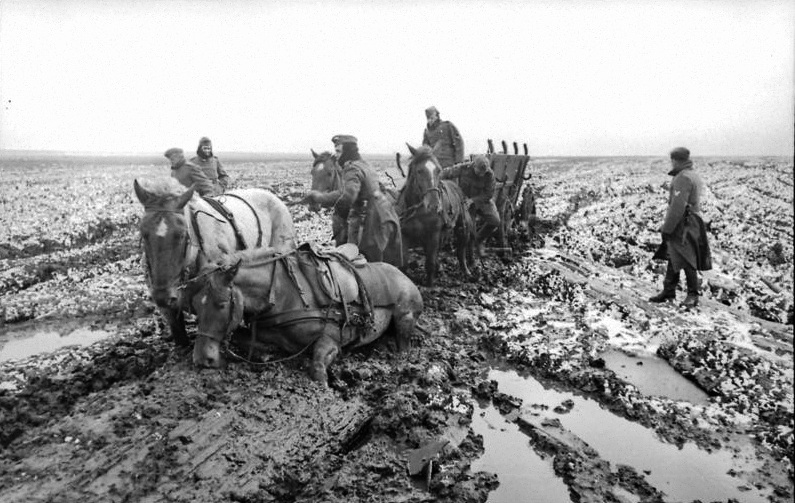
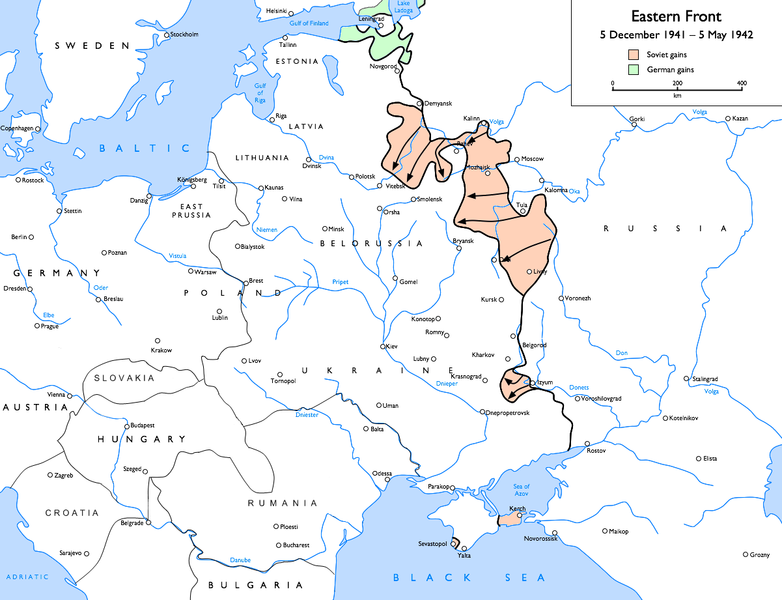
«Corridors» are strips of terrain favorable to the movement of military forces and limited on either side by terrain that is difficult to transitability. The concept explains that it is a strip of favorable and protected terrain. The term «compartment» or «section» defines terrain that is more or less perpendicular to the desired directions of movement of forces and unfavorable to them. Thus, the same qualities can form either cross-sections of terrain or corridors, depending on the intended direction of operations. Although both types tend to be described in terms of terrain and/or its drainage characteristics (swamps, wetlands, marshes), the case of strips of dense vegetation or wooded areas can imply the same phenomena on troop mobility. In 1941, the German advance towards Moscow (Brest, Minsk, Smolensk, Vyazma, and Moscow lines), crossing the Great North European Plain during Operation Barbarossa, successively discovered compartments or cross-sections formed by lines of wild forests. The forested areas in Belarus and that western part of Russia are arranged in bands oriented north-south, following the course of rivers and in poorly drained areas. Between these forested belts lay vast areas of gently rolling, well-drained terrain, forming vast open agricultural lands. Army Group Center’s eastward advance meant rapid advances in these open areas, followed by slow and arduous crossings with mechanized and motorized vehicles through the wooded areas. Soviet forces relied on these defense-friendly areas to establish fronts to repel the enemy in successive operational echelons in depth. These had, in their case, the character of a rigid defense without giving up space. And the aforementioned cities took on the character of fortresses or large fortified centers of this at all costs defense.

AERIAL VIEW OF AN AREA OF THE PRIPET MARSHES, IN BELARUS AND NORTHERN UKRAINE

In turn, the Pripet River swamps, whose extent varied greatly depending on annual rainfall and which lay between the advance strips of the German Army Groups Center and South in the aforementioned initial invasion operation, formed a protected «wooded corridor» for Soviet cavalry units in the desirable «east-west direction» and in both directions of march. It was an area of ​​extremely difficult transit and great concealment possibilities, more than 200 km long and over 50 km wide, which the Germans did not know, explore, or occupy. Where they did not divert their increasingly limited resources due to the lengthening of their supply lines and the casualties suffered in marching and combat operations. Soviet cavalry regiments could thus move through them and emerge on the exposed flanks or rear of the marching groups and German advance or resupply columns, carrying out limited-objective attacks. Indeed, the distances to their initial bases of departure in Poland and the existence of a few vanguard motorized and mechanized forces with a huge «support mass» of infantry and horse-drawn forces, prolonged German operations and increased their inevitable needs and attrition.

(To be Continued)

Action Interfaces as Zones of Tactical Development against the Enemy. Second Part.

A “weapons system” seeks to attack the enemy preferably in a certain way, taking advantage of its lethal or neutralizing potential. Against it, an enemy will always find an increasingly effective defense: armor, fire, obstacles, mobility; dispersion, concealment with or without cover, etc.

Combined weapons systems seek to produce a synergy, a multiplication of the individual capabilities of the weapons, a compensation for weaknesses or drawbacks and a weakening of enemy capabilities, together with a greater exposure or accentuation of its tactical vulnerabilities.

This synergy should produce effects on enemy combat capabilities and on its speed of action or capacity for movement: It must neutralize enemy defense. It must create in the enemy a vulnerable overexposure, when receiving the effective, complementary and coordinated action of the inter-arms systems. It must produce an operational indecision in the enemy, which harms its speed and capacity to react.

The inter-arms system is a technological and tactical way of increasing the favorable active interfaces on the enemy. It is an element of the operational strategy, carried out on the interesting points of the enemy deployment, to create a tactical vulnerability and to be able to produce the decision or the exploitation with the minimum wear of the available combat capacity of its own.

In the supplementary systems, the enemy defends itself in the same way from all the attacking elementary systems. A kind of saturation or maximum effect of the form of attack undertaken is sought. An example is the indirect fire of artillery and mortars.

In the complementary systems, one of the systems attacks the enemy and when the latter reacts defensively, seeking to dislocate the attacker, it becomes especially vulnerable to the action of the other or several of the other weapon systems used. The enemy thus suffers an extension of his vulnerability, over a longer time or space of action, achieving the three desired effects.

A complementary system is that formed by the obstacle and the fire. To overcome the obstacle, the enemy must concentrate and/or stop his advance and this reduces his impetus or quantity of movement and makes him especially vulnerable to repulse fire, which must not destroy the obstacle. Another complementary system is the fire and tactical maneuver developed by the small units or advance spears of an attack.

Another complementary combined arms system would be the convergent maneuver, taking advantage of positions and terrain and the available combat capacity, echelon it laterally to create more favorable interfaces. Faced with each convergent attack sector, the enemy has to react in a different way. With this, he creates vulnerabilities not well estimated by the enemy, in favor of the rest of the sectors that intervene. On the other hand, the combat capacity deployed towards a rejection will not always be in the best orientation to employ it in another more or less expected direction. If this is combined with neutralizing support fire, the entire enemy system is severely disrupted and dispersed, in its defense plan, in its fire plan and in its conduct.

The inter-arms system seeks to paralyze the enemy’s action or severely disrupt it, by affecting the quality of the combat capacity, generating in it a contradictory and more ineffective mode of action. It also acts in the same way in the successive cycles of action, divided into observation, situation, decision and action. And it does so through the direct deprivation suffered by the enemy of acting coherently and consistently in them, due to the incapacitation of its available combat capacity.

The analysis of the search for the decision in World War I will give us a practical example of the application of the search for the appropriate action interfaces, using inter-arms systems that are different in their composition, although with identical effects and results. Since the tactical solutions achieved on both sides lacked the complement of the sufficient operational movement capacity (the other of the operating systems with which it forms a complementary interactive pair), the operational strategic solution could not be achieved.

The origin of the German assault forces (Stormtroopers) , at the end of 1916, was in the awareness of the need and the possibility of fragmenting the pseudo-compact enemy front, into smaller sectors of advance, practically into advance spears, in which to act through an inter-arms or combined arms system. Favorable action interfaces would thus be created, in which to be able to act with freedom of action, at the level of reinforced assault platoons, which would advance by covered jumps to the enemy positions, behind a relatively short barrage of fire.

Supports in tactical subordination would include Russians shortened 76.2 mm guns, who were very well suited for heavy direct fire support and who lacked the backlash of other cut-off pieces, heavy grenade launchers, light mortars, machine guns and flamethrower squads and engineer platoons (pioneers). These last three supports would be those that would accompany the infantry to the direct assault of the trenches or enemy defense strong points. These were thus isolated from the support of their artillery or other nearby positions, which were neutralized by the German heavy artillery or by other assault sections.

On the other hand, on the Allied side, it was the English who used the first tanks (tanks was their code name in their development), heavy and clumsy, at the level this time of the great front of wide sectors, to provide continuous direct fire support to their infantry and enable them to successfully fight deep into the German tactical zone and even break through it. They were also used to clear trenches along their lines, protected by their armor and using mainly their machine guns.

However, neither side had a single “medium” that could maintain, depending on the use and circumstances, an adequate tactical speed and operational speed without interruption between them. In short, it could successively achieve tactical and operational objectives. The logistic support system was also not developed enough to be able to quickly send a significant flow of supplies and people along narrow, unconsolidated lines of advance.

In effect, there was a tactical speed (very few km per hour) that could be maintained both by infantry (of course, also German) and by tanks designed to support it, and a higher operational speed, maintained by the railway and trucks and other vehicles in the deep operational zone of each belligerent side.

This meant that, once a local tactical breakthrough was achieved, exploitation within the enemy operational zone could not be achieved. Faced with this, any of the contenders would bring their operational or strategic reserves closer in time and convert them into units deployed with full combat readiness. Thus, they created a new tactical zone very close to the breakthrough, blocking it.

To achieve the operational decision, a “means” was needed that was capable of acting with a certain autonomy at both levels of war activity: the tactical or immediate and the operational or deep and transcendent.

In modern warfare, with a considerable deployment of close and long-range, direct and indirect firepower, despite the progressive emptiness of the immediate battlefield (almost thirteen times greater in this world war than a century earlier, in Napoleon’s campaigns), this «means» could only be a well-armed vehicle, sufficiently protected and powered by an internal combustion engine.

But acting according to the tactics of relatively narrow sectors and combined arms systems, developed by the Germans for their assault forces and subsequently used by all their infantry in the general campaign of the spring of 1918, from March 21 to July 18, the date on which the Allies began their general offensive. And counting on reasonable logistics, which would compensate for wear and tear, maintenance and the capacity for operational movement.

In 1917 and 1918, neither of the two sides, neither the Cordial Entente or the Allies nor the European Central Empires, possessed either the two concepts or the specific elements of their application. In fact, a polished and developed synthesis (integrating the nascent war aviation into the German infantry inter-arms system) of the ideas and means of both would be necessary.

However, the Western Allies had the classic means in relative abundance. And they used them according to the knowledge of the time to achieve a strategic decision in the Western European theater. Generalissimo Foch used a strategy of hammering, of stubborn reiteration of efforts. Seeking that the «tactical reaction» provoked in the Germans would affect the strategic capacity of systematic renewal of their defensive front. And, in the end, this German strategic combat capacity collapsed.

And thus the Allies achieved the strategic decision of the war.

THE END

Weapons and Their Defense in the History. Third Part.

However, the Mongols flung upon it, Almost completely surrounding the camp and showering it with bombs and incendiary arrows, which burned the wagon trains and tents and frightened the beasts. They sowed chaos among their enemies and already shattered the Hungarians’ self-confidence.

Curiously (or not?), the Mongols still hadn’t completed or covered with any detachments the siege of the Hungarian wagon camp through the gorge leading into the heath. The Hungarian cavalry still with sufficient moral courage, formed a wedge to resist the charge; it was the last firm stand of the Hungarian army. However, most of them retreated through the «gap» in the siege, fleeing in small groups toward what they believed would be their salvation. And, truly falling into a deadly trap, which extended along the entire route of their flight to Pest.

The Mongol light cavalry, taking no risks, softened up the knight’s desperate wedge-shaped deployment from a distance with their bows and arrows, and then, seizing their opportunity, the heavy cavalry charged to crush them.

Numerous Mongol light detachments, in turn, set out in pursuit of the fugitives. One group pressed them directly from the rear, increasing their commotion, chaos, and fear. Meanwhile, other detachments carried out the «overwhelming pursuit,» catching up with them from the sides and spearing them or shooting arrows them from their mounts.

The remains of the Hungarians, their horses, equipment, and baggage were scattered along the road back to Pest for 50 kilometers. More than 70,000 Hungarian cavalry and auxiliaries perished on the battlefield, in the temporary encampment, and in the flight to the southwest.

After the Battle of the Sakh, Hungarian resistance collapsed.

The Mongols then attacked Pest and burned it. But they did not dare to cross to the west side of the Danube, exploiting their success, despite the moral and numerical superiority they enjoyed at the time. Batu and Subodai rested their army and consolidated their positions east of the great river. More than half a year passed, the main event being a half-hearted declaration of a crusade against them by the Pope, which achieved little in practice.

In December 1241, the Danube froze in this large region. The Mongols took advantage of the situation to sack Buda, reconnoissance in force in Austria, and sent a detachment south toward Zagreb in pursuit of King Béla. On the 25th, they assaulted Gran, the Hungarian capital and seat of its archbishopric, taking with them everything valuable and antique they could.

A portentous end for Europe.

Central andWestern Europe were ripe for a Mongol invasion. The Europeans lacked an army capable of confronting this threat, which was already breathing down their necks. The strategic plan Subodai explained to the Khan and his generals seemed to be faithfully carried out down to its final stages. But this was now merely an illusion, an impossibility. An «appearance,» as Sun Tzu would say.

OGEDEI GREAT KHAN

On December 11, 1241, they had received at Batu and Subodai‘s headquarters an escorted messenger from Karakorum, the Mongol capital. He brought news that Ogedai, the Great Khan, had died and that his widow was acting as regent until a new Mongol emperor was elected and ascended the throne. The Mongol princes present in the camps were eager to assert their rights to the succession and decided to return to their capital, taking the imperial tumans with them. Batu knew that without these elite troops, he could not hold Hungary, but he believed that with the Turkmen recruits, who were already experienced and had seen combat, he could retain most of his territories.

Thus, the Mongols evacuated Hungary, unhindered, harassed, or pursued by their enemies. Although they left behind the land that had been theirs devastated. This was a symbol of their idiosyncrasy and plundering nature, a land bandit and absolute predator. And they lacked the slightest capacity to create, maintain, develop, extend, and bequeath to their successors a civilization worthy of the name. And they could leave them only the accumulated results of their atrocities, bonds, tributes, plunder, and loot, and the military lessons to obtain them.

Sarai, capital of the subsidiary Empire of the Golden Horde.

Batu returned to his original base camp, in Sarai, near the Volga and barely 100 km north of Astrakhan. And there he established a subsidiary Mongol empire, which became known as the Golden Horde.

The Mongols would have no other opportunity to invade Europe. After this aberrant nightmare suffered by the Europeans, they invented all kinds of stories and myths, in which they recounted how they had defeated the «Tatar» invaders (as the Mongols were generally known in Europe) and forced them to return to their lands.

This unthinkable, sudden, and portentous result, occurring in the last possible moments… Was it a work of the Fate and Karma of Europe and its privileged Civilization? Or was it the result of Divine Intervention through the intercession of the Virgin Mary?

Of course, it was, humanly speaking, an excessive and incredible coincidence. But faith can never provide «evidence» either, because it would cease to be evidence and become verifiable reality. The effective Divine Intervention, in favor of Europe and its civilization, which without Christianity acting from its core would never resemble what it was and what it is, is likely, because It is never thunderous or overwhelming.

OGEDEI, LORD OF ASIA AND SUCCESOR OF GENGHIS KAN

God did not visit Elijah in a lightning storm or a hurricane, but in a gentle, soft breeze. And, for esotericists and syncretists, the explanation could be «a cosmic action of astral and Akashic forces, in favor of Light, Peace, and Human Civilization toward higher levels of Universal Consciousness.»

There is also a common «rational» explanation for what happened, but it cannot pinpoint the moment for this opportune withdrawal. The Mongols and associated Central Asian tribes were creating a Eurasian empire in the first half of the 13th century. But their material capabilities and ideological and religious resources were not adequate for such an important objective.

As we have seen, they had nothing satisfactory or lasting to offer the peoples of the occupied countries. The Mongols were kept in these foreign lands by the threat of known terror. As with other tyrants who sought to become «global,» their necessary collaborators were ethnically or ideologically similar. But the Mongol ethnic group and its ilk were demographically insignificant, for allowing them to monitor and defend themselves alone. All of this, in the decades since the invasion of Eastern Europe, had strained their military capabilities to the breaking point.

Thus, sooner rather than later, the Mongols would have had to undertake this general retrograde march to secure and consolidate their lands in Eastern Eurasia. They would have distanced themselves from contact with dynamic, ideological, and expansive civilizations, such as Europe, with which their relations of neighborliness and early exchanges of merchants, explorers, and adventurers would have been resolved through military confrontation.

(to be continued)
Weapons and Their Defense in the History. Second Part.

The Mongols Armies.

The Mongol Army’s cavalry was divided into light and heavy cavalry.

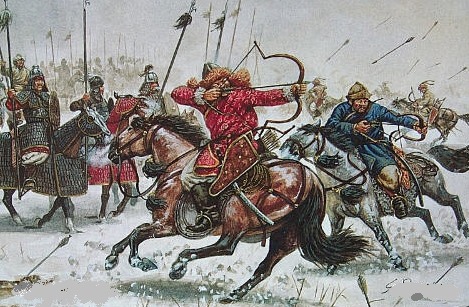
Their most distinctive weapon, used by all cavalry, was the S-shaped composite bow, which, properly drawn, could launch an arrow over 300 meters away. Its length made it useful for shooting from a mount.

The Mongols were herders, and their occupation gave them a lot of free time. This allowed them to amuse themselves by shooting the composite bow, thereby achieving great skill in its shooting and use and, very importantly, maintaining it over time.

Light cavalry was intended to harass the enemy in formation, send patrols ahead of their main body to gather intelligence, and pursue and finish off the defeated enemy as they fled.

Heavy cavalry struck the enemy in the clash; care was taken to ensure that the enemy was tired, dispersed, or in the minority.

The Mongols did not have a sufficient siege formation. They defeated the entrenched enemy with lures and tricks. And, by offering them a much-desired advantage, they trapped them.

Development.

In 1241, some 100,000 Mongols crossed the Polish-Ukrainian border to attack Hungary. A detachment of 20,000 men, two Mongol tumans or divisions, under the command of Princes Baidar and Kadan, will be tasked with ensuring that the Hungarians receive no reinforcements from Poland, Germany, or Bohemia.

To this end, they defeat the concentrations of forces from those countries at Chmielnik, about 18 km from Krakow. They lure the enemy into pursuit without prior combat, into an ambush, appearing to the enemy as a raiding party retreating to its base.

And, at Liegnitz, about 60 km west of Breslau, they employ a mangudai to deceive them. It consisted that a Mongol army «corps,» inferior to the enemy, seriously engaging in the fight with them. Its size was large enough to make the Mongol effort considered significant. This would mentally lure the enemy away from any other thoughts or possibilities. After a fierce battle, the sheer weight of the enemy forced the Mongol corps to retreat.

Batu crosses the Sakh with 40,000 men via the Stone Bridge

What had been a tactical retreat, never truly disorderly, was mistaken by its enemies as an exploitable defeat. Its complete and permanent ignorance of the Mongol enemy left it unaware of anything. And its desire for victory, heightened by the genuine effort exerted in the initial engagement, prevented it from seeing beyond its reach.

The relentless, full-throttle pursuit eventually dispersed the tight, solid formations of the European nobles. At one point during the pursuit, always far from the waiting enemy forces, the bulk of the Mongol heavy cavalry emerged, hidden, fresh, and launched into the clash. It ultimately broke up the disjointed cavalry groups into which the European pursuers had dispersed.

After a genuine hunt, the European forces remaining in the initial positions of the battle either dispersed as well or were in turn attacked by the entire Mongol force.

By then, in less than a month of operations, 20,000 Mongols (at the outset) had advanced some 650 km into enemy territory and won two decisive battles.

Poland was battered and shaken, and the Germans west of the Oder River were retreating and preparing to defend their kingdoms. The Bohemians, still intact, were some 400 km from the first Hungarian defensive positions on the Danube; therefore, their army was operationally ineffective in achieving the resolution against the Mongol attack on Hungary.

To ascertain the Germans’ «intent,» the Mongols staged a demonstration westward into Germany. King Wenceslas pursued them. At a certain point, the two tumans (-) split into small, elusive detachments. And, forming a cloud almost invisible to the enemy, they slipped past both sides of the Bohemian army and retreated eastward.

Recreation General Subodai Bahadur

In their retreat to join the main Mongol army (80,000 men), commanded by Subudai Bahadur, the Khan’s deputy, the Mongols crossed Moravia, ravaging its villages, warehouses, and fields. They thus created a vast desert wasteland, which would further protect Subudai‘s right flank by rendering those Moravian lands incapable of sustaining a passing army for any length of time.

The remnants of Princes Baidar and Kadan‘s forces managed to join Subudai‘s forces and continue to participate in his campaign.

General Subudai had devised and presented the invasion and attack plan to the Khan and his generals, and had been placed in command of the forces to carry it out.

Subudai concentrated his army in three marching groups. Each would enter Hungary by a different route, through the passes and valleys of the Carpathian Mountains. This deployment provided the Mongols with protection from enemy surprises and gave them an initial deployment, preparatory to the maneuvers of their three mobile corps. The Hungarians, for their part, did not dare attack any of them, for fear of the other corps advancing on their operational rear or capturing some of their cities.

On April 3, Subudai formed his three mobile attack columns opposite Pest, on the east bank of the Danube. There stood King Béla of Hungary with his army of 100,000 men. Across the river, linked by bridges, lay Buda.

Having also deployed a tuman to Transylvania to ensure that the Christians did not receive reinforcements from Romania, the Mongols now numbered about 70,000 (plus) men. And the more time Subudai took in his calculations, decisions, and preparations, the more time other European rulers would have to make up their minds and come to support king Béla.

The Mongol general applied one of his combat stratagems on a strategic scale: his army retreated east. Using «reasoning,» the Hungarian commanders assumed that the Mongols did not dare to fight against their more powerful army. And, spurred on by their inaction in the face of the unhindered advance of the three Mongol columns, they demanded the King Bela to begin their pursuit. The Hungarians did not appreciate that Subudai was luring them away, from the protection of the Danube and the support of detachments and corps of the Hungarian army.

King Béla IV of Hungary.

King Béla, commanding the vast majority of his army, led the pursuit against the Mongols. The Mongol retreat was deliberately slow. It took them six days to reach the Sakho River, about 160 km northeast of Buda and Pest.

West of the river and on the plain opposite Mohi, the main town in the area, Prince Batu and Sabudai decided to confront their «pursuers.» On April 9, the Mongols crossed a wide gorge, advanced through a heath, crossed a Stone Bridge, and continued some 16 km to the thickets west of the Tokay hills and vineyards. There, they had numerous places to camouflage and hide.

Prince Batu, founder of the Golden Horde

The Hungarian army, pursuing them head-on, encamped in the heath, arranging their wagons in a circle, where they set up their tents, equipment, and horses. To the right of the temporary camp were the swamps along the banks of the Tisza River, to their front lay the Sakho Heath, and to their left were forests and small hills.

At dawn on Wednesday, April 10, 1241, Batu and around 40,000 men advanced toward the stone bridge from its eastern side. The Hungarians defended it vigorously, until they were forced to retreat due to the «fire bombs» launched by the Mongol catapults, as they were on a very narrow front.

We are now seeing, quite clearly, how the opposing rivals are assuming the roles of winner and loser. And that this situation continues until the very end. These are some of the «signs» that announce and precede the final results of the war dialectic.

The Mongols crossed to the western side of the Sakh, but for more than two hours, they were terribly pressed by the Hungarian charges, and only the fire of their archers allowed them to briefly reestablish their defensive line. Little by little, the Hungarian army deployed to eliminate the Mongol bridgehead over the Sakh.

Suddenly, General Subodai, who had also crossed to the western side via a makeshift bridge built downstream of the Sakh, while the Hungarians were distracted by the threat of the Mongol bridgehead, appeared with around 30,000 Mongols in the Hungarian rearguard.

Beaten and stunned, but with the courage and experience to avoid panic, the Hungarians retreated in good order to their nearby camp.

(To be Continued)

Weapons and their Defenses in the History. First Part.

Introduction.

Throughout history, supposed war rivals have perfected their weapons, Techniques, and Tactics to defeat an enemy who violently opposes the achievement of their objectives.

In the Beginning,

The strongman appeared with a large stick or club, coming after his neighboring rival. At one point, the latter, who was practically a weakling, hid in a bush by the side of the road. When the strongman passed by, confident and well-equipped, he waited for him to leave his back free and attacked him on an unprotected «essential vulnerability.» The «big man» fell lifeless to the ground. History doesn’t say what happened to the two characters in the fable.

When the number of members of the two factions increased enormously, they instinctively sought to group together, so they could attack and defend themselves much better.

At first, there was a relatively large group, and soon the focus was on organizing and utilizing the group. And the phalanx was born, a wall of twelve or sixteen ranks of men armed with long spears or pikes, extending several ranks ahead, well-trained in their combined handling at close range. They were protected by a large shield and pieces of metal or heavy leather on the chest, head (helmet), arms, and legs.

In ancient Greece, the Spartans refined the tactical instrument of the phalanx to the fullest.

No one was as trained and protected as they were. And their society accepted and honored their militari ethos, embodied in the phalanx. Spartan mothers would tell their sons, phalangist hoplites, to «return with the shield or on the shield.» There was no quartermaster or medical care, properly speaking. And mothers instilled in their sons the warrior social mentality of their society.

THE IMPRESSIVE PHALANX

But, behold, the right wing of the phalanx was less protected than the left. This was due to the way the men naturally protected their left flanks with their shields.

And at Leuctra, around 344 BC, Sparta, with a majority of its forces (10,000 men), set out to crush Thebes (6,000 men). Unaware that its phalanx model had changed,

Epaminondas and his pair, Pelopidas, had introduced the «oblique order» into their Theban phalanx. On their left wing, they deployed a greater number of forces, and the best of them. Among them, a phalanx formed by homosexual couples, which they called the «Sacred Band

They also refused to employ their center and right wings, as is typical of the oblique order. Perhaps the heightened sensitivity of homosexuals, which is said to be present in the Theban homosexual leaders, may have influenced their sharpness and refinement.

On the Spartan right wing was the commander of all their forces. This was thus the «core of their resistance.» And this was battered and beaten by the Theban forces on their left wing. And then appeared the «Caedes,» the slaughter and the finish of the vanquished.

From afar, the Spartans on their center and left were also affected by the defeat and the damage to the hoplites on their right wing. And they began to retreat, without having been defeated by weapons.

A year after Leuctra, Epaminondas was touring the Peloponnese peninsula, commanding forces of the newly formed Arcadian League. And he appeared in front of the city of Sparta, within whose sight, it was said, enemy forces had never appeared.

Phalanxes were too large to be able to move freely and quickly against the enemy. They acted as a «dam» of Force against Force, where surprise, skill, and flexibility could not exist. Another characteristic of their technical rigidity is that they had to fight on flat terrain, at least without undulations or obstacles such as rocky outcrops or patches of trees and bushes, which broke their structural continuity.

Rome meets the Greek phalanxes.

The Romans had a military structure based on the legion, as a large operational unit, of about 5,000 men. The legions were made up of maniples or, much later, cohorts, small tactical units capable of moving and maneuvering on the battlefield, gaining the flexibility, skill, and surprise that phalanxes lacked. And their centurions, one to the right and one to the left of the first row of the maniple, and their officers were capable of leading them individually.

At the Battle of Pydna, in June 168 BC, a battle took place between the Romans led by Aemilius Paullus and the Macedonian Perseus. The Macedonian phalanx vigorously attacked the Roman formation of two legions and forced it back toward the fortified Roman camp. However, the terrain was uneven and somewhat rocky, and as it advanced, the phalanx lost its solidity and integrity.

A MOMENT AND A PLACE OF THE BATTLE OF PIDNA.

Seeing this, Paulus gave orders to the maniples (centurions) to act independently on the enemy phalanx. The centurions then took command. The maniples advanced and began to take advantage of the smallest gap in the enemy’s pseudo-compact formation to introduce their men there.

They began wreaking havoc with their gladius (somewhat short Roman swords, prepared for close combat) on the defenseless flanks of the Macedonian hoplites, armed with long pikes.

Soon, Aemilius Paullus launched the Second Legion against the center of the enemy line. It shuddered and finally gave way. The Greek spearmen were now nothing more than a hindrance, both in fighting and defending. The Roman legionaries vigorously launched themselves into the attack. And then came the Caedes, the massacre, the collapse of the formation into a shapeless mass, terrified and fleeing individually.

When the sun set, Paulus halted exploiting his success. The death toll showed one hundred Romans and twenty thousand Macedonians had finally fallen.

The Mongols threaten Central and Eastern Europe.

At the beginning of the 13th century, the Mongols, nomadic tribes from the interior of Asia, who dominated mounted combat and had a very elaborate and simple military organization, appeared for the first time on the borders of eastern Europe.

Their logistics were simple and involved supplying on the ground they trod, following the broad pastures as they advanced, each rider carrying several mounts with him.

The Mongols started from their strategic zone, defined by the «advance and location» of their nomadic settlements, their yurts or nomadic houses, pulled by oxen, never observed or suspected by their enemies, and reached the tactical zone with them. Their operations did not require the physical and mental support of the operational zone, the transition for the forces and their support between the strategic and tactical zones.

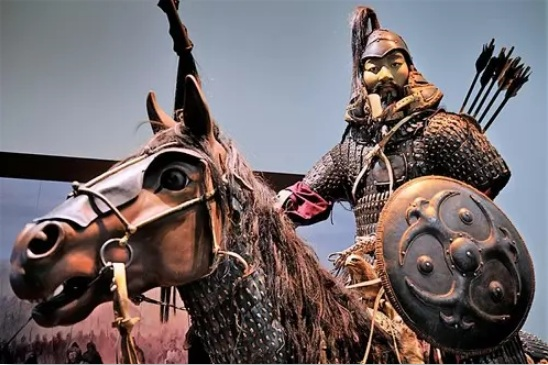
A RECREATION OF SUBUDAI BAHADUR, THE GREATEST MONGOLIAN STRATEGIST.

In front of the discontinuous front of their enemy positions (cities), there is a wide, unprotected, and empty area, uncontrolled by anyone, which the Mongols make the most of for their operational approach. Their enemies, the feudal heavy cavalry forces and their infantry spearmen and archers, maintain nothing resembling advanced detachments, which make mobility reconnaissance and repel the Mongol advance parties of reconnaissance and combat.

The Mongols’ concern toward the enemy was generally strategic, considering their «exposed flanks» at the level of the «occupied» countries. This concern stemmed from their always small numbers for the objectives entrusted or sought.

And from the real tactical no invincibility of their forces, if they encountered an organized, skilled, and, above all, calm enemy.

In 1221, after conquering the Muslim Empire of Samarkand, located between the Syr Darya and Amur Darya rivers, Genghis Khan systematically plundered Afghanistan. His son Tilui slaughtered most of the inhabitants of northern Persia. With no possible live enemies on their strategic flank, they protected the southern flank of the Mongol Empire.

(To be continued)
ACTION INTERFACES as Zones of TACTICAL DEVELOPMENT against the Enemy. Part One.

Introduction.

The action interface is a spatial concept that defines the zone and space where we develop violent action against the enemy and his means, following tactical criteria adapted to the nature of our objectives. The effective action factor in the action interfaces is the combined arms or inter-arms system.

In a penetrating attack, for example, the surface of the interfaces is quantitatively limited and these are selected in the enemy’s depth, according to their critical points and those that hinder the advance of our forces, for example, observatories and anti-tank firing points. In defense, we quantitatively increase the potential interfaces in our depth and in a somewhat laminar way.

The interface is what makes tactical action and the destruction of the enemy possible, applying a pure, chosen, selective and favorable attrition. The absence of interfaces, on the contrary, gives a certain security to any force. With the presence of the enemy, even close by, being a threat.

The interface is not only linear or frontal and with the depth of the range of heavy infantry weapons and tanks. But is extended superficially and spatially by the action of indirect artillery, surface destruction means (reactive artillery) and combat and bombing aircraft. The smaller the interface in an area of ​​operations, the more the operational maneuver criterion will work and in a larger interface. We will seek from advantageous positions and with effective and synergistic means (combined or inter-arms) to annihilate (incapacitate) the enemy.

The speed of exchange (actions and effects) in the interface is qualitatively variable and is conditioned by the transitability of the terrain and by the nature of our intention. In the attack we seek the fluidity of tactical actions. In defense, we wish to add a thickening to them, which will help us break the enemy in front of the front limit of the defense position and in the various ambushes and prepared fire pockets, both main and alternative as well as supplementary, preferably before their irruption.

In the interfaces there are certain critical points, where our tactical interaction with the enemy will be especially effective. These are their tactical vulnerabilities, their gaps in protection or combat capacity or their neglected means of defense, even if they are only so for a time. Combat reconnaissance is essential to detect them and it is the tactical leader’s mission to decide which one or ones to act on, seeking in the tactical decision, the operational significance of the higher command.

Combat capacity is applied on an interface with a variable depth depending on the weapons. Combat capacity has a maximum, useful, relatively stable value for the different weapons or weapon systems, which we can measure in men per meter of action interface.

For the shock, for example, it is not possible to use more than one man per 1.5 ms. of contact interface. For rifle fire, considering a platoon of 50 men useful for about 300 ms of interface, its value drops from 0.6 to 0.15 men per m. of front. Artillery would produce a blinding, disruptive, neutralizing or destructive effect, added to the action in the interface, but complementary to it and never a substitute. Machine gun fire would not substantially lower the proportion, since its fire “equivalent” to that of a certain number of infantry, depending on the terrain and its ability to acquire targets, in rapid fire of 15 rounds per minute and marksman.

Development.

However, from the wars of antiquity to the wars of the 1980s, dispersion has increased from a proportional value of 1 to 5,000 on the battlefield or tactical field. For modern static organized defense, it is equivalent to a battalion of 750 men in 3 km2. Mobile or nuclear defense can triple that surface. This dispersion has emptied the battlefield, now covered by direct fire and indirect fire support, and has allowed the operational terrain of large units to be greatly deepened, up to 50 to 75 km.

An obstruction, a gorge, a river in which the interface was reduced or altered, would limit the real possibilities of the attacker and greatly empower the defender. Thus, the defensive battle of King Leonidas in the Thermopylae gorge would be an example of containment of overwhelmingly superior forces, due to the absolute limitation of the interface of action between the Persian and Spartan armies and not being able to apply it to the critical Greek centers, for example, an exposed flank, until a shepherd served as a guide to a Persian contingent to reach it.

All this operational complication simultaneously makes most of the forces employed in an action unproductive or inactive at a given time.

Given that there is this practical limitation to the use of our available combat capacity, due to the disproportion between tactical space and combat interface, the issue of achieving the maximum application of our force arises.

To achieve this we must:

Increase as much as possible our favorable interfaces with the enemy, especially on the weak and critical points of his deployment; adequately rotate the units in tactical contact; maintain an adequate space for maneuver in our tactical rear, which allows us to push forward the necessary spears of attack or maintain the different possible defensive interfaces in the face of enemy irruption or penetration.

And employ each weapon in the most favorable possible interface of action:

Thus, the weight of the effort will be borne by the infantry in prepared attacks against an enemy ready to repel (for example, an anti-tank front), at long advance distances and in terrain with limited visual control, such as forests, built-up areas and broken terrain, with the tanks supporting them with fire and advancing by covered jumps. The tanks can go ahead in encounter attacks, in slightly undulating terrain and if the enemy has a poorer combat readiness, but taking care that the infantry closes the distance quickly. For short distances, we use the joint attack in the same sector; both weapons can advance from different positions in a convergent attack in encounter combats and in enveloping combats, the synchronization of both being fundamental. Inside the enemy position, the tanks attack the firing positions with their fire and the infantry clears the positions from their flanks.

It is also possible to structurally increase our favorable action interfaces with the enemy.

This is achieved in the attack by breaking through and penetrating favorable sectors and always by encirclement, reversal of fronts and encirclement and by coordinated frontal and overflow pursuit. The attacker’s successive echelons can, in turn, create a favorable action interface against an enemy that is not sufficiently defended, for example, artillery positions or communication centers or logistics parks, and also by a flank attack from our depth with mechanized or armored units, on an enemy counterattack against our penetration.

In the defense, the opposite will occur. The breach of the defense zone, even if it is mobile, will be avoided by increasing the possible unfavorable interfaces for the enemy along its «range».

This is achieved by the echelon in depth of active defensive means and by their preferential placement on the counter-slopes, in covered, hidden, preferably flanking, alternative and supplementary positions and received by a local infantry defense and seeking good and intersecting firing sectors. Also by the increase in interceptions (reinforced cuts, quickly placed minefields, natural obstacles more or less perpendicular to their sectors of advance) defended by fire, which channel the attack towards zones of convergent fire or which delay and erode it. And, finally, by the timely use of local counter-shocks and counter-attacks by mobile or, at least, rapid, tactical or operational reserves. These constitute the extraordinary and unexpected force that acts on enemy vulnerability, which is then in disorganization, dispersion and neutral morale before the consolidation of its gains from the attack.

The effective action factor in the action interfaces is the combined arms or inter-arms system. Each of them individually presents “action characteristics” and more convenient transitability, which give them a preferable target profile and tactical deployment qualities, from whose combination in the system arises the synergy of the whole.

(To be continued)

THE ART OF WAR OF GENGHIS KHAN. 2nd Part.

(Continuation)

The positional Dislocation of the Enemy.

Genghis and his army marched safely, crossing more than 500 km of the seemingly impenetrable Kizil Kum desert. And at the beginning of April 1220, Genghis Khan unexpectedly appeared in the city of Bukhara, some 500 km inside Transoxian territory, near the Amur Daria river.

Without having yet fought a major battle, the numerically inferior Mongol army had positionally dislocated the bulk of the Turkmen army and cut Mohamed II‘s line of connection with his western provinces, where many Turkish forces still remained immobilized for this war.

Idealized description of Lieutenant Subidai Bahadur

A “shock wave” swept through the Kharizmi field army, overwhelming it. Mohamed‘s troops remained in the various fortified positions and cities they occupied, defending them, but with a broken spirit. The operational unity of the forces, which is required for successive tactical battles to have significance, had disappeared. It was in the hands of the Great Khan to go waging the necessary combats to liquidate, as would happen in an «imaginary encirclement«, limited by the Sir Darya to the east, by its imposing and unexpected presence to the west, by the desert to the north and south, to the different enemy tactical groups in Transoxiana, already disjointed and disappointed.

Xenophon had already pointed out: “Whatever happens, pleasant or terrible, the less it has been foreseen, the greater joy or terror it causes. This is nowhere better seen than in war, where any surprise strikes terror into even the bravest.»

Mongolian combat idealization

Let’s see some passages from «My Reflections on the Art of War» by Marshal Mauritiusof Saxony, published posthumously in 1757. In them, a deep insight into tactics and human motivations is evident, greater than in any other work by a European author. since the Romans.

“Men always fear the consequences of danger more than the danger itself. I can give a multitude of examples. Suppose that column storms an entrenchment and its point reaches the edge of the ditch. If a handful of men (from the entrenched side) appear a hundred paces outside the entrenchment, it is certain that the head of the column will stop, or that it will not be followed by the elements of the ranks further back. Why? The reason must be sought in the human heart. In turn, let 10 men climb over the breastworks and everyone behind will flee and entire battalions will abandon their defending position”.

“When one has to defend entrenchments, all the battalions must be placed behind the breastworks, because if the enemy manages to gain a foothold on them, those battalions a little further back will think only of saving their lives. This is a general rule of war, which decides all battles and all actions. She is born in the heart of man and is what has led me to write this work. I do not believe that up to now nobody has tried to investigate the reasons for the lack of success of some armies”.

The Caedes.

Genghis and Subidai left one of the Bukhara gates uncovered. With this they sought to attract a large part of the garrison outside the city, to fight in the open field. Most of the garrison, made up of about 20,000 men, went outside, pretending that they were going to face the Mongols. But they really escaped to the southwest. The next day they were blocked on the Amur Daria and the Mongols overtook and destroyed them.

The rest of the Turkish forces locked themselves in the citadel, while the inhabitants surrendered the city. The Mongols advanced thousands of civilians ahead of them on the citadel and soon took it. During all the fighting, a large part of Bukhara burned and finally Genghis Khan ordered the demolition of its walls.

The aforementioned 3 Mongol armies then quickly converged on Samarkand, while Mohamed fled to the western confines of his empire. Some 50,000 men from the garrison of the capital went out to meet the Mongols and were isolated from it, which was left unprotected. And finally they were surrounded and massacred by the Mongols, who did not accept their requests to desert and join the forces of Genghis Khan, since he said that «whoever betrayed once, could do it again.»

Samarkand was inexorably at the mercy of the Great Khan, who took only 6 days to occupy it. Its remaining 20,000 defenders concentrated on the citadel, leaving all its inhabitants defenseless against Mongol looting. One night a group of about a thousand Turks slipped out and managed to flee. The Mongols soon stormed the citadel and killed the rest of the garrison.

After this, the fall of Transoxiana and the territory of Khorrasan (north of Persia) precipitated, without major combat, into the hands of Genghis Khan and with it hundreds of thousands of km2 of a great Islamic empire. This only survived until the year 1231, after its new defeat at the hands of the Seljuk Turks on its western borders.

A Mongolian special force under the command of Subidai went after Mohamed, who, abandoned by everyone, had become a fugitive and an outlaw. In January 1221 the Shah died of pleurisy on an island in the Caspian Sea, without the Mongols having been able to capture him.

Summary of the campaign and results.

In a rapid campaign of almost a year, the Mongols managed to defeat without great losses a seasoned army, which mobilized against them at least double the number of men, but which remained expectant in a static defense.

Employing a brilliant operational strategy, alternating their tireless capacity for operational movement with their proven and irresistible combat capacity and their terrifying techniques of consummate predator, Genghis Khan and his men maintained the initiative and freedom of action. Thus, they deceived their enemies about their plans, discovered their vulnerabilities and went eagerly for them. And dislocated enemy deployments, before attacking them or rendering them irrelevant and surrendering them.

(The End)

Valery Gerasimov, Russian military commander in Ukraine. 2nd. Part.

(continuation)

The mercenary and rapacious Wagner Group.

A minor issue arises, but of great importance due to the disagreements it creates in Moscow and with the troops in the campaign. It is the growing presence of the Wagner Group as a Russian fire extinguisher in the war in Ukraine.

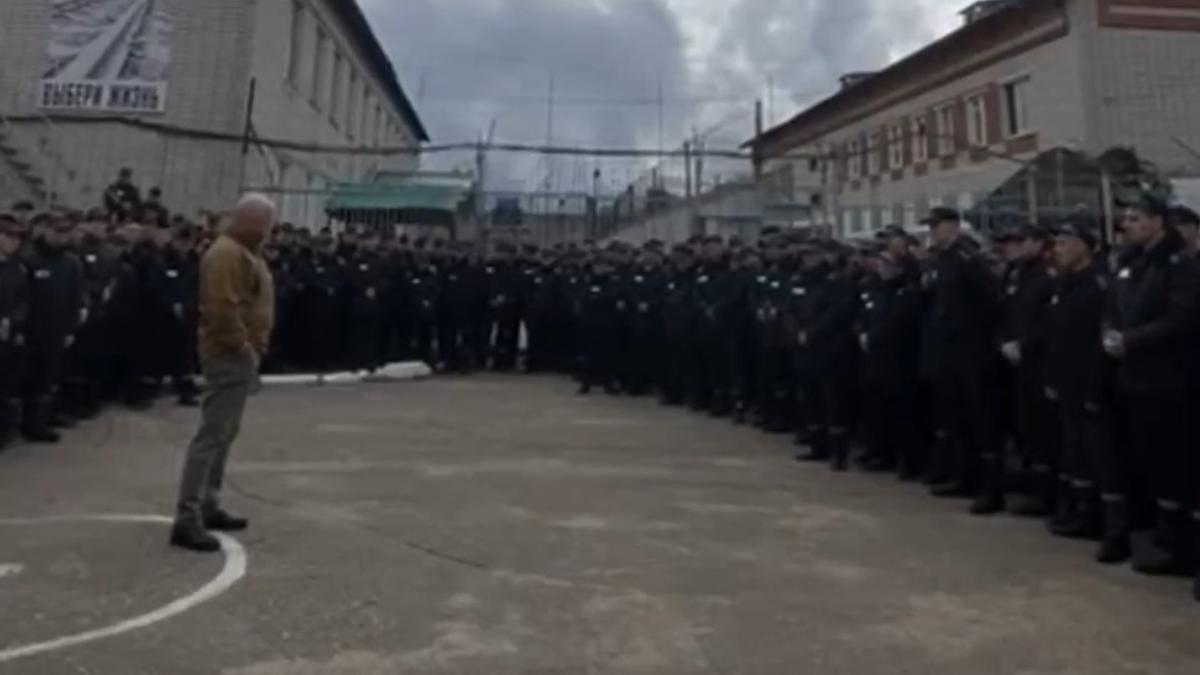
WAGNER RECRUITS RUSSIAN CONVICTS.

It includes convicted criminals, Syrian and Libyan mercenaries «among other elements of bad living» and Russian volunteers. In general, they enjoy disparate salaries, depending on their experience, origin and life path; a convict is basically paid with his freedom, more or less garnished with a clean record.

Their boss is Prigozhin, a Russian plutocrat and Putin henchman. This man is in conflict with part of the Kremlin and with senior military leaders over the permanence of his «private mercenary armed group» in the Russian ranks in the campaign.

The implicit tolerance of the Russian military commands in Ukraine with the men of the Wagner Group generates enormous discomfort among the officers, non-commissioned officers and soldiers stationed there. And it greatly lowers their combat morale and their «esprit de corps«.

If Gerasimov comes with full powers as commander of the campaign and considers the previous arguments, in relation to the motivation and combative disposition of his Russian regular forces, he has to recompose the situation of the forces, in relation to the presence of the Wagner Group in the Russian ranks.

Unity of Action and Concentration of Efforts in the Campaign.

Another of the capital problems that Gerasimov will have to solve is the strategic and operational Integration of all the active Fronts of the Russian forces in presence.

To establish a strategic «Superior Effort Unit» that is coordinated, proportional and synergistic. To optimize in «effective times«, according to the «superior universal saving means» principle and the «military principle of the Objective», the distribution and coordinated use over time of the human and material capacities assigned to the different Fronts.

Thus, the Russians have several Fronts with different importance and presenting different opportunities.

The Kiev Northern Front is inactive. Lukashenko is Putin‘s due ally and with his bravado and maneuvers he causes uncertainty in Kiev. It offers an opportunity to drain mobile Ukrainian troops, to fix and protect the Front from possible Russian rapid raids.

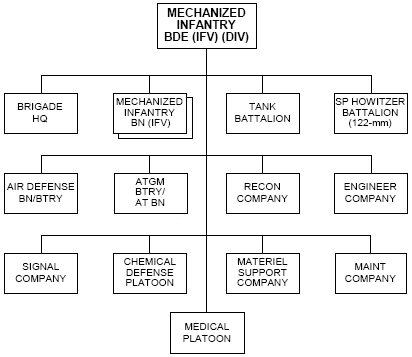
Here the presence in Belarus of a mechanized Russian “task force” would suffice. Counting on tanks and infantry combat and transport vehicles, with support from artillery, engineers, defense against aircraft and ground support aviation and its escort. And integrating a couple of divisions. That moved around the south of Belarus, prowling.

The Crimean Front is active towards Kherson, Mariupol and Zaporiya and creates uncertainty towards Odessa. It allows the defense of the 4 territories annexed by Putin.

The Donbass Front, in southeastern Ukraine, is active in the oblasts or provinces of Lugansk, to the north, along the border with Russia, and Donetz, to the south. The Northeast Front, towards Kharkov is in hibernation. Both hold promise in theory in this new phase of the war.

The joint and coordinated action from both Russian Fronts, of «breaking shock forces» of the Ukrainian Tactical defense. Followed, after the irruption, by «armored mobile groups» with air support, advancing in the Ukrainian operational rear towards a town or small area. Forming a wide and double enveloping movement around the enemy. It can create a “pocket” of it or, at least, a serious threat of cutting off communications for the most active Ukrainian forces, and therefore equipped with heavy equipment, deployed in the east of the country. Russia has more than enough regular mobile forces for this.

The Ukrainian Counterattack.

The Ukrainians can counterattack by employing armored forces with sufficient punch, such as the more modern Main Battle Tanks. The “heavy” tanks that Zelensky claims from the US and Europe now. The Challengers (with their Chobham armor); Leopards 2 A5, of German engineering; Leclercs, the first type built of this new generation of tanks and the Americans Abrams.

Advancing rapidly from the depth of the Ukrainian deployment, on one flank of the Russian advancing points. Let’s remember that this territory is favorable ground for armored vehicles.

For this, Ukraine will need to have several battalions of such tanks. Distributed by their most important concentrations, each with about 50 tanks. Distributing or employing it by isolated companies is to waste its special and unique off-road forward speed, shock and firepower, protected by effective armor. Which is completely decisive in modern combat.

In all this theoretical filigree of maneuvers and combats, the most capable, equipped, motivated and prepared will win.

The denatured current Russian air front.

The goal of the current Russian air front is the weakening of Ukrainian morale. Through the successive attack on civilian facilities (energy, water and communications) and urban centers of some importance in Ukraine.

It should be noted that this rather criminal objective does not target the enemy military forces, but their unarmed rearguard populations. For more INRI, it began to be used shamelessly when Putin and his Kremlin bosses and henchmen realized that his “special military action” in Ukraine was a “bluff”. And that the Ukraine was a tough nut to crack for the Russian forces employed in it.

MASTER SUN.

Almost 2,500 years ago, Master Sun (Sun Tzu), in the Warring States Era, already warned that «when the general is already appointed by the sovereign, he should not interfere in his affairs» and «when the courtiers and ministers interfere in his command, they bring misfortune to the Kingdom”.

In addition, this objective has already been used in other cases and with zero effectiveness, by the way.

Japan was mercilessly bombarded by the US, when it had already managed to occupy the Japanese islands (e.g., Okinawa) close enough to insular Japan. The Japanese were already preparing their civilian population for a Numantine resistance to the invader. Creating an immense natural fortress on its islands, where each one was a fortified redoubt of it.

They were the two atomic bombs of Hiroshima and Nagasaki, which represented an «ascent to the upper limits» in the fight against civilian rearguards. Because they were much more than a very large cannon shot. The ones that forced Japan to surrender unconditionally to the Americans. Because they threatened (although they didn’t have any more artifacts at the time), to destroy the essence and Japanese national identity.

In general, the use of the «indiscriminate bombardment of the civilian rearguards», what it achieves is to galvanize them around their government and their armed forces. Because they perceive from the enemy a demonic, fierce hatred towards them, which would seek the destruction of their identity, culture and idiosyncrasy.

Modernly, such bombing type was used by the US in North Vietnam. They left South Vietnam in 1973 and in 1975 the communist forces occupied it, almost without resistance.

Russia’s Air Support to its Ground Forces.

The Russian air front in Ukraine must be directed against enemy troop concentrations (reserves, attack preparations, marching forces), their ground communications and logistics network, command posts and communications centers, attack points of their forces, artillery and rocket and drones launch positions.

FINAL.

Valery Gerasimov, Russian military commander in Ukraine.

Introduction.

With all the accumulated defeats suffered by the Army of the Russian Federation in its «special military operation» in Ukraine from February 24, 2022 until now, Vladimir Putin does not rest, he is irritated and has no peace.

The latest «ace up his sleeve» is Army General Valery Gerasimov, born in the Russian city of Kazan, 67 years ago and Chief of the General Staff since 2012.

An almost ideal age for the work that is coming up. Defined by organization, structural changes, discipline, sufficient flow of means and a strong hand.

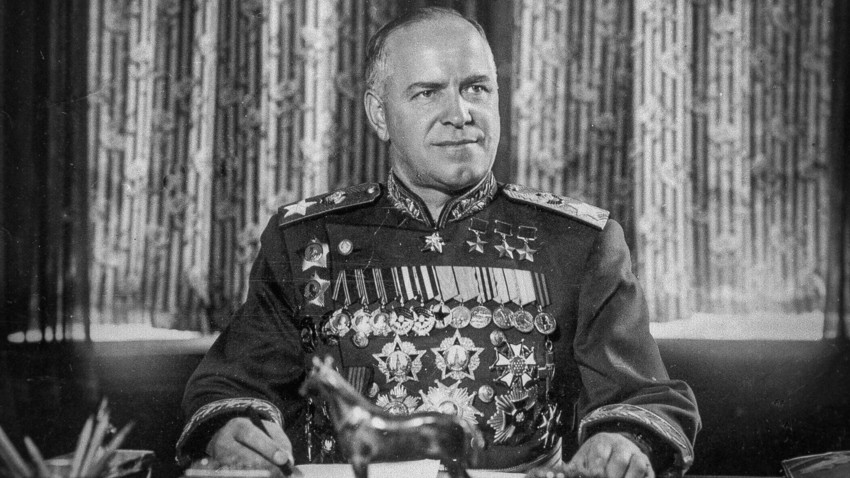
Almost as USSR Marshal Georgi Zhukov had it. When he went to important battle places to preside, on behalf of STAVKA, the General Staff of the Workers’ and Peasants’ Red Army, the main offensives of his Front Groups against the Germans, A Front was the Western equivalent of Army Group, although the Red Armies were smaller in men and means than the Western ones.

MARSHAL OF THE SOVIET UNION GEORGI ZHUKOV, WITH ALL HIS AWARDS.

When Putin appears with his senior military commanders in the photos, his Defense Minister Shoigu is to his right and Gerasimov, the chief of the General Staff of all the Armed Forces, is to his left.

As Assistants at his Main Command Post, probably in Crimea, Gerasimov will have the Chief of the Land Forces of the Russian Federation, to which the vast majority of the troops present in that theater of operations belong, and the current deputy chief of his General Staff (his G-1, in our nomenclature).

At first there was talk that the appointment of Gerasimov was a maneuver by the top Russian military commanders. To see how an intellectual general, a modern hybrid warfare theorist, performed in the field. But, it is not true that he has no combat experience. He has enough of her.

Gerasimov already participated in his day in the two «anti-banditry wars» or counterinsurgency (Russian name) in Chechnya. That was fighting hard for his independence from Russia, as the heir of the USSR, the former imperialist oppressor. In the second, in 1999, he was the deputy head of the Russian armed forces in the campaign. He is accused of war crimes against Chechen populations for his direct action.

He also acted, already as Chief of the General Staff of the Russian forces, during Russia’s campaign in direct support for the Syrian regime of Bashar al-Assad, since 2015, making frequent trips to the Syrian theater of operations.

Based on his direct experiences and his ability to analyze and synthesize the issues of his profession, Valery Gerasimov developed his Theory of Military Doctrine, currently in force in Russia. It’s his Hybrid War Theory.

Although it is nothing more than a Compilation of diplomatic, heterodox foreign, economic and military action policies and their trends. In short, what Gerasimov advocates is to use against the enemy all the means of a modern State in a great centripetous and synergistic action: diplomats, heterodox exteriors (various support for internal enemy dissidents, including armed forces, boycotts, promotion of popular discontent), economic, military

Thus, Putin decided with his military leadership to replace the «butcher of Syria» Colonel General Surovikin, as military chief of the Ukrainian campaign, appointed just a few months ago. He was the fourth replacement for the Russian campaign manager in Ukraine.

The general of ideas and methods with a strong and intransigent hand and centralized orders, which were given from top to bottom, by a general with more flexible and fresh training and ideas.

Based on his direct experiences and his capacity for analysis and synthesis of the issues of his profession, Valery Gerasimov developed his Theory of Military Doctrine, currently in force in Russia. It’s his Hybrid War Theory.

Although it is nothing more than a Compilation of diplomatic, heterodox foreign issues, economic and military action policies and their trends. In short, what Gerasimov advocates is to use against the enemy all the means of a modern State in a great centripetous and synergistic action: diplomats, heterodox exteriors (various support for internal enemy dissidents, including armed forces, boycotts, promotion of popular discontent), economic, military

Thus, Putin decided with his military leadership to replace the «butcher of Syria» Colonel General Surovikin, as military commander of the Ukrainian campaign, appointed just a few months ago. It was the fourth replacement of the Russian campaign commander in Ukraine.

The general of ideas and methods with a strong and intransigent hand and centralized orders, which were given from top to bottom, by a general with more flexible and fresh training and ideas.

That adapted the stagnant and heavy working of the Russian Army to a war of IV (guerrillas) and V (hybrid) generations.

Fighting against a very well equipped enemy (with better equipment and materials than theirs, for a conventional war, in general), committed and determined in their fight, with highly trained officers and cadres, tremendously motivated.

And, educated, trained and mentalized for a modern war, both of «operational movement and combat» and of «guerrillas and counterguerrillas».

Some Problems for Gerasimov.

Many are the problems accumulated by the Army of the Russian Federation and not all of them are solvable in the short term. Probably because they are already structural.

Continuous, effective and sufficient military logistics.

One of the star, creaking, problems of the Russian military is to establish a modern and effective comprehensive military logistics. Even defining it is quite simple for a professional.

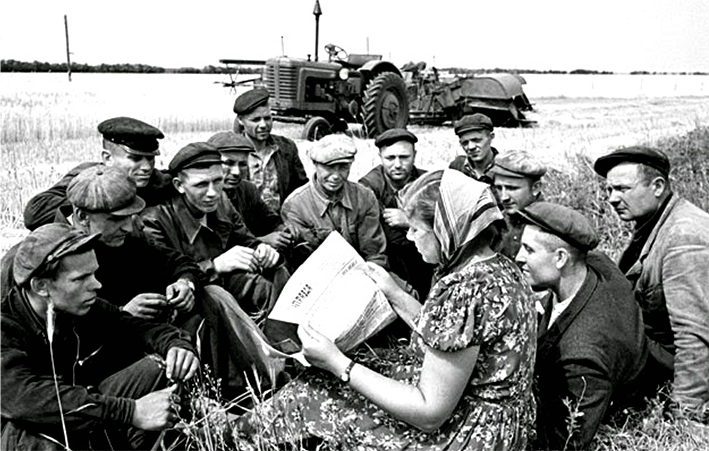
INDOCTRINATION IN A SOVIET STATE AGRICULTURAL COOPERATIVE.

But, in the USSR and now in the Russian Federation, they have not been able to or did not know how to do it well.

In the USSR it was a classic that the potatoes collected in a kolkhoz or sovkhoz rotted in the field. Meanwhile, a few tens of km away, the urban people suffered from hunger or a nearby alcohol manufacturing industry did not receive the potatoes to produce it, from the starch of them.

Probably, the seminal error comes from the Marxist-Leninist economic doctrines, far from reality even in theory. In this case, the economy.

Where logistics is not considered, nor is «added value» attributed to it in the economy. Therefore, in the Budgets and the theoretical Soviet Five-Year Plans it was not taken into account.

The “total value” of a good comes from the “labor of the workers” and, later, of the peasants as well. And, amen.

As all the value of the good is attributed to the producers, the difference between the sale price and the production cost of the workers, the famous surplus value, is accused of being Appropriated (Stealed) by the bloody capitalists.

Capitalist production is not simply the production of commodities; it is essentially the production of surplus value.

This is one more theoretical fallacy of communism, with disastrous economic and military consequences for the country.

Although communism has already disappeared from Russia as a theoretical ruling force, many of its styles, ideas and methods, applied for 70 years, have penetrated and endured in the idiosyncrasies of society and its culture.

(To be continued)
THE ART OF WAR OF GENGHIS KHAN

Introduction.

The conquest by the Mongols between 1219 and 1220 of the Islamic Empire of Kharizm (or Khuarezm), in Turkestan, will serve as a model to present its operational and tactical characteristics. The rapid defeat of the Muslims at the hands of Genghis Khan and his men is an example of the synergistic use of the operational movement capability and combat capability of a highly efficient military system.

Frictions between neighbors.

The Kharizm empire was very recent. While Genghis Khan conquered Central Asia, up to his borders, Shah Mohamed II extended his domain to the south and east. He had inherited the territory of modern Iran (Persia), but had also added Afghanistan, almost to the Indus River, and had reached the Sir Darya, occupying all of Transoxiana.

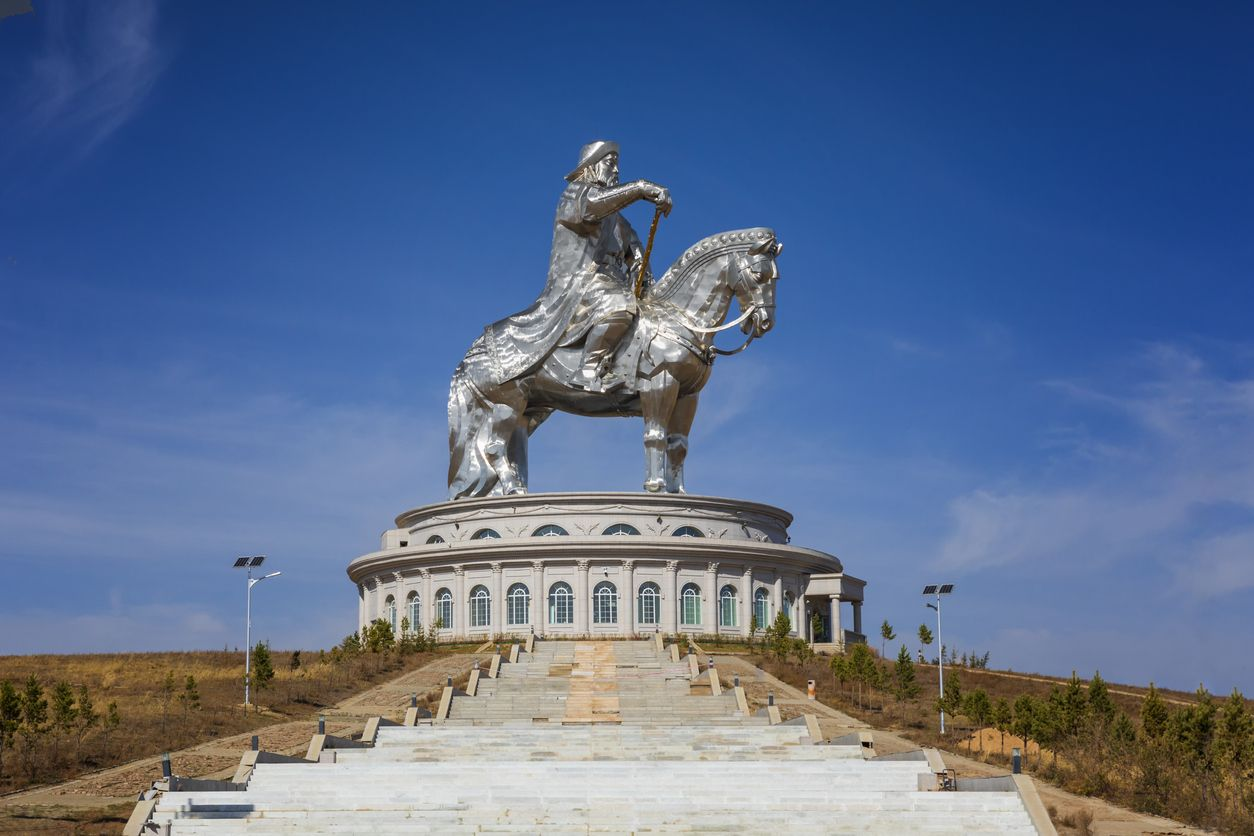
Large Equestrian Statue of Genghis Khan near Dadal, his birthplace, Mongolia

The entire confrontation between the two empires began when Inalchik, the governor of the city of Otrar, on the Sir Daria river, about 200 km from the Aral Sea, stopped a caravan of merchants sponsored by the Great Khan and executed their chiefs, accusing them of spies. And possibly he was right, but that was very undiplomatic and damaged a very sensitive issue in the usual customs between states and hierarchs. Genghis Khan sent an embassy to the Shah, made up of a Kharizmi and 2 Mongols, requesting a punishment for Inalchik. Muhammad executed the Kharizmi and returned the 2 Mongols to Genghis, their heads completely shaved, a serious personal insult to those warriors. War was already inevitable.

Force preparations.

Genghis Khan prepared his army for a march of more than 1,500 km, from his Tien San mountains to the borders of Transoxiana.

The Mongolian army at the time numbered just over 100,000 men. His basic tactical-operational unit was the tuman or division, with about 10,000 men, divided into 10 mingans or regiments. The great army was divided into three parts: the army on the left or the east, the one on the right or the west, and the one in the center. The first two had a highly variable number of men, depending on operational and tactical needs; for example, one could have double the number of men than another. The army in the center was much smaller, made up of elite units and the guards of the Khan and the various Mongol princes; in them their basic unit was the mingan. A Mongol army corps consisted of one or two tumans.

Dead of Mohamed II of Kharizm

Mohamed II assembled a large, well-armed and equipped army, totaling between 200 and 300,000 men (some authors speak of up to 400,000 men, clearly exaggerating), to defend his empire from the expected Mongol invasion from the east. Many of his men were also horsemen from the Turkestan steppes, who were equipped and fought in a similar way to the Mongols. The Shah was sure that his soldiers could stop and repel the invader.

To this end he deployed most of the troops along the Sir Darya, his great natural barrier to the east, and established a fortified line of communications from his army’s deployment to his capital at Samarkand. Lastly, to the north of the empire and protecting it, between the Aral Sea and the Sir Darya stretched the formidable natural obstacle of the Kizil Kum desert, in the Turanian depression, hard and dry where they exist.

Thus, reassured with a good plan, he defensively hoped that he could defeat the Mongols in a major battle, by sheer numerical strength of his army. But, it was von Moltke, the old man, head of the German HHQQ. in the late 19th century, who said that «plans used to last until first contact with the enemy.»

Development of operations.

During the spring and summer of 1219 a Mongol army corps under Jochi, the eldest of Genghis’s sons, ravaged the land west of the great Lake Balkhash, near Otrar, leaving a landscape so devastated that it it was incapable of supporting an army without its own supplies.

Jebe Noyan.

According to the campaign plan drawn up by the orlok or lieutenant of the Khan, Subidai Bahadur, a Mongol army corps headed in the early 1220s towards the valley of the Fergana River, south of the Sir Darya, on the exposed flank of the Turkmen deployment, to carry out a force reconnaissance. It was commanded by Jebe Noyan, one of the Khan’s best orloks.

Part of the Turkish forces, under the command of Mohamed and Prince Jalal-ad-Din, advanced slowly to the east, over the valley. When the vanguards met, Mohamed vastly outnumbered the Mongols and ordered to form up for combat. Caught in narrow terrain, which did not favor his cavalry force, Jebe decided to attack anyway. The Mongols charged the Turks ferociously, inflicting heavy casualties on them. They counterattacked, trying to involve them up and almost succeeded. But the Mongols managed to break contact and escaped to the east.

Most decisive operations for success.

In February 1220, the 3 Mongol armies, under the command of Genghis, Jochi and Ogedei and Chagatai, two of his other sons, crossed the area previously devastated by Jochi and unexpectedly converged on Otrar, on the left flank of the defensive line of Sir Daria. After the assault on the city, the Mongols captured the governor Inalchik and executed him very cruelly.

The two armies commanded by Jochi and the other 2 brothers then headed south, following the Sir Daria, and began to harass during their march the fortified positions of the Turks along their planned great defensive line. Simultaneously, the army corps of the orlok Jebe Noyan, turned north, took the city of Kokand, in the upper Sir Daria, and headed to meet the 2 Mongol armies.

All these offensive operations helped to fix Mohamed’s attention on his fortified defensive line of Sir Daria. In the south, he had won the battle and repelled the invader, and in the north, although the Mongols had taken Otrar, they had not penetrated Transoxiana. The Turkish army maintained its boast of invincibility. Mohamed brought all of his operational reserves closer to Sir Daria. However, although in both cases the Mongols had suffered heavy casualties, their ratio to them was of great concern to the Turks.

For its part, after the capture of Otrar, the army under the command of Genghis Khan, with Subidai as his chief of staff, and made up of 4 tumans, headed north. There he took the Turkmen city of Zarnuk, with the sole purpose of capturing a man who, according to his informants, knew of a practicable path through the Kizyl Kum, following a chain of oases.

Then the Mongols delivered their decisive blow.

(TO BE CONTINUED)

The Gravity Center of the Joint Effort of the Combined Means. 2nd Part.

An Instrument of the Command.

(continuation)

Now, closing the “historical and definer cicle”, the wars of V generation are called hybrid or multi functional wars, which, really, always have existed. With the major or minor participation of each one of the available “means of intervention» (Foreign Relations, regular and irregular Armed Forces, Economy, Cybernetics, etc) in the social group, to obtain the searched «functions of intervention» on the enemy. Forming a “means” mix, adapted to all situations and confrontation theaters.

Not for nominating nowadays with an exotic and new word, preferably foreign, one makes this way a «mean or a function of intervention» fresh and promising. The problem is that the ignorance of the history, still the recent one, impoverishes the new concepts, ideas and situations of conflict. Without winning in application, efficiency and cognitive capacity with it. With this, only it falls or repeats the previous history, returning to learn it. And that, as in a spiral screw, only changes the phenomenon temporal «plane of execution«. Where are kept safe and now partly secret, the different «essential parameters» of the phenomena of the conflicts and fights.

Almost all the «means of intervention» of the State, used to obtain his national aims, already were present in the panoply of means at his disposition, a long before this new name of the Hybrid War. The «functions of intervention» were developed by «means» adapted to the real possibilities of his epoch. And they were obtaining the looked aims, though they were very specific. There we have the actions of the SAS (Special Air Service) as «special forces of punctual intervention with limited objectives” in the enemy rearguard. Fighting against this one and to support and help the local «forces of resistance to the occupant». In the USA we have to the SEALs, the Rangers, the Delta force and the Special Forces, among others. In Germany is the GSG 9 group. In Australia and New Zealand they have the same name that the British corps.

Resultado de imagen de propaganda social
CHINESE PROPAGANDA AGAINST TAIWAN.

The strategic and tactical needs of the war and the functions of the «means of intervention» are slightly variable. And his variability is a function of the improvements in general training, scope, speed, capacity of shock and fire on the enemy, communications between «means», protection of these, etc. That offer the successive technologies applicable to the «means».

One of the «means of intervention» of a world or regional power to obtain his «national and strategic aims» are the «Foreign Relations«. That has a concept qualitatively more extensive than the Diplomacy. This refers to the State or government affairs, that treat two or more nations (alliances). And the diplomatic «function» is to negotiate by the political way what communicates to him his State, department or secretary. Asking and receiving successive instructions, if it was necessary, to support and continue the negotiation. And being kept or not in his execution and protocol relations, within the qualities of discretion, prudence and tact that characterize his trade.

Resultado de imagen de cuba en etiopía
Cuban «internationalists» forces help Ethiopy in 1977.

The Foreign Relations also include other relations and more heterodox actions. That is necessary to look for, to keep and to support in the exterior to obtain our National aims. This way, a function of the foreign relations is to appear for it, new opportunities and more secondary ways or routes and «means of intervention«. The Foreign Relations collaborate directly, since always it has been done, using the means and the in force national strategy, with the Intelligence, the Economy and the national Armed Forces. That is to say, acting together in a «mix» of functions and means of intervention, the war always has been Hybrid from the Prehistory. Creating new opportunities and ways, to apply and use the whole creative and potential capacity of the State, to achieve his strategic and operational aims.

Resultado de imagen de Metternich diplomacia
Prince Klemens Wenzel Metternich (1773-1859). As a chameleon diplomat he was more important in his achievements than Napoleon in his wars.

A succinct example between thousands of situations. The «Central Strategic Command of Combined War» can request to Foreign Relations the search of dissident or domestic enemy in a potential enemy country. Located one o more of these, there are valued his capacities, circumstances, implantation and operational possibilities. This way, FF. RR. would present a report to the Central Command in the shape of a «founded resolution”, involving in it. That is, valuing schematically the existing cases and being decided for one or two, depending on his qualities and our general or punctual convenience.

These dissidents or enemies will be politicians or also armed rebels. In the first case, our nation might grant to them asylum, scholarships, economic support and advice to his groups. In the second one, in a phase of major confrontation, we could also send supply and armaments, advisers and trainers and «special operations» or units of «foreign volunteers», to support and/or reinforce them in his insurgents activities.

At the beginning of the 16th century the «reformists and heretical» ideas of the priest Martin Luther propagated in the center and north of Europe, with the help of the press. The origin of the word propaganda arises during the Counter Reformation. It is a reference to the spread of the catholic faith. With the Jesuits in the forefront of this task of catechizing. Facing to the deviations from the preexisting orthodoxy, taught by the Lutherans, Huguenots, Calvinists, Erasmists, etc.

The propaganda always handles basic, essential information, that are easy and simple by definition. This is due to the fact that his «aim» (the «target«) is always large and numerous: the population of a certain country or region, or a religious, economic, racial or socially different extensive group. They are those that it is necessary to inform, convince and, according with the cases, to protect.

A «mean of intervention» against the enemies or to change or to influence wills, which was not known, for unthinkable, until a few years ago, is the Cybernetic War.

The cybernetic attacks can go to the software or the hardware of the personal IT, managerial or institutional systems. The software is the «logical support» of an IT system, which makes possible the accomplishment of the different tasks. This «logical support» includes the operating system and the applications or IT programs that those realize. The hardware is the machinery or the set of physical components of the computer. This way, summarizing, the software generates instructions that are executed by the hardware or physical support of the system.

June 2021 Cyber Attacks Statistics – HACKMAGEDDON

In general, the attacks are realized to the software of a system, looking for a «weakness» of this one. And using the malicious codes, the back entrances, etc. A penetration or attack to the software is prevented in general with an antivirus adapted to the received virus. To attack the hardware is necessary to act on the «physical component» of the computer. And his detection, with the nowadays existing miniaturization, turns out to be very improbable and long in the time, until the devastation is detected. The best way of acceding to the hardware is realizing the intrusion in the factories of components and of assemblies. But these are protected by control measures of components and external equipment, based on the nationality and the producer of them. Unless the attacker and the manufacturer undesirably match…

Imagen relacionada
Somewhat confusing scheme of Cyber War.

The Economy is an important and classic “mean of intervention» of the State and of the Nation. It means and involves in the effort of war the capacity of obtaining and producing all kinds of goods and services, intermediates and finals, that the technologies and processes in effect in each stage are capable of get and obtain.

Resultado de imagen de reagan and gorbachev

The Economy is tied directly with the applied, specific education, of the skilled workforce, who is needed and could be achieved in a nation. The own aptitude to obtain goods or services (even with tourism, raw materials, trade) appetizing to other nations or social groups, will serve for the direct exchange or for barter of the goods and services in which a society is showing a deficit. As an example, energy or specifically qualified workforce.

Also, in cases of need and usefulness, a nation can decide to assign more productive resources to the production of a certain good. But, all more it is required specialization in the production, the performances, both neat and economic (as cost of them) will be minor. By virtue of the laws of the diminishing performance and of the increasing costs that suffer these «specialized reconverted productive processes«.

It is very easy to use the cement in producing military goods of static defense (bunkers, defensive armed lines) and not to raise buildings with it; it is relatively easy to convert the industrial vehicles factories of into armored vehicles plants. And it is very difficult to obtain great performances from a dairy changed in an arms plant.

All of these «means of intervention» require been necessarily and sufficiently harmonized and coordinated by a «centre of gravity» of the Central Strategic Command in each theatre of operations. That, in a centripetal and convergent effort, simultaneously or successively, it would direct and apply the specific means at its disposal.

The End.

The Gravity Center of the Effort of the Joint Means

An Instrument of the Command.

Introduction.

The center of gravity is not an own physical unit, nor is its mission, neither a point in space or one with a predominant physical characteristic or an enemy unit.

The center of gravity is a coordinated flow of ideas of variable application, that generate original actions for fulfilling the mission and objectives. Originality, flexibility, variability, consistency, difficulty to predict by the enemy and effectiveness are essential to its establishment. Actually, the center of gravity is the instrument of direction, distribution and concentration, impulse and work. That the command has to focus on and unify, with the goal of accomplishing objectives and missions, and employing the efforts of his subordinate units and supports.

The chief is centered in his objectives and missions by means of the created center of gravity and follows a methodology for applying the operational systems.

The Efforts Concentration.

As far as concentration goes, the so called “principal effort” expresses an effect of penetration in a given direction and a sense of being able to arrive at the rupture and exploit it. The combined-arms and aerial efforts of the units are concentrated on this.

The center of gravity has a more spatial and temporal sense, looking for an “operational convergence” of “related efforts” towards an objective. Those are not necessarily contiguous, simultaneous or sequential, but are synergic and result in outcomes based on consideration of the optimal form (means economic) of action of each weapon and service.

The center of gravity is more global or holistic; the main effort is more adding and cumulative. The main effort is exemplified by the hammering strategy of French Marshal Foch on the European western front beginning in the summer of 1918. This strategy was used to overcome the Germans purely by eroding their battle capacity in the theater of operations. And only shifting its direction when German resistance was excessive.

The effects of the main effort are more direct, predictable and evident. Those of the center of gravity are more subtle and unexpected, at least in the first phases of a military action.

The main effort is an instrument of the tactical level and is not necessarily generalized to the other levels. The center of gravity can be used in all dialectical activity where several means (either in number or in nature, near or distant) can be used. Within each level of military activity, beginning with the superior one, the center of gravity brings together and harmonizes all activities to obtain the most important effect or objective of that level.

Developing.

At the strategic level, these would be the critical vulnerabilities of the enemy within the theater of operations. The nature of these would be informed by an important political component. At operational level the center of gravity would be created over the critical vulnerabilities of the campaign. At tactical level it would be the objective that would make operational transcendental the battle. If this was correctly addressed, as necessary for the operational direction, the objective would be that which would be decisive in the battle and get the exploitation of victory.

The center of gravity supposes a centripetal action of all the lines of performance, of the ramified activity of all the units and the services, not necessarily coincident, but convergent in their efficiency and result.

Following the communications ramified lines, we take advantage of the departure situation of each force and the transitability of the land, looking for the optimal use of the combined-arms set, reserves and logistics. By means of the different lines of attack or action we induce uncertainty in the enemy, we disperse his defensive capacity and disturb his plans for, and execution of, defense.

The ramified lines, in a final centripetal action, are peculiar to the center of gravity. The accumulation of forces in a sector, reiterating (inserted or successive units) or strengthening (adding tanks, narrowing the sector or providing greater fire support) the effort, is peculiar to the concept of the main effort.

Strategy: Does the Center of Gravity Have Value? - War on the Rocks
ALLEGORY OF THE WORKING OF THE CENTER OF GRAVITY OF THE MEANS

An example of the use of the center of gravity following those ramified lines at the strategic level, is found in Napoleon’s operations to secure the surrender of Ulm held by the Austrian army of General Mack and Archduke Ferdinand.

In an ample advance of its independent army corps, the Great Armée (about 210,000 men) crossed the center of Germany, from the Rhein to the Danube. With this it operationally interposed between the Austrians (about 40,000 men) and the allied Russian forces that went to help them. The French initiated the crossing of the Danube on October 7, 1805 and, during the following week, Napoleon converge most of his army corps in an enormous spiral on Ulm. While a sufficient force watched the arrival from the east of Russian General Kutuzov.

Batalla de Ulm - Wikipedia, la enciclopedia libre
THE SURRENDER OF MACK AT ULM’S OUTSKIRTS

General Mack made, in vain, several attempts at rupturing through Napoleon’s forces, applying his greatest efforts in Haslach and Elchingen. Both Austrian commanders quarreled among themselves and Archduke Ferdinand, with his 6,000 riders, separated from the main force and tried to escape to the northeast.

On the other hand, General Mack and the rest of his men (about 27,000, after the mentioned battles) met Napoleon’s overwhelming numbers at the doors to the city of Ulm since October, 14 and laid down their weapons at the feet of the Michelsberg mount. The capitulation was signed by General Mack on the 20th. The forces of Archduke Fernando were surrounded and won by the cavalry corps of Murat near Trochtelfingen. Another 12,000 Austrians surrendered in Neustadt. The campaign, without properly battles, cost Austria more than 50,000 men of her initial forces of about 70,000 troops.

The center of gravity directs, canalizes, gathers and orients the creation and the direction of the strike of different units and supports in each case. Its shift by the command allows the continuous adaptation to circumstances and the maintenance of focus on intermediate aims.

The center of gravity has as effective factors the speed of operations and logistics. The first allows optimal actuation of the combat capacity of forces and the second diminishes or compensates for the inevitable wearing down of the mobility capacity of troops and posible combat capacity during operations.

Its negative factors are poor transitability, including caused by obstacles, cuts and minefields, and battles command did not wish to engage in. The first “wears away” the operational mobility of the troops and the second “exhausts” their potential combat capacity.

Without those capacities, the fluidity, synergy and the ramified activity of thecenter of gravity tends to revert in a main effort in an operational direction that is quickly known by the enemy. So, the “stunning waves” that are generated on the enemy, cross-sectional to our advance in his operational zone, diminish with it in intensity and frequency, perhaps in the end, even disappear.

The direct elements of performance in the center of gravity are the combined-arms sets, the own and superior level of reserves (even including those in the mass of support or operational rearguard) and logistics. Once the center of gravity is conceived, it is applied and developed by means of the operational systems.

The Development and the Future.

The Hybrid War, a scolium?

Well, but this concept for command can be useful for the wars of I, II, III and IV generation (according to the US denomination, widely «accepted»). But, now we approach the era of the war of V generation: the hybrid or miltifacetic or multifunctional war.

Employing, in addition, digital, computer methods, using the precision and discrimination that allow mathematical algorithms and the technology of radiations and electromagnetic pulses.

NATO Pushed to Upgrade Romania to 'Center of Gravity' for Russian  Deterrence by DC Think Tank - Sputnik International
NATO UPGRADING ROMANIA TO GRAVITY CENTER IN THE DEFENSE OF EUROPE

But it is just that this model of dialectical confrontation with its variable component of physical strength, needs a harmonious and holistic integration of the available multidisciplinary means. By focusing them on achieving different objectives simultaneously or successively, that we want to achieve. And preserving the universal principle of optimization and saving means.

(TO BE CONTINUED)

The Tactical or Operational Success. Its Signs. 2nd. Part.

(CONTINUATION)

The Signs of Tactical or Operational Success related to the Physical and Environmental Support:

Land transitability will be neutral or favorable to the operation.

Transitability is the geographical (superficial or spatial) dimension where military actions take place. It is principally framed by the superficial capacity of an area to support certain means or military capacities and their movements. It is completed today in a spatial dimension, by the range of heavy fire and aircrafts.

It has independent and absolute functions, as are the passing of specific points during a period of time, the time it takes to travel the distance between them and the not superficial simultaneity of military means. These refer on the transitability, related to how the Nature and obstacles interact with operations. Transitability also has relative functions that are generally dependent on geography. These are more concretely determined by the availability and quality of roads, railways and fluvial nets (urbanized geography), the climate, the hydrology, the orography, the season and meteorology and the hour of the day (physical geography). These functions change with different national and regional surfaces.

Transitability determines the facility or physical difficulty for rapidly maneuvering and, in consequence, determines the total time of an operation, in the phases of execution through the successive «cycles of action«. Roads and railroad networks are the most suitable physical support to obtain low times of execution in operations or high «tempos». Their transitability characteristics will be their availability in the operations zone, the road surface resistance, the traffic saturation conditions and the “narrow or critical” points existing in the ways networks and their “continuity traveling cuts”.

Roads that support a good advance pace are problematic, as outside of developed countries pave roads are uncommon. More often it is the case that a terrain is untransitable as an operational element and will require units to physically struggle in order to going on. The channels, the rivers, as continuity cuts, constitute another relative conditioner of the transitability of a zone. On one hand, they constitute an almost inevitable restraint of the impulse of maneuver. In effect, in almost any direction that follows an operational route during sufficient Kilometers, it ended up confronting the crossing of a natural or artificial water obstacle. The bridges that surpass them, as part of a road network, not always will exist or be at hand. Given the present amphibious means, the main obstacle to the transit will be offered by the water flows banks. It will be necessary to consider the slope of both banks and the characteristics of resistance, adherence, consistency, etc. of them and of their immediate approach grounds.

Resultado de imagen de MILITAR traveling grounds

One can try to use the superficial dimension, or even the spatial one, to improve transitability in different cases when good conditions do not exist. The first leads to employ a cross country mechanized formation, supported logistically. This was the imagined ideal of strategists and tacticians in the 1930s. On one hand, the best all-field or tracked vehicle moves better along a highway than across a field. For a given useful load weight, all-field or tracked vehicles have more tare than wheels vehicles. For total given weights, vehicles on tracks and on wheels that advance cross country have greater wears, more breakdowns and more fuel consumption than those that travel on highways.

Resultado de imagen de MILITAR river fording

This raises a double economic and logistic inconvenience, whose solution is very difficult. For this reason, it is ideal to operate along steady surfaces and using the railroad up to a bit more than one hundred kilometers to the front or the enemy. And to fight cross-country, taking advantage of shooting cover sectors, concealment and so on. Using the tactical characteristics of the field. Specially, rolling grounds that favor the mechanized fighting.

The spatial dimension also encompasses the impossibility, like that of saturated ground roads, of the simultaneous arrival of numerous aircraft at a given point. Or the airships fly in row, arriving at the same time, but laterally extended or they go in line to unload or arrive successively in a «single» operations point. The helicopters give more concentrated results than those of the airplanes, but these have more lifting and ordnance capacity.

Resultado de imagen de Military airborne falling

The effects of climate, season, hour, and hemisphere are superposed on these conditions, worsening or mitigating them. Orography affects transitability when it make difficult the construction of a road layout and when it increases the slope that military marches must cross. The cross-sectional passing of “height lines” can become impassable, except by defiles or mountain ports. Which create bottlenecks that collapse the maneuver impulse and prevent the deployments of the units that cross them. Fights at heights have a generic “gravity center” in order to control these passages.

Resultado de imagen de urban warfare city A RESOLUTE ENEMY  IS STILL WAITING YOU OVER THERE

When “height gradient” diminishes there exists a less evident, but more frequent and very important factor, which is the «drop». “Drop» refers to height variations of a few meters up to dozens of meters in relation to the surroundings. It appears in cross-country running, in areas of more or less waviness, in broken areas and even in roadways sections. It has also an expression in urban zones, both residential and industrial. As well as buildings, houses and facilities form «relative concealing heights«. These generate protection and danger, opportunities and risks. And are the urban expression of the «drop». The forest is a special variant of this case, with obstacles and shorts views for both enemy forces.

Urbanized or industrial zones shape numerous parallel, transverse and interweaving «drop» lines. They channel all military effort in the mentioned zones, generating innumerable «interfaces of action» with the enemy. That are frequently determined under surprise conditions. These zones definitively paralyze the impulse of the units and generate attrition (in military means) and wear (in logistical terms) disproportionate to the results obtainable by their occupation.

THE END.

THE MILITARY SURPRISE: concepts, effects, realization and types. 2nd. Part.

(CONTINUATION)

The three cavalry regiments of the brigade had a total of 27 officers, 228 N.C.O.s and 1,740 soldiers mounted on German horses. All those who could, carried sub-machine guns –either the MP-38 or MP-40- instead of the 7.92 mm K98 carbines. They were supported by 30 heavy machine guns (MG-34 on tripods) and 72 light machine guns (MG-34 with bipods). Their heavy support fire was provided by a battery of 6 light howitzers of 75 mm for each of three hippomobile regiments. As external support they would have artillery fire, either centralized or from the divisions placed in its flanks, for the attached observers and officers were accompanying it.

Resultado de imagen de carretas del país soviéticos Country wagons moving forward in a huge Russian plain…

They were also supported by an engineers company (pioneers) and a sanitary company. By means of a park of Russian country wagons, each dragged by a pair of native horses, the supplies, replacements, ammunitions, medical forces, etc. of the brigade would be carried to them. They also had a motorized supply column.

The nature, the structure of the brigade and its support were perfectly adapted to the mission and contributed to its simplicity. It even received the support of a tanks company (14 tanks) for the attack, when the reconnaissance saw the possibility for use it.

Another key aspect of the mission was intelligence, acting already before the conception of the operation. This provided the most complete knowledge of the enemy and operations zone. Intelligence was a combination of information acquired by all the units, that was continually updated. It allowed better definition of the mission, assignment of the means and units, and training preparation. It also allowed for more appropriate adjustments or changes in plans, etc.

Another indispensable factor in this extraordinary or heterodox operation was the training and trial of the mission. The brigade trained for 4 to 6 weeks before its activation, in areas similar to the future operations zone; this fulfilled the security factor.

The training with tanks was not done, because its employment was not foreseen. And one of the problems that arose during the operation was that communication between the cavalry and tanks was poor. In the thick wild forests the wireless radios did not work well and it was necessary to use the existing wire telephony. But these were not enough for adequate communications between all the small units.

Resultado de imagen de frente del este 1942

A characteristic of the training in these special missions is that that it must be as complete as possible, in agreement to its peculiarities. And a full trial, including the total foreseen time, is always necessary. For example, to verify the resistance of certain equipments and not only its good functioning, as would happen in a partial or incomplete test.

The brigade and 5th panzer division were in their departure positions 10 days before the start of the march towards the contact. The Soviets were not capable of detecting the activation of this unit, so the security factor remained fulfilled.

Immediately, the brigade, with the help of the tanks troops, carried out an intense reconnaisance of the intermediate area and the enemy positions (advanced combat troops and the forward limit of the defense). It was deduced that the tanks’ support in the attack was possible (in a narrow sector), if a necessary adaptation was effected in the tracks accessing the area. This innovation would add an important shock capacity and heavy direct fire to the assault, especially in the irruption, in the struggle for enemy fighting positions and in the interior of the defense zone (artillery, units in disorder or in retreat, transport, supplies, etc.)

The factor surprise was going to be achieved by the tactical innovation and the unexpected action in «field of action» chosen for the attack. It is important to remember that the Soviets were prepared and fortified against an attack that they knew was coming. In addition, since the beginning of the war the Soviets had shown themselves to be masters of defense and in disguising positions. Still, the Germans hoped that a strong attack on an unexpected place would dislocate the enemy’s combat capacity and means of defense. The German plan allowed no practical reaction time to the enemy.

Resultado de imagen de frente del este 1942

With this, the speed of action factor is obtained by the attacker. This allowed the Germans to overcome rapidly their principal vulnerability: the initial contact with the enemy in the decided «interface of action«, in which always can be produced unexpected setbacks in the face of potentially bigger forces, until the law of the action is imposed on the enemy.

As the mission begins, there is uncertainty or friction, due to the enormous number of individuals and units involved; mistakes, that are a function of the small failures that happen inevitably in all the human actions that comprise a mission; enemy action, until the fire supremacy and maneuver deprive him of initiative; opportunities, in the shape of favorable situations not foreseen by the Germans and which the commands of the small units must exploit in order to fulfill the mission.

To be able to act this way, the extraordinary or special troops must possess the commitment factor, which involves the acceptance and recognition of the entrusted mission, its important consequences and its real possibilities of success in these conditions.

A couple of days before the assault, the engineers were making progress through the forest boundaries with mechanical saws. They constructed a reinforced path and carpeted it with middle logs cut up “in situ” and arranged about a meter apart. This was to give sufficient firmness to a route up to the Soviet minefields which would support the tanks added to the hippomobile brigade in tactical subordination, which slowly initiated its advance a little later. The noise of the saws and the engines of the vehicles was drowned by the flight of reconnaisance planes at low level and sporadic harassment fire.

The joint assault began on July 2, 1942.

The hippomobile brigade had to cross 15 kilometers of forests and marshes to reach the Soviet positions. At its right was the 5th panzer division attacking, which acted as the normal force or mass of support for the assault. Its left flank was supported on this area of difficult ongoing, covered by weak infantry forces (about a company). Until, on the 3rd day, a German infantry division began its assault through this sector.

At 3 a.m. the tanks advanced close to the cavalry troops, taking advantage of the general artillery preparations. They were accompanied by engineers’ troops. The minefields were immediately detected and the engineers cleaned the area around the passing paths to extend its width. Suddenly, the forwards tanks and cavalry reached the limit of the Soviet position of defense in this decided «field of action» over them.

Resultado de imagen de 9º ejército alemán Rzhev Model saves the day for the 9th German Army.  Column of Soviet military prisioners.
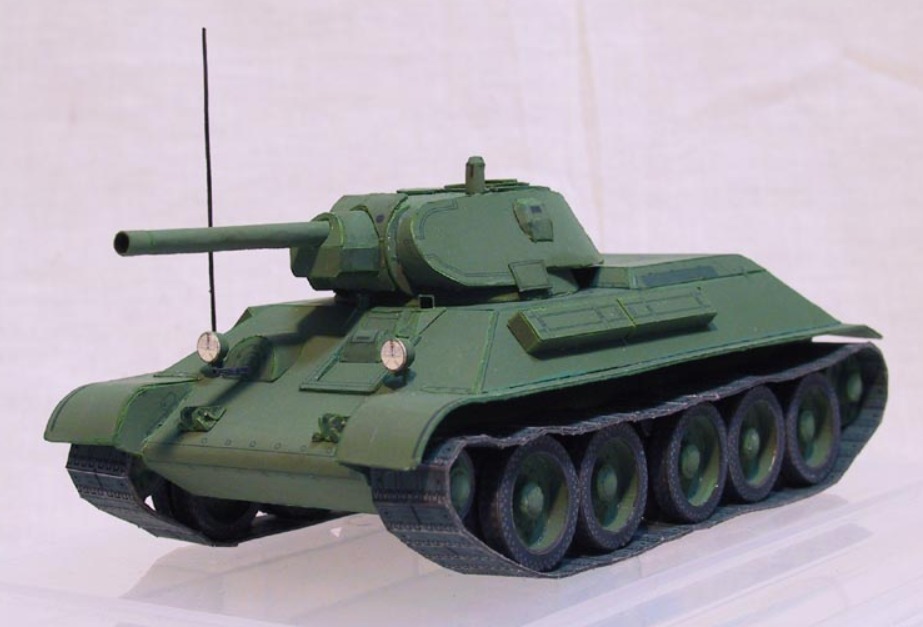
In a single thrust they burst in, breaking the Soviets’ first lines of defense. After this, the tanks were kept in reserve, since the enemy position stretched through an unknown wooded area. That morning the cavalry managed to penetrate 6.5 kilometers inside the Soviet position.

The whole time the train of country wagons was capable of advancing supplies, replacements and munitions to the tired men.

For its part, the 5th panzer division could not advance despite its superior capacity of shock and means, and suffered heavy losses by very well camouflaged Soviet forces in depth.

Around midday, a hippomobile regiment turned to attack the principal enemy positions from the east. To reach them, it had to cross a swampy forests zone where the water was knee-high. At dusk, the brigade had control of a sector of the principal road inside the Soviet position, breaking the Soviets’ tactical cohesion and turned it untenable.

Just after midnight on the 4th, Soviet resistance was collapsing in the area of assault of the 5th panzer division and hippomobile brigade. This crossed another swampy forest area of 10 kilometers depth and emerged at the operational enemy rear. Here was a scene of chaos filled with abandoned vehicles and stroked columns and groups of troops and soldiers. Arrival of the panzer forces accelerated the decline of the 39th Soviet infantry army as an organized and effective force.

That same day the whole sector of this army collapsed and the German infantry divisions of Walter Model’s 9th army converged on its interior by all its assault sectors.

In the 11 days that the operation lasted, the Germans captured 50,000 Soviet prisoners, and around 230 tanks and 760 artillery pieces.

THE CREATION OF THE TACTICAL AND OPERATIONAL SURPRISES.

Prolegomenon.

Military surprise is more a part of the art of war and its creation, than of military science, the doctrine, its regulations and the principles or «good-doing» rules of war. Of course, its scope and instruments are taken from military science. Military science has its logic and practice oriented towards applied theory.

Military doctrine forms the framework, the structure, the heart of all development and the wisdom that military science has been developing so far. The military doctrine of each state incorporates the idiosyncracy, history and civilization of the corresponding nation. The permanent virtues and the more temporary values of the former are also reflected in its military doctrine. All this channels it in one direction and one sense.

War art has in its conception and execution the characteristics of: variability; the unusual and singular conception; the different, unexpected and novel application and the relative ingenuity (naturalness and freshness) and freedom in its facts.

Resultado de imagen de general hermann balck General Hermann Balck, one of the finest German armored tactical Command.

If we are guided mainly by military science, which the enemy also knows, the results of the war dialectic will be obtained by maintaining a superiority in men and means, marches and maneuvers. And the cost will be the attrition of means and human wear in a greater proportion, and always undue, than with the use of surprise.

Thus, a defence deployed in depth and with sufficient reserves, probably deprives us of many opportunities for effective surprise. But, almost always, acting in the microfield, as using a tactical zoom, we can apply the tactical or operational surprise, unusual and unexpected.

Development.

The surprise becomes specify and materializes in an unexpected action on the enemy by fire and/or shock. That, taking advantage of the enemy’s habitual lack of combat availability, makes him the victim of an attack that he is not in a position to successfully reject.

Obviously, the units in charge of surprise must avoid enemy’s reconnaissance, advanced combat units and security. In charge of giving the units that detached them, enough time to get the combative disposition that allows the rejection of their attacker.

But, the mental surprise must not only be unexpected for the enemy. But, in order to be able to take full advantage of its potential and effects, it must also be unusual, special, infrequent. With an unquestionable tendency to be «unusual», as never seen. This unusual character, never occurred, extraordinarily reinforces the quality of unexpected and sudden use of surprise.

Imagen relacionada Soviet  T-34 /76 tank.

We don’t always have the unusual at hand. And surprise often favors, by employing the law of action, the most mobile and even only active rival.

Then, the use and manipulation of the “appearances”, the appreciated characteristics of the events and their circumstance, will allow us to establish and develop a new tactical or operational situation. Which will be surprising and unusual for the enemy. And it will give us an unexpected victory, at the beginning of the faced dialectic situation.

A Tactical example with Operational Trascendence.

Here is an example of an extraordinary force acting as a normal force and, in so doing, completely deceiving the enemy by manipulating appearances of the events.

In January 1943, with the Soviet advance threatening Rostov, the 4th Panzer Army of colonel general Hoth moved back from its positions on the banks of the Sal and established a defensive line south of the river Manich. Passing through that area were the supply and retreat routes of the 1st Panzer Army. Routes that had been kept open, if a disaster like that of Stalingrad was to be avoid. In Stalingrad, the Sixth German Army, the Army unit more powerful of the Wehrmatch, was caught. The 4th Panzer Army was assigned to protect this bottle neck in the communications of the Armies Groups Don.

Soon the Soviets reached the confluence of the Manich and Don rivers, took control of the small city of Manutchskaya that was only 30 kilometers from the mouth of the Don on the south bank, and sent advanced detachments in this direction. On January 23, the 11th panzer division and 16th infantry division counterattacked the Soviet advance spears and pushed them back to Manutchskaya.

Then, it was vital to restore the south front of the Don and Manich and to expel the Soviets from the city. Which was one of their bridgeheads (which, with much skill, could be rapidly reinforces once constituted).

The Germans made a direct assault from the southwest on the 24th, seeking to surprise the Soviets with the operation continuity. Instead, they found that the Soviets had created an antitank front in this entry to the city. Using tanks with their hulls partly buried and distributed between the buildings, along the streets, and in other difficult to see locations.

The 11th panzer division, a crack division with a magnificent tactician as chief, quickly stopped the assault when it detected the importance of defenses.

Imagen relacionada A Panther from the 11th panzer division circa summer 1943
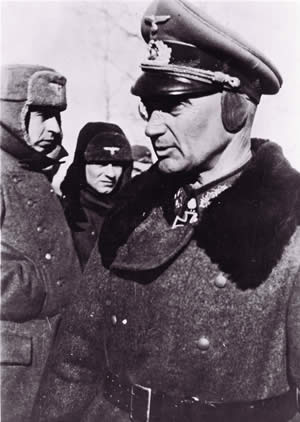
On the 25th, the general Hermann Balck initiated an assault on the northeast sector of the city, which the Soviets identified as a main assault, similar to the previous one and following the orthodox criterion of «not insist on unsuccessful or frontal assaults» (not profitable). For it, they moved rapidly theirs antitank means (tanks are the most mobile) to the new threatened sector.

To make credible this assault (manipulation of the appearances), at the beginning the whole divisional artillery was used in its support. It was also the more dangerous direction of assault for the Soviets. Since that part of the city was nearest to the principal bridge over the Manich and its occupation would isolate the Soviet bridgehead on the south bank. These factors constituted the «primary evidences«.

The assault on the north-east sector was probably already considered by the Soviet defense as a German probably alternative assault and, because of this, they reacted rapidly to what happened.

Infantry half-track vehicles and reconnaissance light tanks executed the principal «virtual» assault, simulating the march of mechanized vehicles, concealed by smoke curtains. And seeking more to hide them from the enemy than to protect their advance. This gave a «secondary evidence» to the credibility of the «appearances«.

When the Soviet’s determination in the new defense was estimated, which confirmed the alteration of its original deployment and the attraction made by the normal «apparent» attack. The bulk of the divisional artillery threw a powerful fire blow on a sector of the southwest zone of the town. A single battery continued to support the ongoing false principal assault.

Most of the tanks of 15th panzer regiment immediately attacked the forward limit of the defense, entering the town and advancing on its interior. To attack from the rear the new defensive Soviet deployment, especially its tanks. The mechanized German infantry then closed in behind them.

The Soviet resistance crumbled. Its infantry ran to the bridge over the Manich river. But was chased by the 61th motorists battalion.

German casualties in liquidating Manutchskaya’s stronghold were, according to its own sources, one man dead and fourteen injured men. The Soviets had between 500 and 600 casualties and 20 destroyed tanks.

I believe, it is all clear and simple. Which are the characteristics of the practical and real ways to do.

THE MILITARY SURPRISE: concepts, effects, realization and types.

The common or general tactical surprise is that which is normally or frequently used and that is known and expected. There is one case we take as example, which is to ambush or hostilize enemy forces who come to help or rescue a group of their own immobilized and/or besieged by us. This attack is logical to do so, because the forces in march, and especially when the urgency drives them, are especially vulnerable: because of the weakness of their flanks, for their scant reconnaisance and greater ignorance of their marching grund to combat, and for their deployment or marching column more or less frayed.

The attack is to be made using sequential or simultaneously different techniques: ambushes, even employing small units; free shooters lines; shutts of the advance routes and his wings with mines; bombardments of the artillery and the unit’s organic mortars, using registered fire on the routes or its singular points; attacks of the own or allied aviation; appearances and assaults by an our «combat group» (of combined arms?) in his immediate rear or covering it in a flank of the itinerary that is favorable for our protection (heights line, edge of forests, industrial and urban areas).

It is necessary to use necessarily this common surprise. But, the attacker must not repeat his set of tactics and military technics during short periods of time. In order that our attack is not so predictable, also in the details and manners, which facilitates his rejection to the enemy. Since with our routine, we are announcing the enemy which is our game, showing him the cards. And, let’s know that, even with these precautions, we are teaching him to fight.

With the mentioned variety, his combinations and the opportunity of use, the enemy will not be able to take sufficient measurements for the rejection. Since the variants of action that we can use are sufficiently different and numerous.

This is a tactical surprise, in the same level in which we are unrolling ourselves. That will allow us to increase the attrition (on the means) and the wear (of the men) of the enemy. And, even, to place and move more favorably with regard to him. But the total results will depend on the development of the set of the raised operations. Based on the forms of fight, the movements and the involved men and means.

Resultado de imagen de walther model Colonel General Walther Model.

This way, this surprise less elaborated conceptually produces fewer fruits that have operational or decisive transcendency. Everything indicates that, in order that it should take place and increases qualitatively the transcendent efficiency in our actions, it is necessary that the quality of the surprise reaches another dimension in his action.

It is necessary, so, in the operational level of the surprise, that this would be an «ungrateful surprise» for the enemy. That has catastrophic effects, though they are local, on him, at the beginning. And that the «commotion waves» in the area or the affected sections, propagate for the enemy military system attacked. Damaging his capacities, his general and grupal moral (a section, the fighters of a weapon) and his intentions and perspectives. It would be equivalent, in the raised scene, to an «exploitation of the success» of our actions. That are encouraged and perfected by the operational surprise obtained.

The following battle during World War II illustrates the use of unexpected «field of action» on the enemy, and the use of ordinary and heterodox forces. That allowed General Walther Model to take the initiative and destroy a Soviet army inserted in his operational rear.

During the winter counter-offensive of 1941-1942, the Soviet Union military had penetrated the operational rear of the 9th German army of Colonel General Model. It was integrated in the Central Armies Group, under the command of Fieldmarshal von Kluge. The Germans withdrew to positions near populated areas, tacked between them by its artillery fire and keeping open a few, precarious communications lines between the units. Thus helping maintain the operational stability of the army’s defensive area.

The Soviets had crossed the lines of the semi-continuous front, crushing weak German positions and setting up in the german rearwarsd the 39th infantry army and the XI cavalry corps (mobile forces for areas of difficult ongoing), a total of 60,000 men. Their deployment was protected in the semi wild forests and marshes between Boly and Rzhev, the principal regional city, and was supplied by a route that edged by Boly and continued to Nelidovo at the north of the zone. These Soviet forces were also in operational hibernation, waiting for the late thaw of the Russian spring.

This powerful enemy nucleus, in coordinated action with Soviet forces at the front, could compromise the German summer offensive (1942) by cutting the supply lines of the 9th army. For this reason, it was necessary to liquidate it before tackling a new campaign.

Under the instructions of General Model, a movil force was put together. This formed a hippomobile brigade with the reconnaisssance forces (a reduced battalion) of each eight divisions of infantry of 9th army, all of which had all ground transit capacity.

Resultado de imagen de batalla Rzhev The Rzhev’s projection was formed after the Soviet counter-offensive in defense of Moscow.

The mission of this brigade was to slip through enemy flanking sectors not covered by the security and principal positions of the enemy. Once in enemy territory, they were to wait for a principal important attack, to begin fighting in the enemy’s interior with the hope of occupying defense nucleus positions. The German aim was to severely unsettle the Soviets’ deployment and the conduction of their defense plan.

By using its forces in the unexpected «field of action«, the Germans hoped to recover the freedom of action to impose on the enemy the law of the action. The objective was simple, but its attainment was difficult.

The brigade, which was to penetrate the Soviet zone, was led by the 5th panzer division of Major General Gustav Fehn. That were the principal interarms forces and the mass of support or normal forces. They were to proceed following the principal reinforced surface road of the zone. Which passed from Olenino in the north and followed the western slope of the Luchesa river.

Soviet troops (39th infantry army), inside its defense zone clung to this road and had an antitank deployment (obstacles and guns). The Soviet flanks were thin but protected on each side by extensive minefields. Its right flank rested on the inhospitable and impassable woods and swamp lands of the deep valley of the Luchesa which, in the Soviets’ thinking, protected them against serious attack. The Soviet command foresaw what must be the German’s principal effort against them and deployed their forces with creativity and inventiveness.

Only healthy, strong, veteran soldiers who worked well together and whose units had cohesion could be used in this mission. It was not work for garrison troops brought from the German rear or the occupied countries. Because of this, Walther Model did not hesitate to deprive his infantry divisions of its only mobile units of maneuver to use in this battle.

THE MONGOLS INVADE EASTERN EUROPE (1238-1241). 2nd. PART.

(CONTINUATION)


The Mongol Army Attacks Hungary.

Subodai concentrated his army in 3 groups of march. Each one would enter Hungary by a different route, across the mountain passes and valleys of the Carpathians. This deployment was given to the Mongols more resistance to the enemy surprises. And gave them an initial unfolding for the maneuvers of their 3 mobile corps, facilitating them to face the enemy. The Hungarians, for their part, did not dare to attack any of them, for fear of an advance of the other corps on their rear or to occupy anyone of their cities. The central column, which was under the command of the prince Batu, crossed Ruske’s mountain pass on March 12 and continued his advance for the valley of the Tisza. His vanguard with combat capacity came to the Danube on the 15th and 2 days later the principal corps did it. The vanguard had realized a march of 290 km in 3 days, crossing an hostile area and still covered by high snow.

On April 3, Subodai formed his 3 columns in front to Pest, in the east bank of the Danube. In Pest the king Bela had assembled his army of 100 thousand men. At another side of the river, joined both cities by bridges, was Buda. Subodai knew they were overcome in number by the Hungarians. Having also detached a tumen in Transylvania the left column of march, to assure that the Christians were not receiving reinforcements from Romania, the Mongols were now 70 thousand. Also, it was very dangerous for them to force a crossing of the Danube at the sights of the Hungarian deployed army.

On the other hand, the more time Subodai was taking in his calculations, decisions and preparations, the more time was giving to other European leaders to decide and to come to support the king Bela. The Mongol general applied then at strategic scale one of his tactic stratagems: his army moved back towards the East. The Hungarian chiefs supposed that the Mongols were not daring to fight against their army. And, spurred by their stagnation before the not hindered advance of the Mongols 3 marching columns, asked to initiate his pursuit. The Hungarians did not notice that Subodai was attracting them out of the protection of the Danube and of the support between detachments and the army corps.

The king Bela, commanded the great majority of the army, directed the pursuit. The Mongol retreat was calculately slow. They took 6 days in reaching the Sajo river, at 160 km at the North-East of Buda and Pest. And, at the west of the river, near its mouth in the Tiszna and in the plain in front of Mohi, the principal city of the zone, Batu and Subodai decided to confront their «persecutors». On April 9, the Mongols crossed a broad gorge, advanced by a heath, crossed a stone bridge and continued 16 km up to the bushes placed at the west of the hills and vineyards of Tokay. In them, they had numerous places where to camouflage or to hide. In effect, when a Hungarian reconnoissance detachment followed them that evening and came up to Tokay’s west, it did not find absolutely nothing. The Hungarian army, who realized a frontal pursuit, encamped in the heath, arranging his cars, joined by chains and ropes, closing a circle, where installed his tents and mounts. At the right of the camp, were the marshes of the bank of the Tisza, at his front, the heath of the Sajo was spreading and forests and hills were covering his left side.

Resultado de imagen de BATTLE of buda and pest 1241 FIGHTING ON THE BRIDGE.

At dawn of Wednesday, the 10th of April, 1241, Batu and 40 thousand men threw towards the stone bridge by its east side. The Hungarians defended it with all energy, until they had to withdraw for the fire bombs of that the Mongols catapults threw them, on having been in a very narrow fighting sector. The Mongols went on to the west side, but during more than 2 hours, were terribly pressed by the Hungarians charges and only the shots of their archers briefly restored their defense line. Little by little, the Hungarian army deployed to liquidate the Mongol bridgehead. Suddenly, the general Subodai, who also had crossed to the west side by a circumstances bridge stretched downstream of the Sajo, while the Hungarians were distracting with the threat in the bridgehead, appeared with 30 thousand Mongols on the Hungarian rear. Struck and stunned, but with guts and experience not to fall down in the panic, the Hungarians moved back in good order to their camp. But the Mongols threw to it, surrounding almost totally the camp and covering it with incendiary bombs and arrows. Which were burning the load coaches and the tents and frightened away the beasts, spreading chaos between their enemies and undoing the autoconfidence of the Hungarians.

The Mongols prepared to throw a charge on the uncohesioned groups of the Hungarian army. But they continued without finishing to cover with any detachment, the siege to the camp by the access gorge to the heath. The Hungarian knights with enough moral courage yet formed a wedge, to resist the charge; it was the last firm resistance of the Hungarian army. But the majority of them moved back by the existing «gap» in the siege, fleeing in small groups towards what they were thinking that would be their salvation. And really falling down In a mortal trap, which was spreading over the whole route of their flight towards Pest.

The Mongol light cavalry, without risking anything, softened from a distant with his arrows the driven to despair deployment of the knights and, later, taking his opportunity, the heavy cavalry charged to squash them. Numerous Mongol light detachments went out in pursuit of the fled ones. A part them was pressing on their rear, to increase their commotion, their chaos and their fear. While, other detachments realized the overflowing pursuit, reaching them from the sides and spearing them or throwing their arrows to them with their small and most powerful compound arches, which shot from the mounts. Along 50 km, in the way of return to Pest, spread the remains of the Hungarians, their mounts and their equipments. More than 70 thousand Hungarians knights and auxiliary died in the battlefield, in the camp and in the escape towards the southwest. After the battle of the Sajo, the Hungarian resistance collapsed.

The Mongols immediately attacked Pest and burned it. But they did not dare to cross to the west side of the Danube in the exploitation of the success. In spite of the moral and numerical supremacies that they enjoyed in these moments. Batu and Subodai gave rest to their army and consolidated the positions at the east of the great river. And so more than half a year passed, where the principal related event was a slightly spirited declaration of Crusade against them from the Pope, of which it was obtained little in the practice. In December, 1241 the Danube froze in this great region.

Resultado de imagen de king bela IV of hungary  MONGOL’S LIGHT AND HEAVY CAVALRIES.

The Mongols made good use of their time to plunder Buda, realized a reconnaissance in force in Austria and sent a detachment to the South, towards Zagreb, in pursuit of the king Bela. And on the 25th they assaulted Gran, the Hungarian capital and See of his archbishop, taking with them everything of value and antiquity they could.

A marvellous End for Europe. Who, What for?

Central and Western Europe were mature for a Mongol invasion. The Europeans did not have an army capable of facing this threat, which already was throwing them the breath in his napes. The strategic plan explained by Subodai to the Khan and to his generals seemed to be faithfully fulfilled up to his last parts. But, this was already only an illusion, the impossible one. An «appearance», which Sun Tzu would say. On December 11, 1241 they had received in the headquarters of Batu and Subodai an escorted messenger from Karakorum, the Mongol capital in the Eastern Asia. He was bringing the news that Ogadai, the Great Khan, had died and that his widow was acting as regent, until a new Mongol emperor was elected and promoting to the throne. The Mongol present princes were anxious to make worth their rights for the succession and decided to return to their capital, taking with them the imperial tumens.

Batu knew that without these select troops, he could not keep Hungary in his power. But he thought that with the Turkoman recruits, who already were experienced and taken part in combats, he might keep most of his territories. This way, the Mongols evacuated Hungary, without being hindered, harassed or pusued by their enemies. Though behind they left the land that was theirs. This was a symbol of their idiosyncrasy and exploiter character up to the extinguishment, land bandit and absolute predator. And without the minor aptitude to create, to keep, to develop, to extend and bequeath his successors, a civilization that was deserving this name. And not only to leave them the accumulated results of his outrages, bails, taxes, plunders and booties and the military educations to obtain them.

Batu returned to his departure field base, in Sarai, near the Volga and at scanty 100 km north of Astrakhan. And there established a Mongol subsidiary empire, which was known as the Golden Horde. The Mongols would not have another equal opportunity to invade Europe. After this aberrant nightmare suffered by the Europeans, these invented all kind of stories and myths, in which they narrated how they had defeated the «Tartar» invaders (this way they in general knew the Mongols) and had forced them to return to their lands.

This unthinkable, sudden and happened, in the last possible moments resulted… marvellous, Was it a matter of Destinity and of Europa’s Karma and his privileged Civilization? ¿Or was it the result of a Divine Intervention by the intercession of the Holy Virgin Mary? Certainly, humanly was an excessive and incredible chance. But the faith can never give some «evidences», because it would stop of being and would turn into the verifiable reality. The Divine effective intervention, in favor of Europe and his civilization, which without the Christianity operating from his marrow, would never look alike to what it went and to what is. But It is probable, because That is never thundering or overwhelming. God did not visit Elias in the beams storm or in the hurricane-force wind, but using a tenuous and soft breeze. And, to the esoteric and sincretists, the explanation might be «a cosmic action of the astral and akasic forces, in favor of the Light, the Peace and the human Civilization, towards the top levels of the Universal Conscience «.

Also, there exists a «rational» and common explanation of what happened, but that cannot specify the moment to begin this opportune retreat. The Mongols and the central Asiatic associate tribes were creating an Euro-Asian empire in the first half of the 13th century. But their material capacities and their ideological and religious resources were not corresponding with such important aim. As already we saw, for the peoples of the occupied countries, they did not have anything satisfactory and lasting to offer them. The Mongols were kept in these foreign lands by the threat of the known terror. As it would happen with other tyrants, that tried to become «worldwides», their necessary collaborators were ethnic or ideologically similar. But the Mongol etnia and his related ones were demographically insignificant, to be able to monitor and defend alone such vast empire. All this, in the decades of the invasion of Eastern Europe, had tightened up to the point of break their military capacities. This way, more early that late, the Mongols had to realize that retrograde general march, to assure and consolidate their lands in the East of Eurasia. Moving away from the contact with dynamic, Ideological and expansive civilizations, as the European. With whom the relations of vicinity and the first exchanges of merchants, explorers and adventurers would been solved by the military clash.

THE END.

THE RECONNAISSANCE AND THE INTELLIGENCE: A MILITARY OPERATIONAL SYSTEM. 2nd Part.

(FINAL)

The near future of tactical reconnaissance.

Major tactical reconnaissance weapons, tanks and low level flying aircraft tend to be vulnerable to modern infantry antiaircraft and antitank missiles. They appeared on the battlefield in the 1970s and have become more effective since then. Since the mid 1990s, these rockets have been incorporating various technologies such as double active heads, multiple search engines, which allow them to discriminate against enemy decoys and secure the target, and those that allow them to use variable flying heights. For example, upcoming infantry tank rockets will be able to locate, define and confirm their target by magnetic distortions of the environment (generated by the relatively large metal mass of the tank), acoustic signals, heat emissions (human and motor and weapons) and short wave emissions. Their way to the target will oscillate to circumvent possible weapons deployed against them.

Resultado de imagen de deep range combat and reconnaissance patrols NEW ZEALAND’S LONG RANGE RECON PATROL.

All this will tend to give greater importance in the reconnaissance of to the deep range combat and/or reconnaissance patrols. They are inserted by air or river means, as close as possible to its operations area and designed to stay longer in it.

Combat reconnaissance: The immediate and continuous contact with the enemy and determination of the capabilities of the fighting ground.

Combat reconnaissance conducts ground reconnaissance, the relation of his own army’s adjacent units in established contact points and the location of the enemy to help determine the enemy’s intentions and characteristics. This latter mission is subordinate to the goal of obtaining intelligence. Every unit must establish it always, without need for specific orders. It is important to advance the subunits as rapidly as possible; if only is conducted by infantry, it may be necessary use vehicles to transport troops, who can then continue on foot.

In open flanks and exposed wings, its range must be adequately extensive. By means of anticipated patrols, combat reconnaissance constitutes in its actuation a real security for units in the front.

 Its organs are armored reconnaissance companies and platoons, reconnaissance patrols of units in the different sectors, observatories and forward platoons of artillery, etc. The platoon at disposal of the H. Q. and services company can be useful in the battalion area for rapid action.

Combat reconnaissance has a basic function to detect resistances and weaknesses in the enemy deployment and weapons, and in the “interfaces of action” created on him. It needs to use tested skill, sufficiently intense and never superficial, that is knowledge about the weaknesses of tactical units and the fortresses of opposing deployments, as well as its efforts to present the illusion of such deployments. It is important to act according to the mission and the gravity center of the effort ordered by the high command. Colonel Tor made this point in his book “Infantry” (page 31 Madrid, 1943), “…advance through the enemy weak points and fight from one’s own strong points».

Resultado de imagen de soldiers on patrol  A PATROL…

Information collected from various sources, becomes available intelligence and is transmitted to those interested.

The reconnaissance generates information on the different action levels and the ground, which it also recognizes. That must be converted into intelligence. This is the reasonably reliable and sufficient knowledge (never excessive or intoxicating) of the enemy, of his intentions and possibilities and of the terrain, in its possibilities of struggle, transitability (more than ground ongoing), etc. Received updated and without continuity solution.

The elaborating organs of intelligence are different for operational and combat reconnaissances, since also they both generate different types of information. The principal difference are their qualitatively different levels of actuation, in which they must give the set vision: enemy, area and possibilities. And that the need for combat intelligence is urgent and more continuous, and its transcendence, very fleeting, so it is much less elaborate and more direct to fighting units, from its reconnaissance.

Once intelligence is created, it is integrated by the superior command, G-2. It will then be transmitted to units and interested commanders. Transmission must be protected by all existing means, guaranteeing secrecy and its arrival to the addresses by means of double couriers, coding, etc.

Transmitted intelligence must assemble the suitable characteristics of the moment and ensure reliability, continuity, transmission security, and the wealth of content and its sufficiency. It must also be opportune and continuous. The security of transmission of intelligence affects plans and decisions that based on it. It must be sufficient, rich and trustworthy enough to give command, within a reasonable amount of time, as complete idea as possible of a situation and to plan for its possible evolution and factors that will affect that evolution. Sufficiency drastically limits the excesses of unnecessary information which disorients and tires those in command that try to use them.

G-2 is converted this way into the penetrating and lucid eyes of the operative command.

The security as “opposed complementary” of the reconnaissance.

The reverse of the own reconnaissance is the fight against the enemy reconnaissance and the intelligence. She has as purpose to blind the enemy about our intentions and deployments, depriving him of operational information on us or misleading them. Security is the “opposite” (complementary, not antagonistic) of our reconnaissance.

Resultado de imagen de soldiers on patrol   COVERING A SECTOR…

One of the active ways of fighting enemy reconnaissance is employing our operations security. Other is to employ advanced detachments, type reinforced platoons, to push back the enemy’s reconnaissance by means of mobile fighting with its center of gravity” focused on where his reconnaissance have to operate. A pushed back reconnaissance can give erroneous information to its intelligence on the actual possibilities of possible axes of advance towards us, our real capacities or our defensive intentions.

One purpose of security is the immediate protection of units against surprises and the unforeseen, by keeping a sufficient “combat readiness” for such situations. Units must also keep necessary forces alert as part of maintaining a practical reaction time. The tasks of security are to protect units from direct fire of infantry heavy weapons, to detect and avoid surprises, ambushes and enemy incursions and to detect and reject enemy reconnaissance. Every unit establishes at all times the security sector, zone (brigade or regiment) and area (division), according to its size. Between 1/3 and 1/6 of the unit, according to the situation, carry out security functions; the organs of which are the different sub units of the branches employed.

For camping units or in assembly areas of different classes, a safety line is established to delimit the protected units and at suitable points (accesses, etc.) double sentries are placed. At difficult to secure places (gorges, etc.) rapid mine barriers are placed. From this line, security units advance fixed and mobile patrols. Fixed patrols monitor critical security points (dominating points, enemy possible observatories, inevitable passing points, etc), relying on the mobile units to achieve always an active security.

Resultado de imagen de campos de minas militares  MINES BARRIER.

And, this so useful and simple, is always done? No, sir, not always.

«On June 10, 1944, soon after the midnight, the second battalion of the 29th division of infantry of U.S.A. was prepared to pass the night. The men had traveled approximately 25 kilometers over the last 20 hours. The official in charge of the battalion, Commander Maurice Clift, chose a zone of two meadows so that the troops were to spend the night in the open. The men entered the zone and set themselves up for sleep along terraced hedges. They were so tired that no one bothered to untie their rucksacks and personal equipment. The majority fell asleep at once. Some heard the noise of approaching engines but thought they were American vehicles.

However, the vehicles were actually German tanks and trucks belonging to the 352nd infantry division. Unknown to each side, the Germans had been withdrawing along the same route that the American battalion followed in its advance. When they stopped, the German explorers detected the North American movements encamped in the meadows. They quietly advanced and surrounded the meadows.

Suddenly, the Germans threw flares. Under the sinister light, almost as brilliant as the midday light, its assault cannons opened fire on the hedges against the Americans. Along one of the hedges a platoon got up and was cut down by the German machine guns. Many Americans, scared and disoriented, were running in search of a way out of the meadow while the German infantries continued knocking them down them with repetitive fire. The shells of the German mortars were falling all over the meadows. The Americans responded with weak rifle fire, directed at the opposite hedges, which ran the risk of hitting either the Germans or their own men.

«It was terrible”, a survivor told General Cota. «We crawled more than 90 meters out of the field when we heard from behind the shouts of our men. I thought that the Germans were launching a bayonet charge against them».

The commander of second battalion, Lieutenant Colonel William Warfield had his command post in a farm close to the highway. Warfield tried in vain to establish a defense. Those officials who ran from the house towards the field were brought down rapidly. A German shouted in English to the command group: «Give up, give up!». «We will certainly not give up!”, roared Warfield. He tried to lead a small group towards meadow where the rest of his men were, but was killed instantly.

The battle lasted around 20 minutes. The battalion had 150 casualties with some 50 dead, slightly more than one third of its effective force. Just before dawn a gravely injured young lieutenant who was reporting to his division commander, General Charles Gerhardt, fell down suddenly on his knees and struck the soil with his fists, sobbing that he was sorry that all his men were dead and that he had left them where they had fallen.

General Gerhardt was angry. “Without regard for safety, he shouted, The battalion simply came to the field to fall asleep».