THE COMBAT OF THE SMALL MILITARY UNITS.

Introduction.

Each small military unit, each «action unit» is a sub unit that is capable of carrying out a function in the superior unit to which it belongs or gets support. From its tactical integration will arise bigger units of action, capable of actuating in larger » fields of action».

The units of action can be of command, combat (of fire, of shock and mixed), organizational (H. Q. sections), logistics, communications and of intelligence (exploration, intelligence and counterintelligence and propaganda and psychological war). The smallest of combat would be the squad with its fire support (light machine gun and servants) and its 2 or 3 teams, capable of maneuvering or defending a firing line.

It keeps them united and makes possible the fulfillment of its functions, its interest (esteem, self esteem and shared aim of the unit, opposite to the wear and the certain or apparent danger, but assumed as such), the full deployment (that provides an organizational structure and that feeds its functions, to guarantee the union and the action), the command (that offers guide, cohesion, example and correct command sense) and the situation (that is friendly, neutral or threatening, in increasing order of dilution of the union and loss of the efficiency). These originate in turn the deployments and the combats and the maneuvers, which are the «form» decided by the command to apply the capacity of combat and a “tempo”, pace or speed of action, thanks to the freedom of action that is possessed; those offer, together with the evolution of the situation, the opportunities and the dangers.

FIRE SUPPORT BASE WITH 105 MM. HOWTIZERS.

It appreciates a rich multiplicity of interactions between the subunits, on the basis of its functions and the dependence between them, in relation with its integration in the unit, the maintenance of its cohesion and the fulfillment of its superior function.

The deployments make possible the success or the failure; they also guarantees the order against the environment chaos or negative interactions, always unpredictable and unproductive; the situation gives intrinsically to the unit the courage or the cowardice; the command and the interest drive the positive or effective action of the unit, in order to its cohesion and its function or aim in the all set.

The Combined Arms Performance Process. The Control Means.

The units of action face the enemy using a combined arms system. They go to the enemy keeping a direction (maneuver and shock) and with a fire support. And though it could be a unit as small as the squad, with its shooters or fusiliers and of support teams, are specializing subunits in the combined arms concept. Sometimes the van men must do something strange to the Americans, but very effective advancing to the contact or passing the flank an enemy group or position, crawling.

REACTIVE ARTILLERY IN ACTION.

They try to reach the effective combat distance, creating a favorable interface, a shooting enfilade or a position for grazing fire or an effective assault distance, without losing its combat capacity. For example, by fixation by the enemy fire, by important losses or what affects its cohesion or the command, and by wear). And protected by the natural concealment or artificial one (fogs, covering fire). They work quietly and unseen in the micro ground without limitation of time up to the effective distance. They can use hand grenades to disguise their action on intermediate obstacles (sentries, etc.), that appears as mortar bombs.

The supposed continuous line of the front is crumbled. There arise a multitude of unexpected new internal fronts, possible favorable “interfaces of action” for us. It is not an infiltration, because the front is diffuse (approximately 0,15 man/m) and emptiness (some 4.000 m2/man). But of the active creation of «action fields» adapted in successive stages of action, for the employment of the unit in favorable interfaces over the enemy. The characteristics of performance are the coordination and/or the convergent effort of the different weapons in «fields of action» where they act. That are different and can be superpose, as they are shooters, light and middle mortars, machine guns, grenade-launchers, direct fire cannons, etc. From our appearance in effective force, where less they wish us and without having being detected, the erroneously expressive concept that «we» «infiltrate arises. But that is a mere spatial consequence of the real operational concept followed.

Technologically a division of significance exists between the support or the firing base and the attack or the offensive advance, linked by its cooperation. The support weapons are the protectors, those of greater effective range. The offensive weapons are those of smaller relative range in the set. Sequential and practically, thus, the cannon (direct or indirect heavy fire) protects the machine gun, the grenade launcher, the medium or light mortar. And these three protect and impel the shooters, when their action is or is already going to be evident.

Evolution of the Actions in his Sector. The Retroinformation of the Commands.

As consequence of the interfaces of action with the enemy, there arise in the tactical zone multiple actions of the action units. With them, the information feedback to the command, tends to enlarge to saturation, to bunch in all kinds of communications links and to affect the functional interrelationships of the unit. So, hindering its synergy, and demanding the reinforcement and/or the decision of the command, if he has not delegated sufficiently or is not monitoring the situation changes.

LAV’s ATTACKED WITHOUT INFANTRY AND ARTILLERY SUPPORT, THROUGH A VERY NARROW LANE, A BRIDGE…

This «undue plethora» is a structural generator of rubbing, a squandering of efforts and means. And it is the measurement of the trend to the loss of the cohesion, of the principal sense and the goal, which suffers a tactical combined arms unit.

The key to manage this «undue plethora», containing it reasonably, resides that everyone must observe, control and drive the necessary for the fulfillment of its mission, below its level in the hierarchy. For it the commander must share his intention and aims (mission type orders), establish a gravity center of his combined effort in every situation and guarantee the cooperation between and the support to his units. All this relying on the operations order and the updated intelligence received.

As parts of a complex system (hierarchy, specialization and aims and intentions), the units of action can be all autonomous (mission type orders, gravity center, different or shared operational sectors) and all specialized (engineers, antitank, anti-aircraft, exploration, chemistry, etc.) as is needed. To be able to fulfill, this way, with flexibility, rapidity and efficiency its functions in the interfaces of action with the enemy. It kept with all this, the structural hierarchy (integration in a major unit and its support) and functional (in the area of the intention and on support of this one).

The effective performance of the units of action resides in its aptitude to actuate flexible and semi independently from the section or platoon level in fulfilling the received mission. For it, they also will have to know and consider the capacities and needs of other weapon and supports. And acting the men looking for themselves and for other companions in the unit. Its officers and NCO must be capable of taking and drive decisions based on the mission and on the evolution of the situation.

Evidently, the desideratum is to work this way. And this one must be the trend to continue in the selection, formation, training and utilization of the men and the units. In the practice. the “degree of general efficiency” obtained, will be determined by the idiosyncrasy of a nation, the character more or less gregarious or independent of its peoples, its military doctrine and tradition, the defense budgets, the national moral, the national politics and the international situation, the integration of institutions and national organizations in the international sphere, etc.

An example attack of a combined arms unit.

Lets see an example. Against an infantry position more or less prepared, with advanced antitank means, a typical defensive zone, we can use in the breakthrough or in its destruction, if we can not pass outflanking it, the dismounted infantry followed in covered bounds by tanks for the protection and the direct fire support of it.

The antitank defender will look for a punctual, relatively big and protected target, from covered positions preferably or, at least, well camouflaged and flanking, and will act in batteries. With the pieces dispersed in order that the same enemy heavy fire can not incapacitate them. The infantry heavy weapons (machine guns in tripods) neutralize, «sweeping and searching», a more or less narrow zone of the front, occupied by a dispersed, small and smooth target, an infantry platoon.

The attacking tanks will beat with H.E. and H.E.S.H. shells those infantry strong positions. And the infantry squads will attack with its light machine guns the servants of the antitank pieces, hindering to acquire a punctual target. All this destruction and neutralization labor is spreading, once achieved the irruption, as a worm movements, in the depth of the tactical zone of the assault sector of the combined arms unit. Other parts of the enemy position that could collaborate in the defense rejection are blocked up by smoke and neutralized by indirect heavy fire.

GOING OUT TO CLOSE FIGHTING.

Besides, the artillery and aviation advanced observers will be defining to these support weapon the new targets that the own assault is discovering in the depth and in the flanks (combat exploration) in the advance sector. The criterion of the gravity center of the fire of support will be neutralize, at least, all the targets that are opposed to the advance towards the enemy position, to the irruption and to the struggle inside the position of defense in the assigned sector. Facilitating this way the direct fire and the shock of the land attackers. And that, by means of concentrated and punctual blows of its fire.

With it, the effective action in the given environment, «interfaces of action» essential characteristic, are optimized at the level of the tactical groups of action or combined arms systems, whose complementariness we have stood out.

In broken, very wavy, wooded or urbanized (housings and factories) grounds, not necessarily mountainous, that have scanty “sight control” and with abundant “relative concealing heights”, the “interfaces of action” reduce its sector.

The element of effective action continues being the combined arms system suitable sized. The action is effected by companies or reinforced interarms platoons, with the heavy fire support provided even by the battalion (medium and heavy mortars). Except in the most flat areas and of scanty obstructions to sight, the transitability, which limits physically the possible interfaces of action, prevents the fight using concentrated means beyond the company. The battalion role will be of reinforcing the efforts of their companies and canalizing the supports.

Always are critical in the land action the existing rivers, streams and channels, especially the more or less ones perpendicular to the front. The blockade of these waters flows affects enormously the tempo, the total speed of the operation, for the difficulty of the more or less sloping or obstructed area that surrounds them (forests, gullies, constructions, not reinforced fords). The advance slows down or the means have to be dispersed in the available parallel routes, forcing to enter other difficult bordering areas.

General Plans and Forecasts of the Command.

The contingencies plan of the units must include overcoming essentially four types of situations not foreseen, that intervene in the fulfillment of the mission and that can manage to compromise it.

These would be:

a) Possible direct action of the enemy, in use of the initiative or claiming recover it. It might be an interdiction bombardment, a counterattack. The solution is to tactically neutralize its action, without compromising the mission.

b) Possible encounter with the enemy. It would be a theme of patrols and sentries, advanced security forces and advanced detachments and reconnaissance patrols. It is necessary to submit or push back them and change positions rapidly and even direction temporarily, to not compromise the mission.

c) Possible unforeseen obstacle. They would be a ditch, a slope of more difficult soil, the blowing-up of a bridge, a flood, a storm, which affect the transitability of the area. It would be a matter of overcoming it as rapidly as possible, keeping the security and extending more yet the reconnaissance.

d) Possible action defensive/passive of the enemy. These are the cases of enter an ambush, a minefield, a reinforced cut covered by fire, the rejection fires of a defense position, an antitank obstacle. Is necessary to overcome it as soon as possible, as the natural obstacle case, avoiding besides to be canalized by the enemy in a direction he wished, favorable to a counterattack or at zone beaten by the artillery or by convergent fires.

In general lines, including in the commander plan, must always be foreseen:

1) To overcome or to repel the enemy and/or the obstacle, which hinder and which will present without being able to be foreseen, avoiding facilitate own information to the enemy.

2) Lost or detached means to overcome, to neutralize or to repulse are means deprived to the fulfillment of the mission. The surviving enemy can facilitate compromising information, which will be late a term in to be an effective intelligence.

3) It is necessary to continue the execution of the mission, with the necessary means to fulfill it. It is a multiplier factor of the efficiency, after the commotion and the incident losses, to keep a high execution «momentum»: the product of its “combat capacity” by its average movement speed in a period, at a given direction and sense.

The example of the preparation and the action of 3er. American Army of the general Patton, counter-attacking the German penetration in the Ardennes, is significant of these difficulties. Its «incident» was a sudden change of mission and of direction and sense of performance and the possibilities of their «execution momentum».

All this is not improvised. It results in the practice only as fruit of the frequent training and the organization work and the coordination of the H.Q. and all the commands and me. We shall remember the sayings, «it is actuated as it is trained» and «the man is an habit animal».

The Elite Military Units.

These units receive a more complete and effective training in the modern times. That is applicable to a personnel that clearly enjoys the exercise of his profession. And not only it enlists to fulfill a civic duty, to collaborate with the companions (up to the level of battalion), though the immediate ones are those of the piece or squad, and to come back home. In general, they act rapidly and hard, even inconsiderately, against his aim.

Resultado de imagen de ranger de texas A TIPICAL TEXAS RANGER OF THE XIX CENTURY.
It is a question of a military closed «system», that it is vulnerable to the encircle and the ambush and whose limited means are only the assigned for the mission. So, it is difficult to receive reinforcements, including when they operate in the surroundings of the own “supporting mass” or great units. The intelligence for the mission must be elaborated from confirmed, constant, sufficient and updated informations. Since she will protect them from the surprises and the setbacks in destination, which are the «critical difficulty» that they can find and the major danger for all men.

His combat experience has advised them to never surrender the weapons and to always continue the effort, the fight. What has saved them from more than one failure, since the enemy was surrendering before they: for not paying the high cost of conquering them. They largely accept the discipline as a necessary quality for the cohesion and efficiency of his unit. Here, more that in other branches, the commands have to be authentic leaders, directing with the example. And of proven formation, in order that his men admit that his «life insurance» in the missions is the fulfillment of the orders of his commands and with the flexibility degree that grants the order for the mission.

THE ARMED DEFENSE OF THE ISLAMIC STATE OR DAESH.

Introduction.

The Islamic State has the strategic advantage of his territorial unity, which allows him to support the fights following his interior communication lines. His enemies are dispersed by his borders and operate in multitude of combats sectors or strips. This advantage can be used to fix and keep his enemies, dispersed and operationally unconnected for the different countries and zones. This way, IS preventing them any concentration to attack him.

So, in his Mosul’s operational center, with approximately 2 million habitants, the major city under his power, and the third of Iraq, he keeps the Erbil’s peshmergas fixed, the capital of the Iraqi autonomous Khurdistan. These are not capable of throwing an individual offensive, to go snatching cities and zones from the ISIL and are kept at the defensive. They are Sunnis Kurds, that do not want to coordinate with the army of Iraq and the sectarian Shiites militias.

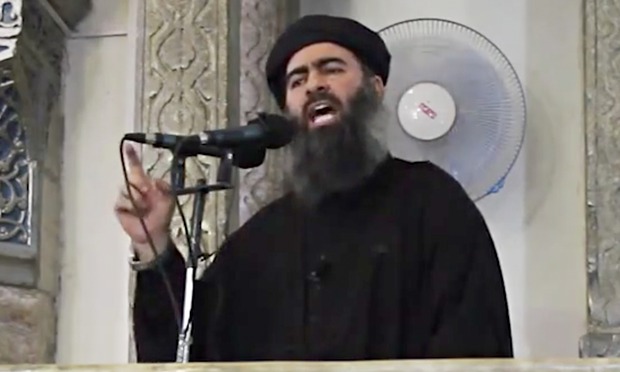
 ABU BAKER AL-BAGDADI.

In Anbar, the ISIL occupied al-Ramadi, its capital, where the Iraqi army went out, here also, at the disbandment, in an unforeseen and accelerated retrograde march. Los iraquíes culparon de sus desventuras operativas a una gran tormenta de arena, que facilitó la “marcha al combate” de los muyahidines del DAESH. And he threatens the western flank of Baghdad, which says to be training and concentrating forces to recover her, departing from the new base in Taqaddum, at 25 km from al-Ramadi, where are a reinforce of 450 new American soldiers of the four stars American general James Terry. Which acts as a bolt, a ground perpendicular obstruction, against the projection of the ISIL over Baghdad.

The Islamic State has now three great operational areas.

The first great zone includes all the south of the Caliphate, from Aleppo’s south-east up to al-Ramadi, following the course of the high Euphrates. In her, the ISIL is spreading and being consolidated, occupying Palmyra city, finishing the expelling of the National Syrian Army from Dar-ez-Zour’s province (his last troops in her are surrounded at the west of the capital) and the Iraqi soldiers and the Shiites militias from Anbar’s province. At the west of Palmyra are Tiyas and the military airports of the Shayrat, occupied by the NSA, which are vulnerable targets for the ISIL, capable of attacking them from two marching directions. With it, a western defensive flank, directed to Damascus, might be established.

In the north of Iraq, the ISIL keeps his positions in Nínive’s province and part of Saladin’s province, so being consolidated also in the high Tigris.

In Syria, at Aleppo’s north and north-east, along around 400 Kms. of the border with Turkey, up to Hasaka’s frontier province, the ISIL keeps a strategic base, using small offensives and tactical retreats, in a zone of great operational instability. Trying to debilitate the Front al-Nusrah (near the frontier Azaz), the Syrian peshmergas (in Kobani) and other opponents groups and to keep open the narrow frontier sectors, Ras al-Ayn, between others, where he realizes his exchanges of crude oil and derivatives, seized goods, armaments and new supporters. Also he wants to stop the offensive of the opposition in Aleppo, since the ISIL does not have now free means to exploit any destabilization in Aleppo, that would be produced this way. But in Hasaka he wants to be consolidated, to increase his geographical continuity, to protect his frontier passages with Iraq and Turkey, here is Tel Abyad, and to increase his strategic rear, reinforcing this way the Palmyra’s projection over Damascus.

 AN EXECUTION IN PALMIRA.

Turkey, which wants to keep in his south border a difficult military politic balance of power, suspects so much of the (Syrian) Kurds of the YPG and of the ISIL, both approaching in force to his territory. And Erdogan is considering to establish a safety zone of 10 Km. in depth in Syrian territory from the common border, occupying her with around 12 thousand Turkish soldiers. From her, the Turks might also partially control other more 25 or 30 Km. in depth, using his heavy artillery. It is a thorny and controversial topic, of international indefinite transcendence, so the command of the Turkish AA.FF. has asked Erdogan for a formal wrote order, that the President still has not granted.

The air bombardments of the Coalition of the 60 nations, assigned to the Operation «Inherent Resolve», erode and cause casualties to the Islamic State during almost one year. But they do not stop his military principal operations of fixation of his enemies and of increasing the territory of the Islamic State. At less that the western countries, including the USA, the NATO and the European Union, in any degree and practical necessary national combination, are ready and resolve to put on the Syrian and/or Iraqi territories a “sufficient investment of their own soldiers”, in the form of combined ground forces, distributed in the combinations adapted for the tasks that they will assume, the ISIL will not be beaten by his enemies of these Arabic infected countries. And it seems that the ISIL will possible be indefinitely defend from his frontier enemies. In the air raids in Syria take part Arabia, the USA, Bahrain, Canada, the Arab United Emirates and Jordan. In Iraq, asking for the authorities permission attack Australia, Belgium, Denmark, the USA and Great Britain.

The Geographical Scene of the Islamic State (ISIL).

This organization acts in a diffuse, not occupied, but controlled strip, of 300 thousand Km2., that spreads over Iraq and Syria, from Baghdad up to Aleppo and the mountains of the center west of Syria. The width changes along the route. The pillaged territory begins in Faluya, at 60 km to the west of Baghdad, and includes the nearby cities of Habbaniya and al-Ramadi and and Anbar’s extensive and desert province. And, following the Euphrates towards the northwest, it reaches the riverside cities of Haditha and Âna, before penetrating in Syria by Abu Kemal, leaving behind Níniveh and part of Saladin provinces. In the middle of the south and eastern desert of Syria, only relieved by the river, is Dayr al-Zawr. And continuing by the river, we come first to Raqqa, close to the river mouth of the river Belikh in the Euphrates. And then to the artificial lake al-Assad in the great meander of the Euphrates, to continue up to Aleppo and the Kurdish mountains of the center west, in the border with Turkey. Up to 10 million persons might be controlled by the ISIL in this territory.

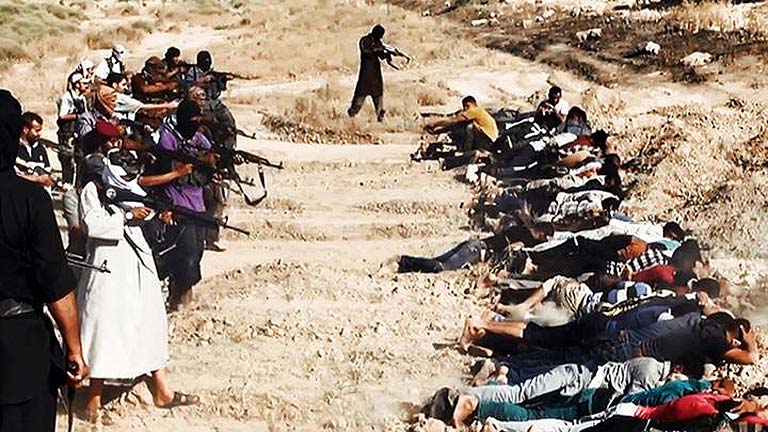
EXECUTIONS OF ENEMIES OF THE DAESH

It is not easy to move by these lands, which are infertile, beyond the irrigations of the Euphrates and of the artificial lake of al-Assad, without leaving a «tactical fingerprint» of the march. The lands of this great strip lack concealments and natural covers, in the shape of forests, extensive bushes and mountains. This does that the most frequent refuges and stays for the yihadists groups are the villages and populations along his backbone: the Euphrates, his aluentes, as the Jaipur in Hanaka’s province, and his banks. For his defense and more lasting cover they have to disperse by them, forming one or several «muyahidins squads» of not more than 40 men each one.

Operational decisive possibilities.

In any case, the fight in the occupied territories by the Islamic State is an urban fight. It is not an area for a movements warfare. It was so in June, 2014, when the Islamic State spread out, uncontrollably and overwhelming, by the north and north-east of Iraq. And the 30 thousand Iraqi soldiers of the Niniveh and Saladin provinces, went out, afflicted and in stampede, towards Baghdad. Looking for protection and refuge between the walls of the gigantic city and his al-Sadr shii neighborhood, at the east of the Tigris (known as al-Sadr city). And it before the simple «march to the combat» of several hundreds muyahidins. Mounted in Toyotas pick-ups, half “roof opened”, without any armoured and armed with light cannons and heavy machine guns. Certainly, who does facilitate the always present Toyota vehicles to the muyahidines? Some neoconverted concessionaire to al-Bagdadi?

THEY LOVE TOYOTAS, WHOSE PAY IT?

The operational strategy of the irregular bands of the Islamic State centres on never let been got in combat by the Armies or other great forces in «lost in advance» combats. His technics and tactics are the constant and far-sighted mobility; the dispersion and the infiltration in the urban fight, going forward in a flexible and wearing out defense, with space cession; the small, dispersed and more or less simultaneous or sequential actions in an area; the flight by covered bounds; the fight with limited goals and in profitable temporaral conditions; the systematic giving up of positions, forcing the enemy to redeploy and to be prepared every time. They can win to the ISIL the necessary time to survive.

In the temporaral occupations of great populations, they extend his defensive positions beyond what it is necessary in the conventional defense. Covering this way a major surface. His «delaying points» are diffuse, secret and imperceptible to the strangers. It is necessary to enter the houses to detect perforated walls and to find alleys under a furniture or a carpet. The destruction that generates the vague heavy fire, reinforces his combat positions, surrounding them with debris that divide and impede the accesses of the enemy. Except when they are reached by one direct impact. The “resistance nests” have more importance in this fighting form. Because the occupation of the defense zone is more tenuous, they cannot strengthen too much the positions, the sights are more short and there exist numerous approximation routes. They depend on the delaying points, to which they return if they are invaded or destroyed. Numerous “alternative positions” exist. This “resistance structure” allows to deceive the enemy, who attacks and burst, on the forward limit of the defense position: about his real extension, the limits of the sectors that form her and the interest of the rebel commands in the defense of the zone; and manages to disperse the heavy fire of the attacker.