Weapons and Their Defense in the History. Third Part.

However, the Mongols flung upon it, Almost completely surrounding the camp and showering it with bombs and incendiary arrows, which burned the wagon trains and tents and frightened the beasts. They sowed chaos among their enemies and already shattered the Hungarians’ self-confidence.

Curiously (or not?), the Mongols still hadn’t completed or covered with any detachments the siege of the Hungarian wagon camp through the gorge leading into the heath. The Hungarian cavalry still with sufficient moral courage, formed a wedge to resist the charge; it was the last firm stand of the Hungarian army. However, most of them retreated through the «gap» in the siege, fleeing in small groups toward what they believed would be their salvation. And, truly falling into a deadly trap, which extended along the entire route of their flight to Pest.

The Mongol light cavalry, taking no risks, softened up the knight’s desperate wedge-shaped deployment from a distance with their bows and arrows, and then, seizing their opportunity, the heavy cavalry charged to crush them.

Numerous Mongol light detachments, in turn, set out in pursuit of the fugitives. One group pressed them directly from the rear, increasing their commotion, chaos, and fear. Meanwhile, other detachments carried out the «overwhelming pursuit,» catching up with them from the sides and spearing them or shooting arrows them from their mounts.

The remains of the Hungarians, their horses, equipment, and baggage were scattered along the road back to Pest for 50 kilometers. More than 70,000 Hungarian cavalry and auxiliaries perished on the battlefield, in the temporary encampment, and in the flight to the southwest.

After the Battle of the Sakh, Hungarian resistance collapsed.

The Mongols then attacked Pest and burned it. But they did not dare to cross to the west side of the Danube, exploiting their success, despite the moral and numerical superiority they enjoyed at the time. Batu and Subodai rested their army and consolidated their positions east of the great river. More than half a year passed, the main event being a half-hearted declaration of a crusade against them by the Pope, which achieved little in practice.

In December 1241, the Danube froze in this large region. The Mongols took advantage of the situation to sack Buda, reconnoissance in force in Austria, and sent a detachment south toward Zagreb in pursuit of King Béla. On the 25th, they assaulted Gran, the Hungarian capital and seat of its archbishopric, taking with them everything valuable and antique they could.

A portentous end for Europe.

Central andWestern Europe were ripe for a Mongol invasion. The Europeans lacked an army capable of confronting this threat, which was already breathing down their necks. The strategic plan Subodai explained to the Khan and his generals seemed to be faithfully carried out down to its final stages. But this was now merely an illusion, an impossibility. An «appearance,» as Sun Tzu would say.

OGEDEI GREAT KHAN

On December 11, 1241, they had received at Batu and Subodai‘s headquarters an escorted messenger from Karakorum, the Mongol capital. He brought news that Ogedai, the Great Khan, had died and that his widow was acting as regent until a new Mongol emperor was elected and ascended the throne. The Mongol princes present in the camps were eager to assert their rights to the succession and decided to return to their capital, taking the imperial tumans with them. Batu knew that without these elite troops, he could not hold Hungary, but he believed that with the Turkmen recruits, who were already experienced and had seen combat, he could retain most of his territories.

Thus, the Mongols evacuated Hungary, unhindered, harassed, or pursued by their enemies. Although they left behind the land that had been theirs devastated. This was a symbol of their idiosyncrasy and plundering nature, a land bandit and absolute predator. And they lacked the slightest capacity to create, maintain, develop, extend, and bequeath to their successors a civilization worthy of the name. And they could leave them only the accumulated results of their atrocities, bonds, tributes, plunder, and loot, and the military lessons to obtain them.

Sarai, capital of the subsidiary Empire of the Golden Horde.

Batu returned to his original base camp, in Sarai, near the Volga and barely 100 km north of Astrakhan. And there he established a subsidiary Mongol empire, which became known as the Golden Horde.

The Mongols would have no other opportunity to invade Europe. After this aberrant nightmare suffered by the Europeans, they invented all kinds of stories and myths, in which they recounted how they had defeated the «Tatar» invaders (as the Mongols were generally known in Europe) and forced them to return to their lands.

This unthinkable, sudden, and portentous result, occurring in the last possible moments… Was it a work of the Fate and Karma of Europe and its privileged Civilization? Or was it the result of Divine Intervention through the intercession of the Virgin Mary?

Of course, it was, humanly speaking, an excessive and incredible coincidence. But faith can never provide «evidence» either, because it would cease to be evidence and become verifiable reality. The effective Divine Intervention, in favor of Europe and its civilization, which without Christianity acting from its core would never resemble what it was and what it is, is likely, because It is never thunderous or overwhelming.

OGEDEI, LORD OF ASIA AND SUCCESOR OF GENGHIS KAN

God did not visit Elijah in a lightning storm or a hurricane, but in a gentle, soft breeze. And, for esotericists and syncretists, the explanation could be «a cosmic action of astral and Akashic forces, in favor of Light, Peace, and Human Civilization toward higher levels of Universal Consciousness.»

There is also a common «rational» explanation for what happened, but it cannot pinpoint the moment for this opportune withdrawal. The Mongols and associated Central Asian tribes were creating a Eurasian empire in the first half of the 13th century. But their material capabilities and ideological and religious resources were not adequate for such an important objective.

As we have seen, they had nothing satisfactory or lasting to offer the peoples of the occupied countries. The Mongols were kept in these foreign lands by the threat of known terror. As with other tyrants who sought to become «global,» their necessary collaborators were ethnically or ideologically similar. But the Mongol ethnic group and its ilk were demographically insignificant, for allowing them to monitor and defend themselves alone. All of this, in the decades since the invasion of Eastern Europe, had strained their military capabilities to the breaking point.

Thus, sooner rather than later, the Mongols would have had to undertake this general retrograde march to secure and consolidate their lands in Eastern Eurasia. They would have distanced themselves from contact with dynamic, ideological, and expansive civilizations, such as Europe, with which their relations of neighborliness and early exchanges of merchants, explorers, and adventurers would have been resolved through military confrontation.

(to be continued)

Weapons and Their Defense in the History. Second Part.

The Mongols Armies.

The Mongol Army’s cavalry was divided into light and heavy cavalry.

Their most distinctive weapon, used by all cavalry, was the S-shaped composite bow, which, properly drawn, could launch an arrow over 300 meters away. Its length made it useful for shooting from a mount.

The Mongols were herders, and their occupation gave them a lot of free time. This allowed them to amuse themselves by shooting the composite bow, thereby achieving great skill in its shooting and use and, very importantly, maintaining it over time.

Light cavalry was intended to harass the enemy in formation, send patrols ahead of their main body to gather intelligence, and pursue and finish off the defeated enemy as they fled.

Heavy cavalry struck the enemy in the clash; care was taken to ensure that the enemy was tired, dispersed, or in the minority.

The Mongols did not have a sufficient siege formation. They defeated the entrenched enemy with lures and tricks. And, by offering them a much-desired advantage, they trapped them.

Development.

In 1241, some 100,000 Mongols crossed the Polish-Ukrainian border to attack Hungary. A detachment of 20,000 men, two Mongol tumans or divisions, under the command of Princes Baidar and Kadan, will be tasked with ensuring that the Hungarians receive no reinforcements from Poland, Germany, or Bohemia.

To this end, they defeat the concentrations of forces from those countries at Chmielnik, about 18 km from Krakow. They lure the enemy into pursuit without prior combat, into an ambush, appearing to the enemy as a raiding party retreating to its base.

And, at Liegnitz, about 60 km west of Breslau, they employ a mangudai to deceive them. It consisted that a Mongol army «corps,» inferior to the enemy, seriously engaging in the fight with them. Its size was large enough to make the Mongol effort considered significant. This would mentally lure the enemy away from any other thoughts or possibilities. After a fierce battle, the sheer weight of the enemy forced the Mongol corps to retreat.

Batu crosses the Sakh with 40,000 men via the Stone Bridge

What had been a tactical retreat, never truly disorderly, was mistaken by its enemies as an exploitable defeat. Its complete and permanent ignorance of the Mongol enemy left it unaware of anything. And its desire for victory, heightened by the genuine effort exerted in the initial engagement, prevented it from seeing beyond its reach.

The relentless, full-throttle pursuit eventually dispersed the tight, solid formations of the European nobles. At one point during the pursuit, always far from the waiting enemy forces, the bulk of the Mongol heavy cavalry emerged, hidden, fresh, and launched into the clash. It ultimately broke up the disjointed cavalry groups into which the European pursuers had dispersed.

After a genuine hunt, the European forces remaining in the initial positions of the battle either dispersed as well or were in turn attacked by the entire Mongol force.

By then, in less than a month of operations, 20,000 Mongols (at the outset) had advanced some 650 km into enemy territory and won two decisive battles.

Poland was battered and shaken, and the Germans west of the Oder River were retreating and preparing to defend their kingdoms. The Bohemians, still intact, were some 400 km from the first Hungarian defensive positions on the Danube; therefore, their army was operationally ineffective in achieving the resolution against the Mongol attack on Hungary.

To ascertain the Germans’ «intent,» the Mongols staged a demonstration westward into Germany. King Wenceslas pursued them. At a certain point, the two tumans (-) split into small, elusive detachments. And, forming a cloud almost invisible to the enemy, they slipped past both sides of the Bohemian army and retreated eastward.

Recreation General Subodai Bahadur

In their retreat to join the main Mongol army (80,000 men), commanded by Subudai Bahadur, the Khan’s deputy, the Mongols crossed Moravia, ravaging its villages, warehouses, and fields. They thus created a vast desert wasteland, which would further protect Subudai‘s right flank by rendering those Moravian lands incapable of sustaining a passing army for any length of time.

The remnants of Princes Baidar and Kadan‘s forces managed to join Subudai‘s forces and continue to participate in his campaign.

General Subudai had devised and presented the invasion and attack plan to the Khan and his generals, and had been placed in command of the forces to carry it out.

Subudai concentrated his army in three marching groups. Each would enter Hungary by a different route, through the passes and valleys of the Carpathian Mountains. This deployment provided the Mongols with protection from enemy surprises and gave them an initial deployment, preparatory to the maneuvers of their three mobile corps. The Hungarians, for their part, did not dare attack any of them, for fear of the other corps advancing on their operational rear or capturing some of their cities.

On April 3, Subudai formed his three mobile attack columns opposite Pest, on the east bank of the Danube. There stood King Béla of Hungary with his army of 100,000 men. Across the river, linked by bridges, lay Buda.

Having also deployed a tuman to Transylvania to ensure that the Christians did not receive reinforcements from Romania, the Mongols now numbered about 70,000 (plus) men. And the more time Subudai took in his calculations, decisions, and preparations, the more time other European rulers would have to make up their minds and come to support king Béla.

The Mongol general applied one of his combat stratagems on a strategic scale: his army retreated east. Using «reasoning,» the Hungarian commanders assumed that the Mongols did not dare to fight against their more powerful army. And, spurred on by their inaction in the face of the unhindered advance of the three Mongol columns, they demanded the King Bela to begin their pursuit. The Hungarians did not appreciate that Subudai was luring them away, from the protection of the Danube and the support of detachments and corps of the Hungarian army.

King Béla IV of Hungary.

King Béla, commanding the vast majority of his army, led the pursuit against the Mongols. The Mongol retreat was deliberately slow. It took them six days to reach the Sakho River, about 160 km northeast of Buda and Pest.

West of the river and on the plain opposite Mohi, the main town in the area, Prince Batu and Sabudai decided to confront their «pursuers.» On April 9, the Mongols crossed a wide gorge, advanced through a heath, crossed a Stone Bridge, and continued some 16 km to the thickets west of the Tokay hills and vineyards. There, they had numerous places to camouflage and hide.

Prince Batu, founder of the Golden Horde

The Hungarian army, pursuing them head-on, encamped in the heath, arranging their wagons in a circle, where they set up their tents, equipment, and horses. To the right of the temporary camp were the swamps along the banks of the Tisza River, to their front lay the Sakho Heath, and to their left were forests and small hills.

At dawn on Wednesday, April 10, 1241, Batu and around 40,000 men advanced toward the stone bridge from its eastern side. The Hungarians defended it vigorously, until they were forced to retreat due to the «fire bombs» launched by the Mongol catapults, as they were on a very narrow front.

We are now seeing, quite clearly, how the opposing rivals are assuming the roles of winner and loser. And that this situation continues until the very end. These are some of the «signs» that announce and precede the final results of the war dialectic.

The Mongols crossed to the western side of the Sakh, but for more than two hours, they were terribly pressed by the Hungarian charges, and only the fire of their archers allowed them to briefly reestablish their defensive line. Little by little, the Hungarian army deployed to eliminate the Mongol bridgehead over the Sakh.

Suddenly, General Subodai, who had also crossed to the western side via a makeshift bridge built downstream of the Sakh, while the Hungarians were distracted by the threat of the Mongol bridgehead, appeared with around 30,000 Mongols in the Hungarian rearguard.

Beaten and stunned, but with the courage and experience to avoid panic, the Hungarians retreated in good order to their nearby camp.

(To be Continued)

Weapons and their Defenses in the History. First Part.

Introduction.

Throughout history, supposed war rivals have perfected their weapons, Techniques, and Tactics to defeat an enemy who violently opposes the achievement of their objectives.

In the Beginning,

The strongman appeared with a large stick or club, coming after his neighboring rival. At one point, the latter, who was practically a weakling, hid in a bush by the side of the road. When the strongman passed by, confident and well-equipped, he waited for him to leave his back free and attacked him on an unprotected «essential vulnerability.» The «big man» fell lifeless to the ground. History doesn’t say what happened to the two characters in the fable.

When the number of members of the two factions increased enormously, they instinctively sought to group together, so they could attack and defend themselves much better.

At first, there was a relatively large group, and soon the focus was on organizing and utilizing the group. And the phalanx was born, a wall of twelve or sixteen ranks of men armed with long spears or pikes, extending several ranks ahead, well-trained in their combined handling at close range. They were protected by a large shield and pieces of metal or heavy leather on the chest, head (helmet), arms, and legs.

In ancient Greece, the Spartans refined the tactical instrument of the phalanx to the fullest.

No one was as trained and protected as they were. And their society accepted and honored their militari ethos, embodied in the phalanx. Spartan mothers would tell their sons, phalangist hoplites, to «return with the shield or on the shield.» There was no quartermaster or medical care, properly speaking. And mothers instilled in their sons the warrior social mentality of their society.

THE IMPRESSIVE PHALANX

But, behold, the right wing of the phalanx was less protected than the left. This was due to the way the men naturally protected their left flanks with their shields.

And at Leuctra, around 344 BC, Sparta, with a majority of its forces (10,000 men), set out to crush Thebes (6,000 men). Unaware that its phalanx model had changed,

Epaminondas and his pair, Pelopidas, had introduced the «oblique order» into their Theban phalanx. On their left wing, they deployed a greater number of forces, and the best of them. Among them, a phalanx formed by homosexual couples, which they called the «Sacred Band

They also refused to employ their center and right wings, as is typical of the oblique order. Perhaps the heightened sensitivity of homosexuals, which is said to be present in the Theban homosexual leaders, may have influenced their sharpness and refinement.

On the Spartan right wing was the commander of all their forces. This was thus the «core of their resistance.» And this was battered and beaten by the Theban forces on their left wing. And then appeared the «Caedes,» the slaughter and the finish of the vanquished.

From afar, the Spartans on their center and left were also affected by the defeat and the damage to the hoplites on their right wing. And they began to retreat, without having been defeated by weapons.

A year after Leuctra, Epaminondas was touring the Peloponnese peninsula, commanding forces of the newly formed Arcadian League. And he appeared in front of the city of Sparta, within whose sight, it was said, enemy forces had never appeared.

Phalanxes were too large to be able to move freely and quickly against the enemy. They acted as a «dam» of Force against Force, where surprise, skill, and flexibility could not exist. Another characteristic of their technical rigidity is that they had to fight on flat terrain, at least without undulations or obstacles such as rocky outcrops or patches of trees and bushes, which broke their structural continuity.

Rome meets the Greek phalanxes.

The Romans had a military structure based on the legion, as a large operational unit, of about 5,000 men. The legions were made up of maniples or, much later, cohorts, small tactical units capable of moving and maneuvering on the battlefield, gaining the flexibility, skill, and surprise that phalanxes lacked. And their centurions, one to the right and one to the left of the first row of the maniple, and their officers were capable of leading them individually.

At the Battle of Pydna, in June 168 BC, a battle took place between the Romans led by Aemilius Paullus and the Macedonian Perseus. The Macedonian phalanx vigorously attacked the Roman formation of two legions and forced it back toward the fortified Roman camp. However, the terrain was uneven and somewhat rocky, and as it advanced, the phalanx lost its solidity and integrity.

A MOMENT AND A PLACE OF THE BATTLE OF PIDNA.

Seeing this, Paulus gave orders to the maniples (centurions) to act independently on the enemy phalanx. The centurions then took command. The maniples advanced and began to take advantage of the smallest gap in the enemy’s pseudo-compact formation to introduce their men there.

They began wreaking havoc with their gladius (somewhat short Roman swords, prepared for close combat) on the defenseless flanks of the Macedonian hoplites, armed with long pikes.

Soon, Aemilius Paullus launched the Second Legion against the center of the enemy line. It shuddered and finally gave way. The Greek spearmen were now nothing more than a hindrance, both in fighting and defending. The Roman legionaries vigorously launched themselves into the attack. And then came the Caedes, the massacre, the collapse of the formation into a shapeless mass, terrified and fleeing individually.

When the sun set, Paulus halted exploiting his success. The death toll showed one hundred Romans and twenty thousand Macedonians had finally fallen.

The Mongols threaten Central and Eastern Europe.

At the beginning of the 13th century, the Mongols, nomadic tribes from the interior of Asia, who dominated mounted combat and had a very elaborate and simple military organization, appeared for the first time on the borders of eastern Europe.

Their logistics were simple and involved supplying on the ground they trod, following the broad pastures as they advanced, each rider carrying several mounts with him.

The Mongols started from their strategic zone, defined by the «advance and location» of their nomadic settlements, their yurts or nomadic houses, pulled by oxen, never observed or suspected by their enemies, and reached the tactical zone with them. Their operations did not require the physical and mental support of the operational zone, the transition for the forces and their support between the strategic and tactical zones.

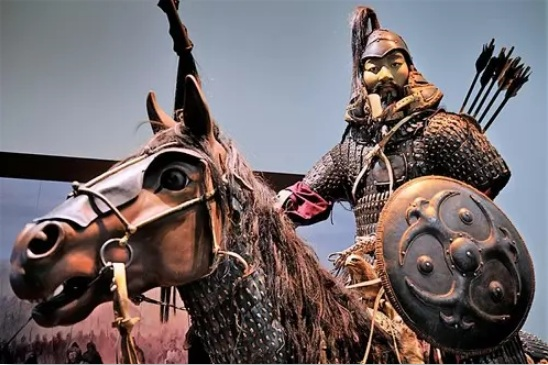
A RECREATION OF SUBUDAI BAHADUR, THE GREATEST MONGOLIAN STRATEGIST.

In front of the discontinuous front of their enemy positions (cities), there is a wide, unprotected, and empty area, uncontrolled by anyone, which the Mongols make the most of for their operational approach. Their enemies, the feudal heavy cavalry forces and their infantry spearmen and archers, maintain nothing resembling advanced detachments, which make mobility reconnaissance and repel the Mongol advance parties of reconnaissance and combat.

The Mongols’ concern toward the enemy was generally strategic, considering their «exposed flanks» at the level of the «occupied» countries. This concern stemmed from their always small numbers for the objectives entrusted or sought.

And from the real tactical no invincibility of their forces, if they encountered an organized, skilled, and, above all, calm enemy.

In 1221, after conquering the Muslim Empire of Samarkand, located between the Syr Darya and Amur Darya rivers, Genghis Khan systematically plundered Afghanistan. His son Tilui slaughtered most of the inhabitants of northern Persia. With no possible live enemies on their strategic flank, they protected the southern flank of the Mongol Empire.

(To be continued)

THE ART OF WAR OF GENGHIS KHAN. 2nd Part.

(Continuation)

The positional Dislocation of the Enemy.

Genghis and his army marched safely, crossing more than 500 km of the seemingly impenetrable Kizil Kum desert. And at the beginning of April 1220, Genghis Khan unexpectedly appeared in the city of Bukhara, some 500 km inside Transoxian territory, near the Amur Daria river.

Without having yet fought a major battle, the numerically inferior Mongol army had positionally dislocated the bulk of the Turkmen army and cut Mohamed II‘s line of connection with his western provinces, where many Turkish forces still remained immobilized for this war.

Idealized description of Lieutenant Subidai Bahadur

A “shock wave” swept through the Kharizmi field army, overwhelming it. Mohamed‘s troops remained in the various fortified positions and cities they occupied, defending them, but with a broken spirit. The operational unity of the forces, which is required for successive tactical battles to have significance, had disappeared. It was in the hands of the Great Khan to go waging the necessary combats to liquidate, as would happen in an «imaginary encirclement«, limited by the Sir Darya to the east, by its imposing and unexpected presence to the west, by the desert to the north and south, to the different enemy tactical groups in Transoxiana, already disjointed and disappointed.

Xenophon had already pointed out: “Whatever happens, pleasant or terrible, the less it has been foreseen, the greater joy or terror it causes. This is nowhere better seen than in war, where any surprise strikes terror into even the bravest.»

Mongolian combat idealization

Let’s see some passages from «My Reflections on the Art of War» by Marshal Mauritiusof Saxony, published posthumously in 1757. In them, a deep insight into tactics and human motivations is evident, greater than in any other work by a European author. since the Romans.

“Men always fear the consequences of danger more than the danger itself. I can give a multitude of examples. Suppose that column storms an entrenchment and its point reaches the edge of the ditch. If a handful of men (from the entrenched side) appear a hundred paces outside the entrenchment, it is certain that the head of the column will stop, or that it will not be followed by the elements of the ranks further back. Why? The reason must be sought in the human heart. In turn, let 10 men climb over the breastworks and everyone behind will flee and entire battalions will abandon their defending position”.

“When one has to defend entrenchments, all the battalions must be placed behind the breastworks, because if the enemy manages to gain a foothold on them, those battalions a little further back will think only of saving their lives. This is a general rule of war, which decides all battles and all actions. She is born in the heart of man and is what has led me to write this work. I do not believe that up to now nobody has tried to investigate the reasons for the lack of success of some armies”.

The Caedes.

Genghis and Subidai left one of the Bukhara gates uncovered. With this they sought to attract a large part of the garrison outside the city, to fight in the open field. Most of the garrison, made up of about 20,000 men, went outside, pretending that they were going to face the Mongols. But they really escaped to the southwest. The next day they were blocked on the Amur Daria and the Mongols overtook and destroyed them.

The rest of the Turkish forces locked themselves in the citadel, while the inhabitants surrendered the city. The Mongols advanced thousands of civilians ahead of them on the citadel and soon took it. During all the fighting, a large part of Bukhara burned and finally Genghis Khan ordered the demolition of its walls.

The aforementioned 3 Mongol armies then quickly converged on Samarkand, while Mohamed fled to the western confines of his empire. Some 50,000 men from the garrison of the capital went out to meet the Mongols and were isolated from it, which was left unprotected. And finally they were surrounded and massacred by the Mongols, who did not accept their requests to desert and join the forces of Genghis Khan, since he said that «whoever betrayed once, could do it again.»

Samarkand was inexorably at the mercy of the Great Khan, who took only 6 days to occupy it. Its remaining 20,000 defenders concentrated on the citadel, leaving all its inhabitants defenseless against Mongol looting. One night a group of about a thousand Turks slipped out and managed to flee. The Mongols soon stormed the citadel and killed the rest of the garrison.

After this, the fall of Transoxiana and the territory of Khorrasan (north of Persia) precipitated, without major combat, into the hands of Genghis Khan and with it hundreds of thousands of km2 of a great Islamic empire. This only survived until the year 1231, after its new defeat at the hands of the Seljuk Turks on its western borders.

A Mongolian special force under the command of Subidai went after Mohamed, who, abandoned by everyone, had become a fugitive and an outlaw. In January 1221 the Shah died of pleurisy on an island in the Caspian Sea, without the Mongols having been able to capture him.

Summary of the campaign and results.

In a rapid campaign of almost a year, the Mongols managed to defeat without great losses a seasoned army, which mobilized against them at least double the number of men, but which remained expectant in a static defense.

Employing a brilliant operational strategy, alternating their tireless capacity for operational movement with their proven and irresistible combat capacity and their terrifying techniques of consummate predator, Genghis Khan and his men maintained the initiative and freedom of action. Thus, they deceived their enemies about their plans, discovered their vulnerabilities and went eagerly for them. And dislocated enemy deployments, before attacking them or rendering them irrelevant and surrendering them.

(The End)

THE ART OF WAR OF GENGHIS KHAN

Introduction.

The conquest by the Mongols between 1219 and 1220 of the Islamic Empire of Kharizm (or Khuarezm), in Turkestan, will serve as a model to present its operational and tactical characteristics. The rapid defeat of the Muslims at the hands of Genghis Khan and his men is an example of the synergistic use of the operational movement capability and combat capability of a highly efficient military system.

Frictions between neighbors.

The Kharizm empire was very recent. While Genghis Khan conquered Central Asia, up to his borders, Shah Mohamed II extended his domain to the south and east. He had inherited the territory of modern Iran (Persia), but had also added Afghanistan, almost to the Indus River, and had reached the Sir Darya, occupying all of Transoxiana.

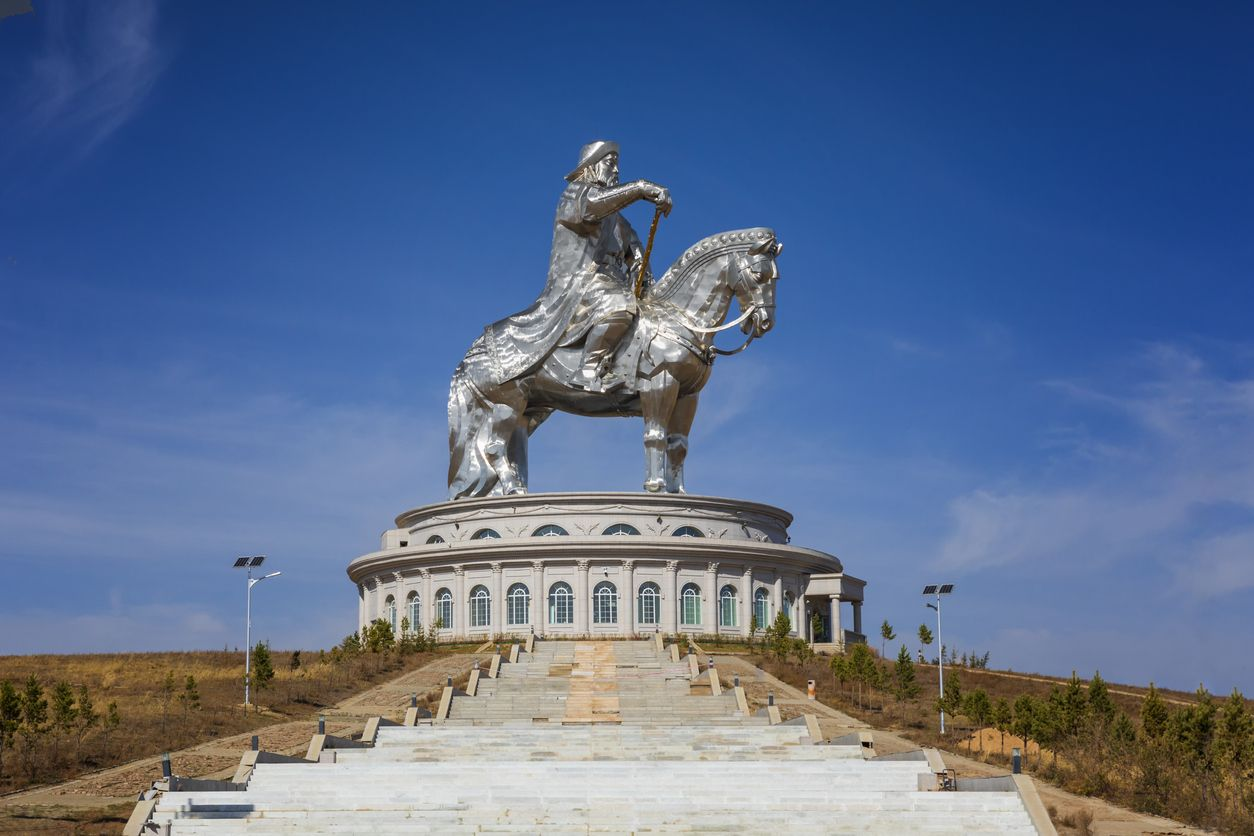
Large Equestrian Statue of Genghis Khan near Dadal, his birthplace, Mongolia

The entire confrontation between the two empires began when Inalchik, the governor of the city of Otrar, on the Sir Daria river, about 200 km from the Aral Sea, stopped a caravan of merchants sponsored by the Great Khan and executed their chiefs, accusing them of spies. And possibly he was right, but that was very undiplomatic and damaged a very sensitive issue in the usual customs between states and hierarchs. Genghis Khan sent an embassy to the Shah, made up of a Kharizmi and 2 Mongols, requesting a punishment for Inalchik. Muhammad executed the Kharizmi and returned the 2 Mongols to Genghis, their heads completely shaved, a serious personal insult to those warriors. War was already inevitable.

Force preparations.

Genghis Khan prepared his army for a march of more than 1,500 km, from his Tien San mountains to the borders of Transoxiana.

The Mongolian army at the time numbered just over 100,000 men. His basic tactical-operational unit was the tuman or division, with about 10,000 men, divided into 10 mingans or regiments. The great army was divided into three parts: the army on the left or the east, the one on the right or the west, and the one in the center. The first two had a highly variable number of men, depending on operational and tactical needs; for example, one could have double the number of men than another. The army in the center was much smaller, made up of elite units and the guards of the Khan and the various Mongol princes; in them their basic unit was the mingan. A Mongol army corps consisted of one or two tumans.

Dead of Mohamed II of Kharizm

Mohamed II assembled a large, well-armed and equipped army, totaling between 200 and 300,000 men (some authors speak of up to 400,000 men, clearly exaggerating), to defend his empire from the expected Mongol invasion from the east. Many of his men were also horsemen from the Turkestan steppes, who were equipped and fought in a similar way to the Mongols. The Shah was sure that his soldiers could stop and repel the invader.

To this end he deployed most of the troops along the Sir Darya, his great natural barrier to the east, and established a fortified line of communications from his army’s deployment to his capital at Samarkand. Lastly, to the north of the empire and protecting it, between the Aral Sea and the Sir Darya stretched the formidable natural obstacle of the Kizil Kum desert, in the Turanian depression, hard and dry where they exist.

Thus, reassured with a good plan, he defensively hoped that he could defeat the Mongols in a major battle, by sheer numerical strength of his army. But, it was von Moltke, the old man, head of the German HHQQ. in the late 19th century, who said that «plans used to last until first contact with the enemy.»

Development of operations.

During the spring and summer of 1219 a Mongol army corps under Jochi, the eldest of Genghis’s sons, ravaged the land west of the great Lake Balkhash, near Otrar, leaving a landscape so devastated that it it was incapable of supporting an army without its own supplies.

Jebe Noyan.

According to the campaign plan drawn up by the orlok or lieutenant of the Khan, Subidai Bahadur, a Mongol army corps headed in the early 1220s towards the valley of the Fergana River, south of the Sir Darya, on the exposed flank of the Turkmen deployment, to carry out a force reconnaissance. It was commanded by Jebe Noyan, one of the Khan’s best orloks.

Part of the Turkish forces, under the command of Mohamed and Prince Jalal-ad-Din, advanced slowly to the east, over the valley. When the vanguards met, Mohamed vastly outnumbered the Mongols and ordered to form up for combat. Caught in narrow terrain, which did not favor his cavalry force, Jebe decided to attack anyway. The Mongols charged the Turks ferociously, inflicting heavy casualties on them. They counterattacked, trying to involve them up and almost succeeded. But the Mongols managed to break contact and escaped to the east.

Most decisive operations for success.

In February 1220, the 3 Mongol armies, under the command of Genghis, Jochi and Ogedei and Chagatai, two of his other sons, crossed the area previously devastated by Jochi and unexpectedly converged on Otrar, on the left flank of the defensive line of Sir Daria. After the assault on the city, the Mongols captured the governor Inalchik and executed him very cruelly.

The two armies commanded by Jochi and the other 2 brothers then headed south, following the Sir Daria, and began to harass during their march the fortified positions of the Turks along their planned great defensive line. Simultaneously, the army corps of the orlok Jebe Noyan, turned north, took the city of Kokand, in the upper Sir Daria, and headed to meet the 2 Mongol armies.

All these offensive operations helped to fix Mohamed’s attention on his fortified defensive line of Sir Daria. In the south, he had won the battle and repelled the invader, and in the north, although the Mongols had taken Otrar, they had not penetrated Transoxiana. The Turkish army maintained its boast of invincibility. Mohamed brought all of his operational reserves closer to Sir Daria. However, although in both cases the Mongols had suffered heavy casualties, their ratio to them was of great concern to the Turks.

For its part, after the capture of Otrar, the army under the command of Genghis Khan, with Subidai as his chief of staff, and made up of 4 tumans, headed north. There he took the Turkmen city of Zarnuk, with the sole purpose of capturing a man who, according to his informants, knew of a practicable path through the Kizyl Kum, following a chain of oases.

Then the Mongols delivered their decisive blow.

(TO BE CONTINUED)

THE MONGOLS INVADE EASTERN EUROPE (1238-1241). 2nd. PART.

(CONTINUATION)


The Mongol Army Attacks Hungary.

Subodai concentrated his army in 3 groups of march. Each one would enter Hungary by a different route, across the mountain passes and valleys of the Carpathians. This deployment was given to the Mongols more resistance to the enemy surprises. And gave them an initial unfolding for the maneuvers of their 3 mobile corps, facilitating them to face the enemy. The Hungarians, for their part, did not dare to attack any of them, for fear of an advance of the other corps on their rear or to occupy anyone of their cities. The central column, which was under the command of the prince Batu, crossed Ruske’s mountain pass on March 12 and continued his advance for the valley of the Tisza. His vanguard with combat capacity came to the Danube on the 15th and 2 days later the principal corps did it. The vanguard had realized a march of 290 km in 3 days, crossing an hostile area and still covered by high snow.

On April 3, Subodai formed his 3 columns in front to Pest, in the east bank of the Danube. In Pest the king Bela had assembled his army of 100 thousand men. At another side of the river, joined both cities by bridges, was Buda. Subodai knew they were overcome in number by the Hungarians. Having also detached a tumen in Transylvania the left column of march, to assure that the Christians were not receiving reinforcements from Romania, the Mongols were now 70 thousand. Also, it was very dangerous for them to force a crossing of the Danube at the sights of the Hungarian deployed army.

On the other hand, the more time Subodai was taking in his calculations, decisions and preparations, the more time was giving to other European leaders to decide and to come to support the king Bela. The Mongol general applied then at strategic scale one of his tactic stratagems: his army moved back towards the East. The Hungarian chiefs supposed that the Mongols were not daring to fight against their army. And, spurred by their stagnation before the not hindered advance of the Mongols 3 marching columns, asked to initiate his pursuit. The Hungarians did not notice that Subodai was attracting them out of the protection of the Danube and of the support between detachments and the army corps.

The king Bela, commanded the great majority of the army, directed the pursuit. The Mongol retreat was calculately slow. They took 6 days in reaching the Sajo river, at 160 km at the North-East of Buda and Pest. And, at the west of the river, near its mouth in the Tiszna and in the plain in front of Mohi, the principal city of the zone, Batu and Subodai decided to confront their «persecutors». On April 9, the Mongols crossed a broad gorge, advanced by a heath, crossed a stone bridge and continued 16 km up to the bushes placed at the west of the hills and vineyards of Tokay. In them, they had numerous places where to camouflage or to hide. In effect, when a Hungarian reconnoissance detachment followed them that evening and came up to Tokay’s west, it did not find absolutely nothing. The Hungarian army, who realized a frontal pursuit, encamped in the heath, arranging his cars, joined by chains and ropes, closing a circle, where installed his tents and mounts. At the right of the camp, were the marshes of the bank of the Tisza, at his front, the heath of the Sajo was spreading and forests and hills were covering his left side.

Resultado de imagen de BATTLE of buda and pest 1241 FIGHTING ON THE BRIDGE.

At dawn of Wednesday, the 10th of April, 1241, Batu and 40 thousand men threw towards the stone bridge by its east side. The Hungarians defended it with all energy, until they had to withdraw for the fire bombs of that the Mongols catapults threw them, on having been in a very narrow fighting sector. The Mongols went on to the west side, but during more than 2 hours, were terribly pressed by the Hungarians charges and only the shots of their archers briefly restored their defense line. Little by little, the Hungarian army deployed to liquidate the Mongol bridgehead. Suddenly, the general Subodai, who also had crossed to the west side by a circumstances bridge stretched downstream of the Sajo, while the Hungarians were distracting with the threat in the bridgehead, appeared with 30 thousand Mongols on the Hungarian rear. Struck and stunned, but with guts and experience not to fall down in the panic, the Hungarians moved back in good order to their camp. But the Mongols threw to it, surrounding almost totally the camp and covering it with incendiary bombs and arrows. Which were burning the load coaches and the tents and frightened away the beasts, spreading chaos between their enemies and undoing the autoconfidence of the Hungarians.

The Mongols prepared to throw a charge on the uncohesioned groups of the Hungarian army. But they continued without finishing to cover with any detachment, the siege to the camp by the access gorge to the heath. The Hungarian knights with enough moral courage yet formed a wedge, to resist the charge; it was the last firm resistance of the Hungarian army. But the majority of them moved back by the existing «gap» in the siege, fleeing in small groups towards what they were thinking that would be their salvation. And really falling down In a mortal trap, which was spreading over the whole route of their flight towards Pest.

The Mongol light cavalry, without risking anything, softened from a distant with his arrows the driven to despair deployment of the knights and, later, taking his opportunity, the heavy cavalry charged to squash them. Numerous Mongol light detachments went out in pursuit of the fled ones. A part them was pressing on their rear, to increase their commotion, their chaos and their fear. While, other detachments realized the overflowing pursuit, reaching them from the sides and spearing them or throwing their arrows to them with their small and most powerful compound arches, which shot from the mounts. Along 50 km, in the way of return to Pest, spread the remains of the Hungarians, their mounts and their equipments. More than 70 thousand Hungarians knights and auxiliary died in the battlefield, in the camp and in the escape towards the southwest. After the battle of the Sajo, the Hungarian resistance collapsed.

The Mongols immediately attacked Pest and burned it. But they did not dare to cross to the west side of the Danube in the exploitation of the success. In spite of the moral and numerical supremacies that they enjoyed in these moments. Batu and Subodai gave rest to their army and consolidated the positions at the east of the great river. And so more than half a year passed, where the principal related event was a slightly spirited declaration of Crusade against them from the Pope, of which it was obtained little in the practice. In December, 1241 the Danube froze in this great region.

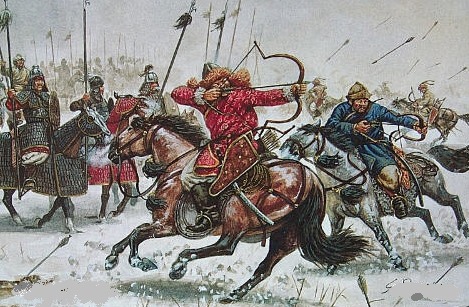
Resultado de imagen de king bela IV of hungary  MONGOL’S LIGHT AND HEAVY CAVALRIES.

The Mongols made good use of their time to plunder Buda, realized a reconnaissance in force in Austria and sent a detachment to the South, towards Zagreb, in pursuit of the king Bela. And on the 25th they assaulted Gran, the Hungarian capital and See of his archbishop, taking with them everything of value and antiquity they could.

A marvellous End for Europe. Who, What for?

Central and Western Europe were mature for a Mongol invasion. The Europeans did not have an army capable of facing this threat, which already was throwing them the breath in his napes. The strategic plan explained by Subodai to the Khan and to his generals seemed to be faithfully fulfilled up to his last parts. But, this was already only an illusion, the impossible one. An «appearance», which Sun Tzu would say. On December 11, 1241 they had received in the headquarters of Batu and Subodai an escorted messenger from Karakorum, the Mongol capital in the Eastern Asia. He was bringing the news that Ogadai, the Great Khan, had died and that his widow was acting as regent, until a new Mongol emperor was elected and promoting to the throne. The Mongol present princes were anxious to make worth their rights for the succession and decided to return to their capital, taking with them the imperial tumens.

Batu knew that without these select troops, he could not keep Hungary in his power. But he thought that with the Turkoman recruits, who already were experienced and taken part in combats, he might keep most of his territories. This way, the Mongols evacuated Hungary, without being hindered, harassed or pusued by their enemies. Though behind they left the land that was theirs. This was a symbol of their idiosyncrasy and exploiter character up to the extinguishment, land bandit and absolute predator. And without the minor aptitude to create, to keep, to develop, to extend and bequeath his successors, a civilization that was deserving this name. And not only to leave them the accumulated results of his outrages, bails, taxes, plunders and booties and the military educations to obtain them.

Batu returned to his departure field base, in Sarai, near the Volga and at scanty 100 km north of Astrakhan. And there established a Mongol subsidiary empire, which was known as the Golden Horde. The Mongols would not have another equal opportunity to invade Europe. After this aberrant nightmare suffered by the Europeans, these invented all kind of stories and myths, in which they narrated how they had defeated the «Tartar» invaders (this way they in general knew the Mongols) and had forced them to return to their lands.

This unthinkable, sudden and happened, in the last possible moments resulted… marvellous, Was it a matter of Destinity and of Europa’s Karma and his privileged Civilization? ¿Or was it the result of a Divine Intervention by the intercession of the Holy Virgin Mary? Certainly, humanly was an excessive and incredible chance. But the faith can never give some «evidences», because it would stop of being and would turn into the verifiable reality. The Divine effective intervention, in favor of Europe and his civilization, which without the Christianity operating from his marrow, would never look alike to what it went and to what is. But It is probable, because That is never thundering or overwhelming. God did not visit Elias in the beams storm or in the hurricane-force wind, but using a tenuous and soft breeze. And, to the esoteric and sincretists, the explanation might be «a cosmic action of the astral and akasic forces, in favor of the Light, the Peace and the human Civilization, towards the top levels of the Universal Conscience «.

Also, there exists a «rational» and common explanation of what happened, but that cannot specify the moment to begin this opportune retreat. The Mongols and the central Asiatic associate tribes were creating an Euro-Asian empire in the first half of the 13th century. But their material capacities and their ideological and religious resources were not corresponding with such important aim. As already we saw, for the peoples of the occupied countries, they did not have anything satisfactory and lasting to offer them. The Mongols were kept in these foreign lands by the threat of the known terror. As it would happen with other tyrants, that tried to become «worldwides», their necessary collaborators were ethnic or ideologically similar. But the Mongol etnia and his related ones were demographically insignificant, to be able to monitor and defend alone such vast empire. All this, in the decades of the invasion of Eastern Europe, had tightened up to the point of break their military capacities. This way, more early that late, the Mongols had to realize that retrograde general march, to assure and consolidate their lands in the East of Eurasia. Moving away from the contact with dynamic, Ideological and expansive civilizations, as the European. With whom the relations of vicinity and the first exchanges of merchants, explorers and adventurers would been solved by the military clash.

THE END.

THE MONGOLS INVADE EASTERN EUROPE (1238-1241).

After the death of Gengis Khan in 1227 his the second surviving son, Ogadai, succeeded him in the Mongol throne. The Mongol expansion eastward was limited by the Pacific Ocean and scarcely were staying free enclaves in China and Persia. But, towards the West, the great steppes of Russia were offering to the Mongols an enormous opportunity of conquests. Using these extensive areas, which were favorable to the advance and the maintenance of his rapid hippomoviles armies. These steppes had been awarded to the grandson of Gengis, Batu. The great Mongol general Subodai urged his conquest, to strategically protect the west flank of the Empire and as possible operational headquarters for the invasion of the green plains of Hungary. These natural plains might serve in its moment for the advance in north and west directions of the Mongols tumens («divisions»), towards the conquest of the core heart of the Christian Europe.

The Prolegomenons of Europe’s Invasion.

This «strategic panoramic» insight of Subodai filled with enthusiasm the court and the Mongolian chiefs. And, this way, Ogadai provided the general with around 50 thousand veteran men, under Batu’s nominal control, to conquer the steppes of the west Russia. In the winter of 1237, the Mongols crossed the frozen Volga and penetrated in Russia. The Mongol army was reaching 120 thousand light and heavy riders, with auxiliaries and luggages. Including their catapults for the heavy fire and the means of siege and to construct these. And it had increased with the recruitments of Turkoman realized in the advance route and authorized by Ogadai. The quality of this reinforcement for the Batu and Subodai’s army was deficient and variable, in comparison with the Imperial tumens.

During the following 3 years, the Mongols systematicly destroyed the feudal Russian kingdoms of the west. Using the frozen rivers as broad and long routes without obstacles to deeply penetrate in them and to positionally dislocate the enemy defenders forces. With the capture of Kiev in December, 1240, the rest of the Russian organized resistance disappeared. And the Mongols were reaching in force the Carpathians mounts, the natural obstacle that was protecting Hungary.

Resultado de imagen de BATTLE of buda and pest 1241

Though in this epoch, in the beginning of the Low Middle Ages, the European leaders did not know practically anything on the Mongols, both the general Subodai and the prince Batu were regularly informed about the difficult political European situation. In effect, in February, 122, Subodai and Jebe, at the command a corps army of 20 thousand Mongols initiated a reconnaissance in force of two years in the western Russian steppes, looking for advance routes for the Mongol armies towards Europe. There they recruited a permanent and well paid spies’ network in different nations. And they realized a secret alliance with Venice, for which, in exchange for relevant information about the geography and the always changeable politics of the European states, Venice would get a trade monopoly in the Mongol conquered territories.

In January, 1241, Subodai concentrated the army around Lvov and Przemysl, close to the river San, tributary of the Vístula. This «strategic departure base» was at the north of the Carpathians and at a distance of 300 km to the Hungarian Danube. To realize the invasion, the army only was possessing then 100 thousand men. The reason was that it had to keep occupation detachments in the Russian west and to protect its communications towards his base. The operational gravity center of these were the mountain passes of the Carpathians towards the south, towards Hungary.

That were defined by the Tisza and his tributaries network, which were forming the Carpathians valleys. But the advance of the Mongols towards Gran, the great capital at that time, at 40 km to the northwest of Buda and Pest, all on the Danube, would leave the invading army exposed to an operational counterattack of the Germans, Austrians, Bohemians or Poles. That might fall down on his right flank and eastward communications. Threatening them, this way, with serious losses or isolating them from their base, being able to surround some Mongol detachments.

The Mongol worry towards the enemy was generally strategic, thinking about their exposed flanks at the level of the occupied countries. This worry was originated in his always exiguous number of riders for the entrusted or looked aims. And also in the not tactical invincibility of his forces, if were meeting an organized, skilful enemy, who was using opportunely and effectively his heavy and light cavalries, and calm to resist their tricks and feints. The Europeans only were possessing the heavy cavalry. Where his nobles and chiefs fighted and around which, as main weapon, his infantry armed retinues and armies were articulated. This way, Gengis Khan, in 1221, after the conquest of the Moslem empire of Samarqand, placed approximately between the Sir Daria and the Amur Daria, systematicly plundered Afghanistan. And his son Tului killed most of the inhabitants of the north of Persia (Khorasan). With it they were protecting the south flank of the brand-new empire.

The Beginnings of the Invasion of 1241.

To defend this flank of the mentioned assaults, Subodai divided his army in 2 «very asymmetric army corps». The principal corps would carry out the invasion of Hungary and the auxiliary, small corps, would fulfill the double mission of clear the European threats to his advance on those Hungarian cities and his communications with the Carpathians. The auxiliary army, at the orders of the princes Baidar and Kadan and formed by 2 tumens, advanced first, in March, 1241 and, crossing the Vistula by Sandomir, surprised the Poles. But, to separate them from Hungary, «they» had «to allow» his mobilization and later concentration. This way, dividing his meager forces, Kadan advanced through Poland in northwest direction. Seeking to extend the alarm and the consternation for all his interior and «to threaten» the German States placed at the west of the Oder.

Resultado de imagen de Mongolians attack Pest

For his part, Baidar went in southwest direction, directly towards Cracow, the capital, burning and plundering everything what could at his passage, to attract on his detachment the enemy attention. And, suddenly, close to Cracow, the Mongols stopped and initiated in a short time their retreat, following the opposite direction to the previous advance. They were simulating this way to be a small incursion force, possibly explorer, already moving back to his base. The Polish cavalry forces, concentrated for the defense of Cracow, did not recognize the rapid retrograde enemy march as a tactical trick. And, filled of a warlike ardor that was inflaming their senses, they were thrown after what they thought that it was a great victory already in their hands. This way, they left their positions under the protection of the infantry and the walls of Cracow, to realize a frontal warm pursuit. Without before having really beaten their enemy and leaving in hands of the wind all the due precautions. On having seen them, the Mongols accelerated their march and even left their prisoners, with what the Poles saw insured the «reality» of his conjectures. But in Chmielnik, at 18 km from the capital, a very ungrateful surprise was waiting for them. The whole Mongol light cavalry, conceal for the distant sights and deployed forming a half moon with his checkered detachments, began to throw clouds of arrows with piercing punch arrowtips, that easily penetrated in the armors and protections of the Polish mounts and riders. The majority of these simply died. The inhabitants of Cracow, when the news came, terrified fled in mass, and the Mongols, reaching the Polish capital, set it on fire.

Baidar continued up to Breslau, the Silesia’s capital, where found that the population had lit fire to the city and sheltered in the citadel. There he knew that in Liegnitz, at 65 km to the west, Henry, the king of Silesia, had formed a very heterogeneous army of 25 thousand men to attack them. He also knew that the king Wenceslao of Bohemia was going with his army of 50 thousand men to meet Henry. Baidar decided to rapidly go to Liegnitz, to prevent the meeting of both enemy armies. In the way, Kadan and his mobile detachment, which already had completed his mission of general grieve the Poles and Eastern Germans, joined him. Both tumens reached Liegnitz on April 8, 1241. The 9th, the king Henry went immediately to facing them. He did not know that Wenceslao and his army were situated at only a day of march. In times of difficult and precarious communications, the ignorance, which is rash for its simplification, was replacing the lacks of information with own elaborations, based on the greed and the dread. His army deployed near the city in a plain.

Resultado de imagen de Mongolians attack Pest BATTLE OF LIEGNITZ

When the Mongol vanguard appeared in the horizon, Henry sent a small detachment to reject it. But a rain of arrows made it to move back to his rows. The king counter-attacked with all his cavalry. The Mongol vanguard, saw threatened, avoided the immediate contact and moved back. In what looked like to the knights an escape, after having kept the calm opposite to minor forces. The charge of the Silesian cavalry transformed in a career at full gallop, being disorganized and dispersed, looking for his prey. The Mongol archers were waiting for them in calmness, provided with their perforating cuirasses arrows. When the Silesian riders were inside their effective range, the Mongol archers covered them with arrows, knocking down many people and pulliing up sharply their clumsy assault. Already beaten the knights, the Mongol heavy cavalry charged against them and dissolved them. In turn, the light cavalry, screened by smoke bombs in his sector of advance, threw against the Silesian infantry, that were waiting at the end of the deployment. Behind, the Mongol heavy riders also charged, knocking down everything at their steps and killing the king Henry of Silesia.

When Wenceslao known about the disaster of the Silesians, stopped his march and moved back to protect Bohemia. Receiving for it reinforcements of the kingdoms of Saxony and Thuringia. The allied army formed in Klodzko, close to the gorges of the river Glatz, at 100 km to the south-east of Liegnitz. But, the Mongol reconnaissance detachments warned their princes of the dangers of those. In addition, the Mongol army corps had suffered enough losses in his raids and previous battles. In that moments, in less than one month of operations, 20 thousand Mongols had crossed around 650 km in enemy territory and gained 2 decisive battles. Poland was beaten and shocked and the Germans at the west of the Oder were moving back and preparing to defend their kingdoms.

The Bohemians, still intact, were at 400 km from the Hungarian defensive positions in the Danube. For what their army was operationally ineffective to achieve the decision in the Mongol attack to Hungary. To make sure of Wenceslao’s «intention», the Mongols realized a demonstration towards the west, inside Germany. Wenceslao pursued them. At a decided moment, the tumens deployed in small and slippery detachments. And, forming an almost invisible cloud for the enemy, they slipped for both sides of the Bohemian army and moved away from this.

In his retreat to meet Subodai, the Mongols crossed for Moravia, destroying his settlements, stores and fields. This way, they created a wide desert plateau, which would protect furthermore the right flank of the principal Mongol corps. On having left these lands unable to support for a time an army crossing it. In this secondary campaign Baidar and Kadan managed to eliminate any possibility that the Czechs, the Germans, the Poles and the Austrians were sending their troops in aid of the Hungarians. And they did it taking and keeping the initiative against a very numerous enemy, who was acting unco-ordinated. Whose principal weapon was the heavy cavalry, that acted only by the shock. And operating with a greater operational movement capacity, protected by the secrecy and the concealment, supported by a sufficient and constant information. And using in the combats decided by them the whole repertory of the tactics and technics of their cavalry, which were almost incomprehensible for the Europeans. And they could come in time of rejoining with Subodai’s corps at almost the end of the Hungarian campaign.

(TO BE CONTINUED)