Weapons and Their Defense in the History. Fourth Part.

The Tactical Inertia of living forces in combat.

One of the command’s means of overcoming men’s «combat laziness» is to always use forces according to their actual capabilities, allowing the phases of the «action and recovery cycle» to be fulfilled at all times.

For example, «militias» could never be the spearhead of a breakthrough, nor operate permanently and aggressively far from their support bases. But they could defend established positions, «redoubts,» against professional units and even successfully counterattack them locally, if well-led. Their objectives had to be simple, easy, and even phased, so that they would not be swept away by a superior enemy combat capability and could accomplish them. And the rewards for the successive stages achieved would maintain and strengthen their morale and self-confidence.
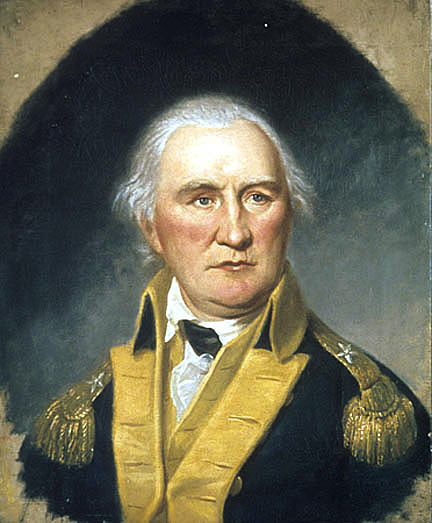
GENERAL DANIEL MORGAN

On January 17, 1781, the 45 year old American General Daniel Morgan engaged in a small battle in Cowpens the English regular forces of 27 year old Lieutenant Colonel Banastre Tarleton. Both had similar contingents, but 2/3 of Morgan’s 1,000 men belonged to American territorial militias.

These troops were at risk of shock in face of the force of the regular troops, whose use of bayonets in close combat would terrify them. The militia men were better than normal shooters, being hunters, and had great personal initiative, but they lacked training in close fighting.

Morgan moved them away from the bayonets and took advantage of their “enemy attrition capacity” by firing at ranges of many tens of yards on even small targets. He did not forget his survival instinct. He remembered that if an enemy infantry charge prevails, the persecution and annihilation of his troops was almost inevitable, since they had their back to the Broad river and the English had a advantage of 3 to 1 in cavalry.

Morgan established his militias in one forward line of dispersed shooters for harassment and in a second line in formation, further to the back to receive the first one. The men of both lines were asked to only make two deliberate shots, allowing the troops to then retire to rear through their left flank, without waiting in fear for the English. The last line of Morgan was his only line of regular troops.

The militias’ moral and survival instincts were also stimulated. No emotion that exceeded their training and aptitudes was requested of them, since this would have generated mental tension and enervation. This was sufficient to seriously hinder the bayonet charge of Tarleton‘s infantry regulars. In addition, without his intermediate commands warning of it, as the troops advanced over lines of militias that behaved as were expected to, that is to say, avoiding assault and running away (or retreating).
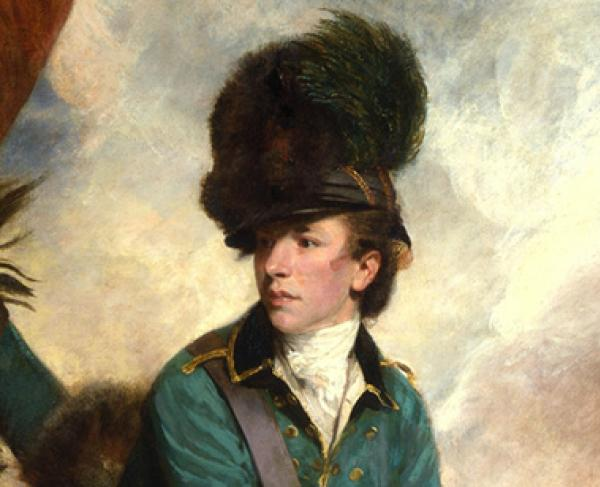
TTE. COLONEL BANASTRE TARLETON.

In his rear, covered by small knolls, Morgan personally intervened to flood his troops with confidence and to send them, around his line of regulars, in a charge on the left flank of the English. When they were exhausted and fixed by American regulars in front of them, they were surrounded on their left flank and rear. The small American cavalry completed the dispersion of the English by attacking them on their right flank.

In an insignificant battle, that lasted little more than one hour, one sees how a commander (24 days short of retirement due to rheumatism or, what was more likely arthritis, more than a sciatic) knew to successively remove from weakness from his troops, to renew their combat capacities and recreate a small Cannas. And without their characteristics had changed at all. He did so well and so impetuous was his enemy (he was an official of the cavalry hated by the Americans for his attacks on civilian that were not loyal to the crown), that the results surpass his expectations, since Morgan only aimed to reject the intense harassment of the impulsive English on his force.

The losses of Morgan were 12 dead and 61 wounded, equivalent to 7% of his contingent. The English had 110 dead and 830 prisoners (about 200 were wounded), accounting for 85% of their forces. They also lost 2 regimental flags, 2 pieces of artillery, 800 muskets, 35 cargo wagons and about 100 slaves.
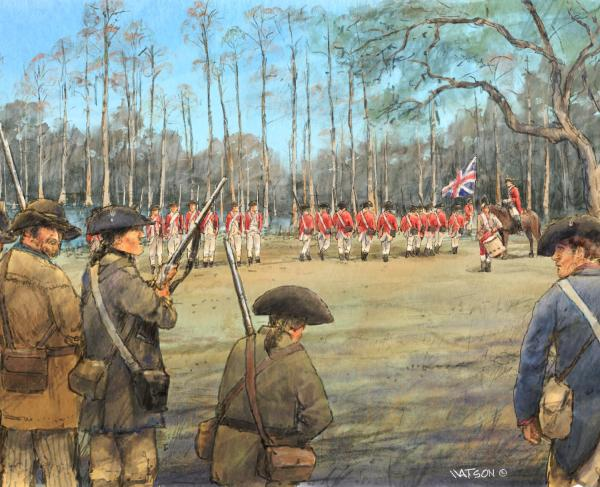
DEFORMED RECREATION OF THE BATTLE OF COWPENS

Tarleton in his later memoirs declared: «(it happens that) some unexpected fact can sow terror among the most disciplined troops and cause resistance to even well-conceived plans”. This is usually called surprise and is an element which multiplies combat capacity.

Sun Tzu also deals with this phenomenon: “He chooses his men and they take best possible advantage of the situation” Li Ch’uang also comments on it: “The brave know to fight; the prudent one knows to defend himself; the learned person knows to advise. The talent of no one is wasted”.

Chang Yu said: “Then the true method in commanding men consists of using the avaricious and the idiot, the learned person and the brave and in giving to everyone the responsibility that best agrees with him in the situation. Do not entrust people with tasks that they cannot fulfill. Make a selection and give to everyone responsibilities suitable their qualities”. “Those who consider the situation, use their men in combat as one who trunks or stones roll. For it is in the nature of the trunks and stones to be balanced on firm ground and to roll on unstable ground. And if they are square, they stop and if they are round, they roll”.

(to be continued)

Iran attacked by air.

HISTORICAL CONTEXT.

Persia is one of the three great Indo-European civilizations, along with Greece and Rome. If the Greeks had their Iliad and the Romans their Aeneid, the Persians had their Book of Kings. Persia is as Western as Ireland. And Ireland means the same as Iran, «land of the Aryans.»

Although Persia converted to Islam after the Battle of Nehawend in 642 a.C., its Islam is Shi’ism and has strong influences from Zoroastrianism. This is one of the oldest monotheistic religions. It was founded by the prophet Zoroaster in Persia around the 7th to 6th centuries b.C. Zoroastrianism has a dualistic view of good and evil. Angra Mainyu is the evil spirit, the principle of evil and destruction. It is the opposite of Ahura Mazda, the good and creator god. A practical summary could be the motto «think good, speak good, do good.»

The Shiite ayatollahs have much in common with the ancient «magi.» The name «magi,» as both category and occupation, is derived from the name given to the sages (of which there were several) who came from Persia in search of the newborn King of the Jews.

For all these reasons, we can say that Iranian Shiism is a national religion.

The last Iranian dynasty, the Pahlavi, focused on expanding and deepening the work «The Book of Kings,» with its 60,000 verses. This was a way to weaken radical Islam through the «ethnic cultural roots» of a 2,600-year-old empire.

The radical Shiite Ruhollah Khomeini had to go into exile in France because of his strict doctrine. He was only able to return to Iran after the 1979 Revolution, which overthrew Shah Mohammad Reza Pahlavi.

All of this enshrines, consolidates, and extends the identity and characteristics of the Iranian people.

CYRUS II THE GREAT, FOUNDER OF THE PERSIAN EMPIRE.

As a symbol of the enduring and strenghting nature of the Iranian Ethos, we have the elite military unit of the Immortals, founded by Cyrus II the Great. Initially an infantry unit, it later became a cavalry unit under the Sasanian Empire. It comprised 10,000 handpicked soldiers. When a member fell, he was replaced after the battle. They formed the Persian king’s personal guard and were also used as shock troops in battles. In this way, they transmitted through time the idea of ​​continuity and strength of this special corps and, with it, of the entire army of the Empire and the Persian nation.

NADIR SHAH

This national identity has been reinforced by its resistance to invasions and oppression throughout the centuries. Iranians have fought in numerous battles and wars to protect their national territory and their sovereignty within it. From Alexander the Great‘s conquest to the 1980-1988 war with Iraq, and including the era of Nadur Shah, who led the resistance against the Afghans (also known as Pashtuns or Patans) in the 18th century, the defense of the nation is seen as a sacred duty by many Iranians. This is reflected in modern public events such as the Day of Sacred Defense.
Resistance, or the modern concept of resilience (a term borrowed from English), and sacrifice in defense of the nation and its characteristics (territory, religion, language) are recurring themes in Iranian culture.

Heavy aerial or artillery fire.
Artillery and ground-attack aircraft (and, more recently, unmanned aerial vehicles) have these tasks to fulfill in their operations:

Blinding. This means preventing or hindering enemy observation. It ranges from the occasional use of smoke or fog to attacking enemy observation positions, sensors, radars, or satellites.
Disrupt. This aims to interrupt or hinder enemy military operations. Counter-battery fire and interdiction attacks in the enemy’s tactical and operational zones are two examples.
Neutralize. This aims to temporarily render an enemy position or unit ineffective. It is the upper and general limit of destruction that should be applied, according to the main principle of saving resources.
Modern tactics and operations, applied by the Russians in support of their «uncomfortable ally» Syria and the al-Assad family, have openly begun to demolish enemy defensive positions, even in urban or industrial areas, before the supported infantry assault to capture them.
An uncomfortable ally is one that causes more setbacks and unpleasantness than results and victories. Italy was such an ally in World War II. The Russians had their only naval base-port in the Mediterranean at Port Taurus in Latakia, Syria.

DESTRUCTION BY HEAVY FIRE IN A SECTOR OF GAZA

Destroy. The goal is to eliminate or permanently disable an enemy capability or position. There are obvious cases where this task is applicable, for example, destroying a bridge or a bunker, an ammunition depot, or a military vehicle distribution park. It is the most costly means in relation to providing operational effectiveness.

The choice of task also depends on the military objective. For example, is it a fortified position or are they forces on the move? And, of course, on the available resources. These are usually always insufficient, and the commander must take this into account when allocating resources and reserves to his forces.

The Unconditional surrender.

This is a diplomatic-military procedure that did not normally exist before World War II.

Simply put forward conditions that were draconian enough to reduce the surrendering nation to near destruction.

GEORGES CLEMENCEAU, FRENCH PRIME MINISTER.

This is what French Prime Minister Georges Clemenceau, nicknamed «The Tiger,» dictated to Germany on November 11, 1918, in a railway carriage at the Compiègne Forest, where the German surrender agreement was signed. He was not in the coach.

Germany lost the provinces of Alsace and Lorraine; the Ruhr industrial basin, the symbol and heart of its heavy industry; its Army was limited to 100,000 men, with a ban on tanks; it was required to pay enormous reparations for the costs of the war, etc.

A separate chapter concerns Germany‘s irreversible loss of its African colonies:

East Africa (present-day Namibia); Tanganyika (present-day Tanzania, along with the island of Zanzibar); Togo; Rwanda; Cameroon.

CHILDREN FLYING A KITE MADE FROM HIGH-VALUE GERMAN BANKNOTES

The hyperinflation in the Weimar Republic was one of the most infamous in history. In 1923, it reached almost 30,000%. Prices doubled every three and a half days. This immense inflation greatly alleviated the real burden of the war debt, which they paid with «paper money,» quite literally.

Tanks were replaced by large wheeled fake models for studies and training (war games).

The 100,000 military personnel assigned to the war, became the officers and non-commissioned officers of the future German Army, which was also provided with a revolutionary doctrine.

The socio-cultural and military mechanisms of the Iranian regime in its development and maintenance.

The arrival of Ayatollah Ruhollah Musavi Khomeini in Iran from his exile in France in 1979 marked the beginning of a shift in direction and the ideologization of the Iranian Civic Revolution.

The Shiite clergy of Qom soon realized that the Revolution was a «source of law» (with great potential) and that it needed to secure its position against an almost intact Iranian Armed Forces, inherited from the Pahlavi Empire.

SADDAM HUSSEIN AL-TIKRITI

In 1980, Iran was attacked by Saddam Hussein al-Tikriti, and the army performed poorly.

The Iranian Revolutionary Guard Corps (IRGC) was established by order of Khomeini on April 22, 1979. It was a Parallel Army, ideologically and religiously unwaveringly loyal to the ayatollahs and Iranian Shiism. Some parallels could be drawn with Hitler’s SS. The ayatollahs sought and implemented an effective army, loyal to them and their principles.

GENERAL QASSEM SOLEIMANI, ONE OF THE MOST FAMOUS COMMANDERS OF THE AL-QUDS BRIGADES (REVOLUTIONARY GUARD)

The Revolutionary Guard is responsible for Iran‘s internal and border security, law enforcement, and Missile Forces. Its operations are geared toward asymmetric warfare, controlling smuggling, and the Strait of Hormuz.

Today, so many years later, the Iranian Armed Forces are sufficiently loyal and effective in the regular defense of Iran.

(To be continued)