THE CONCEPTUALIZATION OF THE TACTICAL AND OPERATIONAL SURPRISES.

Prolegomenon.

Military surprise is more a part of the art of war and its creation, than of military science, the doctrine, its regulations and the principles or «good-doing» rules of war. Of course, its scope and instruments are taken from military science. Military science has its logic and practice oriented towards applied theory.

Military doctrine forms the framework, the structure, the heart of all development and the wisdom that military science has been developing so far. The military doctrine of each state incorporates the idiosyncracy, history and civilization of the corresponding nation. The permanent virtues and the more temporary values of the former are also reflected in its military doctrine. All this channels it in one direction and one sense.

War art has in its conception and execution the characteristics of: variability; the unusual and singular conception; the different, unexpected and novel application and the relative ingenuity (naturalness and freshness) and freedom in its facts.

If we are guided mainly by military science, which also knows the enemy, the results of the war dialectic will be obtained by maintaining a superiority in men and means, marches and maneuvers. And the cost will be the attrition of means and human wear in a greater proportion and always undue, than with the use of surprise.

Thus, a defence deployed in depth and with sufficient reserves, probably deprives us of many opportunities for effective surprise. But, almost always, acting in the microfield, as using a tactical zoom, we can apply the tactical or operational surprise, unusual and unexpected.

Development.

The surprise becomes specify and materializes in an unexpected action on the enemy by fire and/or shock. That, taking advantage of the enemy’s habitual lack of combat availability, makes him the victim of an attack that he is not in a position to successfully reject.

Obviously, the units in charge of surprise must avoid enemy’s reconnaissance, advanced combat units and security. In charge of giving the units that detached them, enough time to get the combative disposition that allows the rejection of their attacker.

But, the mental surprise must not only be unexpected for the enemy. But, in order to be able to take full advantage of its potential and effects, it must also be unusual, special, infrequent. With an unquestionable tendency to be «unusual», as never seen. This unusual character, never occurred, extraordinarily reinforces the quality of unexpected and sudden use of surprise.

We don’t always have the unusual at hand. And surprise often favors, by employing the law of action, the most mobile and even only the active rival.

Then, the use and manipulation of the “appearances”, the appreciated characteristics of the events and their circumstance, will allow us to establish and develop a new tactical or operational situation. Which will be surprising and unusual for the enemy. And it will give us an unexpected victory, at the beginning of the faced dialectic situation.

A Tactical example with operational trascendence.

Here is an example of an extraordinary force acting as a normal force and, in so doing, completely deceiving the enemy by manipulating appearances of the events.

In January 1943, with the Soviet advance threatening Rostov, the 4th Panzer Army of colonel general Hoth moved back from its positions on the banks of the Sal and established a defensive line south of the river Manich. Passing through that area were the supply and retreat routes of the 1st Panzer Army. Routes that had been kept open, if a disaster like that of Stalingrad was to be avoid. In Stalingrad, the Sixth German Army, the Army unit more powerful of the Wehrmatch, was caught. The 4th Panzer Army was assigned to protect this bottle neck in the communications of the Armies Groups Don.

General Erich von Manstein, before his capture of the Crimean fortress

Soon the Soviets reached the confluence of the Manich and Don rivers, took control of the small city of Manutchskaya that was only 30 kilometers from the mouth of the Don on the south bank, and sent advanced detachments in this direction. On January 23, the 11th panzer division and 16th infantry division counterattacked the Soviet advance spears and pushed them back to Manutchskaya.

Then, it was vital to restore the south front of the Don and Manich and to expel the Soviets from the city. Which was one of their bridgeheads (which, usually with much skill, could be rapidly reinforces once constituted).

GENERAL HERMANN BALCK, ONE OF GERMANY’S FINEST TACTICIAN.

The Germans made a direct assault from the southwest on the 24th, seeking to surprise the Soviets with the operation continuity. Instead, they found that the Soviets had created an antitank front in this entry to the city. Using tanks with their hulls partly buried and distributed between the buildings, along the streets, and in other difficult to see locations.

The 11th panzer division, a crack division with a magnificent tactician as chief, quickly stopped the assault when it detected the importance of defenses.

On the 25th, the general Hermann Balck initiated an assault on the northeast sector of the city, which the Soviets identified as a main assault, similar to the previous one and following the orthodox criterion of «not insist on unsuccessful or frontal assaults» (not profitable). For it, they moved rapidly theirs antitank means (tanks are the most mobile) to the new threatened sector.

To make credible this assault (manipulation of the appearances), at the beginning the whole divisional artillery was used in its support. It was also the more dangerous direction of assault for the Soviets. Since that part of the city was nearest to the principal bridge over the Manich and its occupation would isolate the Soviet bridgehead on the south bank. These factors constituted the «primary evidences«.

The assault on the north-east sector was probably already considered by the Soviet defense as a German alternative assault and, because of this, they reacted rapidly to what happened.

Infantry half-track vehicles and reconnaissance light tanks executed the principal «virtual» assault, simulating the march of mechanized vehicles, concealed by smoke curtains. And seeking more to hide them from the enemy than to protect their advance. This gave a «secondary evidence» to the credibility of the «appearances«.

When the Soviet’s determination in the new defense was estimated, which confirmed the alteration of its original deployment and the attraction made by the normal «apparent» attack. The bulk of the divisional artillery threw a powerful fire blow on a sector of the southwest zone of the town. A single battery continued to support the ongoing false principal assault.

Most of the tanks of 15th panzer regiment immediately attacked the forward limit of the defense, entering the town and advancing on its interior. To attack from the rear the new defensive Soviet deployment, especially its tanks. The mechanized German infantry then closed in behind them.

The Soviet resistance crumbled. Its infantry ran to the bridge over the Manich river. But was chased by the 61th motorists battalion.

German casualties in liquidating Manutchskaya’s stronghold were, according to its own sources, one man dead and fourteen injured men. The Soviets had between 500 and 600 casualties and 20 destroyed tanks.

THE DRONES AND THE ENEMY OPERATIONAL ZONE.

The operational zone. Its functions and vulnerabilities.

The operative zone is the geographical space where develops the process of turning the mass of support of the strategic rear (forces, supports, logistics, communications, headquarters) into «units of action» qualified and specialized for its employment in «interfaces of action» with the enemy. These constitute the active points of what can call front, increasingly mobile and discontinuous, due to the dispersion of the forces, its tactical speed and its fire power.

The above mentioned units of action join combined arms groups, which low tactical level is in the habit of being the reinforced battalion or company, that have subsets or elementary units, in the mobile combat.

The critical elements of this zone, which is the physical support of that activity, are the communications of all kinds, the spaces of maneuvers (zones of deployment, of equip, of wait, of advance, provided with covers or desenfilades), the engineers units and of operational reconnaissance, the logistic means (stores, distributions means and zones) and the centers of production of the intelligence and the transmission of the reconnaissances.

The operational zone must have the sufficient geographical depth to be able to contain, supply, deploy, direct and command the sufficient number of units, following the necessary advance or assault spears close to the front, to repeat the efforts in «interfaces of action» and to achieve the tactical aim that in these appears and decides.

In practice a spatial symmetry is in the habit of existing, as general Richard Simpkin indicated, in the operational zones of both contenders, along the supposed constant line of the front. A difference very marked in the depth of a zone, can indicate the tactical weakness of a rival, either by minor resources or by a slower enrollment for the combat of its strategic reserves or military means in general (great strategy or total strategy level).

The reasons for including the engineers troops among the critical elements of the operational zone, reside in its specific fighting functions: they act against the enemy center of gravity; they are very scanty forces for all the tasks that they can fulfill; its action has a great multiplier effect on the enemy effort; they provide other forces engineers’ material for its particular use; they are responsible for the interceptions and reinforced cuts on the area and the most effective obstructions: antitank stable positions, minefields and more elaborated fortifications. With it they affect gravely the effective effort of our capacity of movement as operational system.

The functional mentioned elements of the operational zone are highly vulnerable. In effect, they lack enough nearby capacity of defense (including the infantry antitank, though they are of support), that is usually is limited to the security elements detached by the units and the centers and that, though it is circular, they are of punctual type in its positioning. If there takes place the destruction or the breaking up of these functional critical elements, which act as a connected and interdependent net of an alone seam. Generating the affected elements “commotion waves” for all it and this will affect exponentially the functionality of the operational rear, making it finally collapse.

Deprived the enemy action units in its active points of the front, of its operational zone, which qualifies, supports and stimulates them, the survival of the whole front sector affected is impossible after a time, for exhaustion or consumption. Likewise, the moral effects of the ungrateful surprise and the loss of the expectations precipitate the collapse of its front more rapidly yet. Its forces will tend to move back towards its deep rear, to protect the functional elements that allow them to operate tactically.

And, what about of the capacity of combat of deployed units in the operational zone, being prepared to operate in this front sector or in contiguous one? Can they defend the functional elements of its operational zone? Can they counterattack the enemy penetration?

We must remember that any military group, from a tank crew up to an army, passes most of its time, neither deployed nor prepared to fight. Its time passes doing labors and operations that allow it to go to fight in the chosen moment.

Whether training, embarking, moving, equipping, supplying, reorganizing, waiting, or resting, no unit is fully combat-ready. It is precisely in the operational zone where units prepare to conduct their operations against the enemy. Even if this is a tactical march, «pushing» a flexible and discontinuous front with weak combat readiness on the part of the enemy.

For the defense of the operational zone, we can only rely on the ready operational reserves and the deeper tactical reserves, both located in that sector or in adjacent ones.

The support mass is the set of military assets that converge in the theater or campaign. Its means of action is stability and is governed by the «management» of senior commanders. This is based on defined processes and standards, which are stable over long periods of time, which give it the necessary predictability of the desired effects of its action. They maintain and demonstrate the cohesion and the functionality of these military structures and hyperstructures.

At the army group level, the support mass extends from the forward limit of the defensive position to 300-500 km in own depth and with a width of approximately 300 km.

Towards the 75-100 km zone, the support mass hyperstructure disaggregates into the most active structures and microstructures, which constitute the operational and tactical units. These will operate in the “fields of action” and at the “interfaces of action” with the enemy, up to approximately 150-250 km in depth. To this end, they will follow operational-tactical combat and maneuver procedures, guided by the criteria of decentralization, exploitation of opportunities, surprise, counterattacks, enemy gaps, etc., and governed by the superior intent and its center of gravity, all of which are specific to the structures and microstructures active with the enemy.

(to be continued).

Action Interfaces as Zones of Tactical Development against the Enemy. Second Part.

A “weapons system” seeks to attack the enemy preferably in a certain way, taking advantage of its lethal or neutralizing potential. Against it, an enemy will always find an increasingly effective defense: armor, fire, obstacles, mobility; dispersion, concealment with or without cover, etc.

Combined weapons systems seek to produce a synergy, a multiplication of the individual capabilities of the weapons, a compensation for weaknesses or drawbacks and a weakening of enemy capabilities, together with a greater exposure or accentuation of its tactical vulnerabilities.

This synergy should produce effects on enemy combat capabilities and on its speed of action or capacity for movement: It must neutralize enemy defense. It must create in the enemy a vulnerable overexposure, when receiving the effective, complementary and coordinated action of the inter-arms systems. It must produce an operational indecision in the enemy, which harms its speed and capacity to react.

The inter-arms system is a technological and tactical way of increasing the favorable active interfaces on the enemy. It is an element of the operational strategy, carried out on the interesting points of the enemy deployment, to create a tactical vulnerability and to be able to produce the decision or the exploitation with the minimum wear of the available combat capacity of its own.

In the supplementary systems, the enemy defends itself in the same way from all the attacking elementary systems. A kind of saturation or maximum effect of the form of attack undertaken is sought. An example is the indirect fire of artillery and mortars.

In the complementary systems, one of the systems attacks the enemy and when the latter reacts defensively, seeking to dislocate the attacker, it becomes especially vulnerable to the action of the other or several of the other weapon systems used. The enemy thus suffers an extension of his vulnerability, over a longer time or space of action, achieving the three desired effects.

A complementary system is that formed by the obstacle and the fire. To overcome the obstacle, the enemy must concentrate and/or stop his advance and this reduces his impetus or quantity of movement and makes him especially vulnerable to repulse fire, which must not destroy the obstacle. Another complementary system is the fire and tactical maneuver developed by the small units or advance spears of an attack.

Another complementary combined arms system would be the convergent maneuver, taking advantage of positions and terrain and the available combat capacity, echelon it laterally to create more favorable interfaces. Faced with each convergent attack sector, the enemy has to react in a different way. With this, he creates vulnerabilities not well estimated by the enemy, in favor of the rest of the sectors that intervene. On the other hand, the combat capacity deployed towards a rejection will not always be in the best orientation to employ it in another more or less expected direction. If this is combined with neutralizing support fire, the entire enemy system is severely disrupted and dispersed, in its defense plan, in its fire plan and in its conduct.

The inter-arms system seeks to paralyze the enemy’s action or severely disrupt it, by affecting the quality of the combat capacity, generating in it a contradictory and more ineffective mode of action. It also acts in the same way in the successive cycles of action, divided into observation, situation, decision and action. And it does so through the direct deprivation suffered by the enemy of acting coherently and consistently in them, due to the incapacitation of its available combat capacity.

The analysis of the search for the decision in World War I will give us a practical example of the application of the search for the appropriate action interfaces, using inter-arms systems that are different in their composition, although with identical effects and results. Since the tactical solutions achieved on both sides lacked the complement of the sufficient operational movement capacity (the other of the operating systems with which it forms a complementary interactive pair), the operational strategic solution could not be achieved.

The origin of the German assault forces (Stormtroopers) , at the end of 1916, was in the awareness of the need and the possibility of fragmenting the pseudo-compact enemy front, into smaller sectors of advance, practically into advance spears, in which to act through an inter-arms or combined arms system. Favorable action interfaces would thus be created, in which to be able to act with freedom of action, at the level of reinforced assault platoons, which would advance by covered jumps to the enemy positions, behind a relatively short barrage of fire.

Supports in tactical subordination would include Russians shortened 76.2 mm guns, who were very well suited for heavy direct fire support and who lacked the backlash of other cut-off pieces, heavy grenade launchers, light mortars, machine guns and flamethrower squads and engineer platoons (pioneers). These last three supports would be those that would accompany the infantry to the direct assault of the trenches or enemy defense strong points. These were thus isolated from the support of their artillery or other nearby positions, which were neutralized by the German heavy artillery or by other assault sections.

On the other hand, on the Allied side, it was the English who used the first tanks (tanks was their code name in their development), heavy and clumsy, at the level this time of the great front of wide sectors, to provide continuous direct fire support to their infantry and enable them to successfully fight deep into the German tactical zone and even break through it. They were also used to clear trenches along their lines, protected by their armor and using mainly their machine guns.

However, neither side had a single “medium” that could maintain, depending on the use and circumstances, an adequate tactical speed and operational speed without interruption between them. In short, it could successively achieve tactical and operational objectives. The logistic support system was also not developed enough to be able to quickly send a significant flow of supplies and people along narrow, unconsolidated lines of advance.

In effect, there was a tactical speed (very few km per hour) that could be maintained both by infantry (of course, also German) and by tanks designed to support it, and a higher operational speed, maintained by the railway and trucks and other vehicles in the deep operational zone of each belligerent side.

This meant that, once a local tactical breakthrough was achieved, exploitation within the enemy operational zone could not be achieved. Faced with this, any of the contenders would bring their operational or strategic reserves closer in time and convert them into units deployed with full combat readiness. Thus, they created a new tactical zone very close to the breakthrough, blocking it.

To achieve the operational decision, a “means” was needed that was capable of acting with a certain autonomy at both levels of war activity: the tactical or immediate and the operational or deep and transcendent.

In modern warfare, with a considerable deployment of close and long-range, direct and indirect firepower, despite the progressive emptiness of the immediate battlefield (almost thirteen times greater in this world war than a century earlier, in Napoleon’s campaigns), this «means» could only be a well-armed vehicle, sufficiently protected and powered by an internal combustion engine.

But acting according to the tactics of relatively narrow sectors and combined arms systems, developed by the Germans for their assault forces and subsequently used by all their infantry in the general campaign of the spring of 1918, from March 21 to July 18, the date on which the Allies began their general offensive. And counting on reasonable logistics, which would compensate for wear and tear, maintenance and the capacity for operational movement.

In 1917 and 1918, neither of the two sides, neither the Cordial Entente or the Allies nor the European Central Empires, possessed either the two concepts or the specific elements of their application. In fact, a polished and developed synthesis (integrating the nascent war aviation into the German infantry inter-arms system) of the ideas and means of both would be necessary.

However, the Western Allies had the classic means in relative abundance. And they used them according to the knowledge of the time to achieve a strategic decision in the Western European theater. Generalissimo Foch used a strategy of hammering, of stubborn reiteration of efforts. Seeking that the «tactical reaction» provoked in the Germans would affect the strategic capacity of systematic renewal of their defensive front. And, in the end, this German strategic combat capacity collapsed.

And thus the Allies achieved the strategic decision of the war.

THE END

THE WAR BETWEEN ISRAEL AND IRAN. An apocalyptic war? Second Part.

(Continuation)

The Shiites had neither the means nor the organization to dominate in the territories where they abounded. Thus, Shiism, almost always a demographic minority, assumes a fatalistic, passive attitude, even causing physical suffering because of it.

The Shiites are waiting for the return of the missing Imam (caliph). Imam is the name given to the political-religious leaders in Shiism.

The Shiite Doctrine, application and reality.

The Shiite Historiography, Mythology or Sacred History can be summarized as follows:

The missing caliph Imam of the Shiites will come as “Al-Mahdi” (the Guided by Allah) at a given moment in history, to make the orthodox Umma (Muslim Community) (the Shiites) triumph in the world for a long period.

It is said that up to a millennium on Earth, before being taken individually to one of the heavens of Islam. There are seven heavens, in the last of which is Abraham, father of the Semites, who is visited daily by about 50 thousand angels of Allah.

Unlike the Sunnis, the Shiites soon established a Muslim clergy. In charge of guiding the people and maintaining the “ideological orthodoxy” of the Ummah.

There is no theology in Islam. Because Allah is unfading, incomprehensible, unreachable for men. And, that of father, father, nothing. Islam is unconditional submission to Allah. They only reach Insha’Allah, “may God will it.”

The core of the Shiite ideology is in Qom, Iran. Which is, saving all the inevitable differences, like a “Vatican.” Here there are Grand Ayatollahs, Ayatollahs and Khilafatlahs, decreasing in hierarchical order. And, there is no systematic correspondence between the degrees of study in Islamic sciences and the ranking of the different titles in Governance.

During the long civil war in Syria, the Israelites bombed Hezbollah units on more than one and two occasions, who were fighting there for Bashar al-Assad, the Alawite doctor president. They did not carry out precision attacks, to volatilize a specific target.

After the latter type of attack used against Hassan Nasrallah in Beirut, the main leader of Hezbollah for many years, the Most Supreme leader of Iran, Ali Khamenei, threatened a total war against Israel, calling for the union of Islam for this. And, he had an AK rifle at his side.

But, as stated before, Shiism will never win a total war. Its importance and capacity in the Muslim world prevents it. And, for this to happen, the missing caliph, as al-Mahdi, must come and lead him to inevitable triumph on Earth for a Millennium. First Essential Contradiction.

Another essential contradiction is that Allah gave the Muslims, as weapons to fight against the idolaters and the Jews, the spear, the mace, the sword and the bow and arrows. So that they could conquer their lands of Dar-al-Islam. Where Islam governs and practices its religion in complete freedom and dominion.

And, with them, they conquered in one century from Persia (Sassanid Empire) to Spain, almost all the lands of the Sunni Caliphate. In successive, triumphant and astonishing campaigns.

Incorporating the conquered regions into the caliphate, without persecuting the inhabitants. The administrative link with new power was the payment of a variable tax for practicing another religion. This linked the inhabitants with the Muslim garrison of the area and with the cadi, caid or governor. In some cases, the Sakat or Muslim canonical alms was higher than the tax on the infidels.

On November 1, 630, the Prophet triumphantly entered Mecca, suppressing the idolatry that reigned before Islam (defended by the ruling caste) and the Kaaba, the sacred stone, was transformed into a center of Muslim piety. It will be the point where the Muslim faithful will direct their five daily prayers of Salat. The most devout travel with their prayer mat and some tablets, where they calculate the coordinates of the point where they are, to orient themselves well in the direction of Mecca. Before, the Muslims were oriented towards Jerusalem, but the hostile behavior of the Jews made Muhammad change the geographical direction of the Salat.

In 632, Muhammad died in Medina, the city of the Prophet. In 711, they invaded the Iberian Peninsula, most of which was already conquered in 726. In 732, the Muslim were defeat at Poitiers by the forces of Charles Martell who thwarted the attempt to expand in the West.

And, now in 2023 and 2024, the the Shiites and their irregular allies are constantly using ballistic and free-flying rockets against the Jews. And they are not winning.

And now we are entering the realm of the “possible imaginative.”

Among the clergy of Qom, may arise the temptation, among the youngest, most prepared and ambitious, to force al-Mahdi to come. And to enter into the invincible spiral of victory. They would be toying with the idea that by militarily raiding Tel Aviv they would put themselves at the head of Islam.

Islam was great and powerful, according to them, when it carried out the Minor Jihad: spreading Islam by arms. Also, the Sunni Turks think that the Sublime Porte was only strong and prosperous during the long periods when it was fighting with the Europeans for control of the Mediterranean and Central Eastern Europe.

The Khomeini revolution had already given the Shiites a boost and an influence, then unthinkable, among the nostalgic, young and/or bellicose Muslims.

There is a hypnotic (mesmeric) attraction for the Iranian leaders, in the hidden, unspoken, and unrevealed part of politics and religion, that “That” would be the wake-up call to the hidden al-Mahdi, so that he would reappear and lead his Shiite faithful in the triumph of Islam at the Culmination of History.

The End.

Weapons and Their Defense in the History. Third Part.

However, the Mongols flung upon it, Almost completely surrounding the camp and showering it with bombs and incendiary arrows, which burned the wagon trains and tents and frightened the beasts. They sowed chaos among their enemies and already shattered the Hungarians’ self-confidence.

Curiously (or not?), the Mongols still hadn’t completed or covered with any detachments the siege of the Hungarian wagon camp through the gorge leading into the heath. The Hungarian cavalry still with sufficient moral courage, formed a wedge to resist the charge; it was the last firm stand of the Hungarian army. However, most of them retreated through the «gap» in the siege, fleeing in small groups toward what they believed would be their salvation. And, truly falling into a deadly trap, which extended along the entire route of their flight to Pest.

The Mongol light cavalry, taking no risks, softened up the knight’s desperate wedge-shaped deployment from a distance with their bows and arrows, and then, seizing their opportunity, the heavy cavalry charged to crush them.

Numerous Mongol light detachments, in turn, set out in pursuit of the fugitives. One group pressed them directly from the rear, increasing their commotion, chaos, and fear. Meanwhile, other detachments carried out the «overwhelming pursuit,» catching up with them from the sides and spearing them or shooting arrows them from their mounts.

The remains of the Hungarians, their horses, equipment, and baggage were scattered along the road back to Pest for 50 kilometers. More than 70,000 Hungarian cavalry and auxiliaries perished on the battlefield, in the temporary encampment, and in the flight to the southwest.

After the Battle of the Sakh, Hungarian resistance collapsed.

The Mongols then attacked Pest and burned it. But they did not dare to cross to the west side of the Danube, exploiting their success, despite the moral and numerical superiority they enjoyed at the time. Batu and Subodai rested their army and consolidated their positions east of the great river. More than half a year passed, the main event being a half-hearted declaration of a crusade against them by the Pope, which achieved little in practice.

In December 1241, the Danube froze in this large region. The Mongols took advantage of the situation to sack Buda, reconnoissance in force in Austria, and sent a detachment south toward Zagreb in pursuit of King Béla. On the 25th, they assaulted Gran, the Hungarian capital and seat of its archbishopric, taking with them everything valuable and antique they could.

A portentous end for Europe.

Central andWestern Europe were ripe for a Mongol invasion. The Europeans lacked an army capable of confronting this threat, which was already breathing down their necks. The strategic plan Subodai explained to the Khan and his generals seemed to be faithfully carried out down to its final stages. But this was now merely an illusion, an impossibility. An «appearance,» as Sun Tzu would say.

OGEDEI GREAT KHAN

On December 11, 1241, they had received at Batu and Subodai‘s headquarters an escorted messenger from Karakorum, the Mongol capital. He brought news that Ogedai, the Great Khan, had died and that his widow was acting as regent until a new Mongol emperor was elected and ascended the throne. The Mongol princes present in the camps were eager to assert their rights to the succession and decided to return to their capital, taking the imperial tumans with them. Batu knew that without these elite troops, he could not hold Hungary, but he believed that with the Turkmen recruits, who were already experienced and had seen combat, he could retain most of his territories.

Thus, the Mongols evacuated Hungary, unhindered, harassed, or pursued by their enemies. Although they left behind the land that had been theirs devastated. This was a symbol of their idiosyncrasy and plundering nature, a land bandit and absolute predator. And they lacked the slightest capacity to create, maintain, develop, extend, and bequeath to their successors a civilization worthy of the name. And they could leave them only the accumulated results of their atrocities, bonds, tributes, plunder, and loot, and the military lessons to obtain them.

Sarai, capital of the subsidiary Empire of the Golden Horde.

Batu returned to his original base camp, in Sarai, near the Volga and barely 100 km north of Astrakhan. And there he established a subsidiary Mongol empire, which became known as the Golden Horde.

The Mongols would have no other opportunity to invade Europe. After this aberrant nightmare suffered by the Europeans, they invented all kinds of stories and myths, in which they recounted how they had defeated the «Tatar» invaders (as the Mongols were generally known in Europe) and forced them to return to their lands.

This unthinkable, sudden, and portentous result, occurring in the last possible moments… Was it a work of the Fate and Karma of Europe and its privileged Civilization? Or was it the result of Divine Intervention through the intercession of the Virgin Mary?

Of course, it was, humanly speaking, an excessive and incredible coincidence. But faith can never provide «evidence» either, because it would cease to be evidence and become verifiable reality. The effective Divine Intervention, in favor of Europe and its civilization, which without Christianity acting from its core would never resemble what it was and what it is, is likely, because It is never thunderous or overwhelming.

OGEDEI, LORD OF ASIA AND SUCCESOR OF GENGHIS KAN

God did not visit Elijah in a lightning storm or a hurricane, but in a gentle, soft breeze. And, for esotericists and syncretists, the explanation could be «a cosmic action of astral and Akashic forces, in favor of Light, Peace, and Human Civilization toward higher levels of Universal Consciousness.»

There is also a common «rational» explanation for what happened, but it cannot pinpoint the moment for this opportune withdrawal. The Mongols and associated Central Asian tribes were creating a Eurasian empire in the first half of the 13th century. But their material capabilities and ideological and religious resources were not adequate for such an important objective.

As we have seen, they had nothing satisfactory or lasting to offer the peoples of the occupied countries. The Mongols were kept in these foreign lands by the threat of known terror. As with other tyrants who sought to become «global,» their necessary collaborators were ethnically or ideologically similar. But the Mongol ethnic group and its ilk were demographically insignificant, for allowing them to monitor and defend themselves alone. All of this, in the decades since the invasion of Eastern Europe, had strained their military capabilities to the breaking point.

Thus, sooner rather than later, the Mongols would have had to undertake this general retrograde march to secure and consolidate their lands in Eastern Eurasia. They would have distanced themselves from contact with dynamic, ideological, and expansive civilizations, such as Europe, with which their relations of neighborliness and early exchanges of merchants, explorers, and adventurers would have been resolved through military confrontation.

(to be continued)

Weapons and Their Defense in the History. Second Part.

The Mongols Armies.

The Mongol Army’s cavalry was divided into light and heavy cavalry.

Their most distinctive weapon, used by all cavalry, was the S-shaped composite bow, which, properly drawn, could launch an arrow over 300 meters away. Its length made it useful for shooting from a mount.

The Mongols were herders, and their occupation gave them a lot of free time. This allowed them to amuse themselves by shooting the composite bow, thereby achieving great skill in its shooting and use and, very importantly, maintaining it over time.

Light cavalry was intended to harass the enemy in formation, send patrols ahead of their main body to gather intelligence, and pursue and finish off the defeated enemy as they fled.

Heavy cavalry struck the enemy in the clash; care was taken to ensure that the enemy was tired, dispersed, or in the minority.

The Mongols did not have a sufficient siege formation. They defeated the entrenched enemy with lures and tricks. And, by offering them a much-desired advantage, they trapped them.

Development.

In 1241, some 100,000 Mongols crossed the Polish-Ukrainian border to attack Hungary. A detachment of 20,000 men, two Mongol tumans or divisions, under the command of Princes Baidar and Kadan, will be tasked with ensuring that the Hungarians receive no reinforcements from Poland, Germany, or Bohemia.

To this end, they defeat the concentrations of forces from those countries at Chmielnik, about 18 km from Krakow. They lure the enemy into pursuit without prior combat, into an ambush, appearing to the enemy as a raiding party retreating to its base.

And, at Liegnitz, about 60 km west of Breslau, they employ a mangudai to deceive them. It consisted that a Mongol army «corps,» inferior to the enemy, seriously engaging in the fight with them. Its size was large enough to make the Mongol effort considered significant. This would mentally lure the enemy away from any other thoughts or possibilities. After a fierce battle, the sheer weight of the enemy forced the Mongol corps to retreat.

Batu crosses the Sakh with 40,000 men via the Stone Bridge

What had been a tactical retreat, never truly disorderly, was mistaken by its enemies as an exploitable defeat. Its complete and permanent ignorance of the Mongol enemy left it unaware of anything. And its desire for victory, heightened by the genuine effort exerted in the initial engagement, prevented it from seeing beyond its reach.

The relentless, full-throttle pursuit eventually dispersed the tight, solid formations of the European nobles. At one point during the pursuit, always far from the waiting enemy forces, the bulk of the Mongol heavy cavalry emerged, hidden, fresh, and launched into the clash. It ultimately broke up the disjointed cavalry groups into which the European pursuers had dispersed.

After a genuine hunt, the European forces remaining in the initial positions of the battle either dispersed as well or were in turn attacked by the entire Mongol force.

By then, in less than a month of operations, 20,000 Mongols (at the outset) had advanced some 650 km into enemy territory and won two decisive battles.

Poland was battered and shaken, and the Germans west of the Oder River were retreating and preparing to defend their kingdoms. The Bohemians, still intact, were some 400 km from the first Hungarian defensive positions on the Danube; therefore, their army was operationally ineffective in achieving the resolution against the Mongol attack on Hungary.

To ascertain the Germans’ «intent,» the Mongols staged a demonstration westward into Germany. King Wenceslas pursued them. At a certain point, the two tumans (-) split into small, elusive detachments. And, forming a cloud almost invisible to the enemy, they slipped past both sides of the Bohemian army and retreated eastward.

Recreation General Subodai Bahadur

In their retreat to join the main Mongol army (80,000 men), commanded by Subudai Bahadur, the Khan’s deputy, the Mongols crossed Moravia, ravaging its villages, warehouses, and fields. They thus created a vast desert wasteland, which would further protect Subudai‘s right flank by rendering those Moravian lands incapable of sustaining a passing army for any length of time.

The remnants of Princes Baidar and Kadan‘s forces managed to join Subudai‘s forces and continue to participate in his campaign.

General Subudai had devised and presented the invasion and attack plan to the Khan and his generals, and had been placed in command of the forces to carry it out.

Subudai concentrated his army in three marching groups. Each would enter Hungary by a different route, through the passes and valleys of the Carpathian Mountains. This deployment provided the Mongols with protection from enemy surprises and gave them an initial deployment, preparatory to the maneuvers of their three mobile corps. The Hungarians, for their part, did not dare attack any of them, for fear of the other corps advancing on their operational rear or capturing some of their cities.

On April 3, Subudai formed his three mobile attack columns opposite Pest, on the east bank of the Danube. There stood King Béla of Hungary with his army of 100,000 men. Across the river, linked by bridges, lay Buda.

Having also deployed a tuman to Transylvania to ensure that the Christians did not receive reinforcements from Romania, the Mongols now numbered about 70,000 (plus) men. And the more time Subudai took in his calculations, decisions, and preparations, the more time other European rulers would have to make up their minds and come to support king Béla.

The Mongol general applied one of his combat stratagems on a strategic scale: his army retreated east. Using «reasoning,» the Hungarian commanders assumed that the Mongols did not dare to fight against their more powerful army. And, spurred on by their inaction in the face of the unhindered advance of the three Mongol columns, they demanded the King Bela to begin their pursuit. The Hungarians did not appreciate that Subudai was luring them away, from the protection of the Danube and the support of detachments and corps of the Hungarian army.

King Béla IV of Hungary.

King Béla, commanding the vast majority of his army, led the pursuit against the Mongols. The Mongol retreat was deliberately slow. It took them six days to reach the Sakho River, about 160 km northeast of Buda and Pest.

West of the river and on the plain opposite Mohi, the main town in the area, Prince Batu and Sabudai decided to confront their «pursuers.» On April 9, the Mongols crossed a wide gorge, advanced through a heath, crossed a Stone Bridge, and continued some 16 km to the thickets west of the Tokay hills and vineyards. There, they had numerous places to camouflage and hide.

Prince Batu, founder of the Golden Horde

The Hungarian army, pursuing them head-on, encamped in the heath, arranging their wagons in a circle, where they set up their tents, equipment, and horses. To the right of the temporary camp were the swamps along the banks of the Tisza River, to their front lay the Sakho Heath, and to their left were forests and small hills.

At dawn on Wednesday, April 10, 1241, Batu and around 40,000 men advanced toward the stone bridge from its eastern side. The Hungarians defended it vigorously, until they were forced to retreat due to the «fire bombs» launched by the Mongol catapults, as they were on a very narrow front.

We are now seeing, quite clearly, how the opposing rivals are assuming the roles of winner and loser. And that this situation continues until the very end. These are some of the «signs» that announce and precede the final results of the war dialectic.

The Mongols crossed to the western side of the Sakh, but for more than two hours, they were terribly pressed by the Hungarian charges, and only the fire of their archers allowed them to briefly reestablish their defensive line. Little by little, the Hungarian army deployed to eliminate the Mongol bridgehead over the Sakh.

Suddenly, General Subodai, who had also crossed to the western side via a makeshift bridge built downstream of the Sakh, while the Hungarians were distracted by the threat of the Mongol bridgehead, appeared with around 30,000 Mongols in the Hungarian rearguard.

Beaten and stunned, but with the courage and experience to avoid panic, the Hungarians retreated in good order to their nearby camp.

(To be Continued)

Weapons and their Defenses in the History. First Part.

Introduction.

Throughout history, supposed war rivals have perfected their weapons, Techniques, and Tactics to defeat an enemy who violently opposes the achievement of their objectives.

In the Beginning,

The strongman appeared with a large stick or club, coming after his neighboring rival. At one point, the latter, who was practically a weakling, hid in a bush by the side of the road. When the strongman passed by, confident and well-equipped, he waited for him to leave his back free and attacked him on an unprotected «essential vulnerability.» The «big man» fell lifeless to the ground. History doesn’t say what happened to the two characters in the fable.

When the number of members of the two factions increased enormously, they instinctively sought to group together, so they could attack and defend themselves much better.

At first, there was a relatively large group, and soon the focus was on organizing and utilizing the group. And the phalanx was born, a wall of twelve or sixteen ranks of men armed with long spears or pikes, extending several ranks ahead, well-trained in their combined handling at close range. They were protected by a large shield and pieces of metal or heavy leather on the chest, head (helmet), arms, and legs.

In ancient Greece, the Spartans refined the tactical instrument of the phalanx to the fullest.

No one was as trained and protected as they were. And their society accepted and honored their militari ethos, embodied in the phalanx. Spartan mothers would tell their sons, phalangist hoplites, to «return with the shield or on the shield.» There was no quartermaster or medical care, properly speaking. And mothers instilled in their sons the warrior social mentality of their society.

THE IMPRESSIVE PHALANX

But, behold, the right wing of the phalanx was less protected than the left. This was due to the way the men naturally protected their left flanks with their shields.

And at Leuctra, around 344 BC, Sparta, with a majority of its forces (10,000 men), set out to crush Thebes (6,000 men). Unaware that its phalanx model had changed,

Epaminondas and his pair, Pelopidas, had introduced the «oblique order» into their Theban phalanx. On their left wing, they deployed a greater number of forces, and the best of them. Among them, a phalanx formed by homosexual couples, which they called the «Sacred Band

They also refused to employ their center and right wings, as is typical of the oblique order. Perhaps the heightened sensitivity of homosexuals, which is said to be present in the Theban homosexual leaders, may have influenced their sharpness and refinement.

On the Spartan right wing was the commander of all their forces. This was thus the «core of their resistance.» And this was battered and beaten by the Theban forces on their left wing. And then appeared the «Caedes,» the slaughter and the finish of the vanquished.

From afar, the Spartans on their center and left were also affected by the defeat and the damage to the hoplites on their right wing. And they began to retreat, without having been defeated by weapons.

A year after Leuctra, Epaminondas was touring the Peloponnese peninsula, commanding forces of the newly formed Arcadian League. And he appeared in front of the city of Sparta, within whose sight, it was said, enemy forces had never appeared.

Phalanxes were too large to be able to move freely and quickly against the enemy. They acted as a «dam» of Force against Force, where surprise, skill, and flexibility could not exist. Another characteristic of their technical rigidity is that they had to fight on flat terrain, at least without undulations or obstacles such as rocky outcrops or patches of trees and bushes, which broke their structural continuity.

Rome meets the Greek phalanxes.

The Romans had a military structure based on the legion, as a large operational unit, of about 5,000 men. The legions were made up of maniples or, much later, cohorts, small tactical units capable of moving and maneuvering on the battlefield, gaining the flexibility, skill, and surprise that phalanxes lacked. And their centurions, one to the right and one to the left of the first row of the maniple, and their officers were capable of leading them individually.

At the Battle of Pydna, in June 168 BC, a battle took place between the Romans led by Aemilius Paullus and the Macedonian Perseus. The Macedonian phalanx vigorously attacked the Roman formation of two legions and forced it back toward the fortified Roman camp. However, the terrain was uneven and somewhat rocky, and as it advanced, the phalanx lost its solidity and integrity.

A MOMENT AND A PLACE OF THE BATTLE OF PIDNA.

Seeing this, Paulus gave orders to the maniples (centurions) to act independently on the enemy phalanx. The centurions then took command. The maniples advanced and began to take advantage of the smallest gap in the enemy’s pseudo-compact formation to introduce their men there.

They began wreaking havoc with their gladius (somewhat short Roman swords, prepared for close combat) on the defenseless flanks of the Macedonian hoplites, armed with long pikes.

Soon, Aemilius Paullus launched the Second Legion against the center of the enemy line. It shuddered and finally gave way. The Greek spearmen were now nothing more than a hindrance, both in fighting and defending. The Roman legionaries vigorously launched themselves into the attack. And then came the Caedes, the massacre, the collapse of the formation into a shapeless mass, terrified and fleeing individually.

When the sun set, Paulus halted exploiting his success. The death toll showed one hundred Romans and twenty thousand Macedonians had finally fallen.

The Mongols threaten Central and Eastern Europe.

At the beginning of the 13th century, the Mongols, nomadic tribes from the interior of Asia, who dominated mounted combat and had a very elaborate and simple military organization, appeared for the first time on the borders of eastern Europe.

Their logistics were simple and involved supplying on the ground they trod, following the broad pastures as they advanced, each rider carrying several mounts with him.

The Mongols started from their strategic zone, defined by the «advance and location» of their nomadic settlements, their yurts or nomadic houses, pulled by oxen, never observed or suspected by their enemies, and reached the tactical zone with them. Their operations did not require the physical and mental support of the operational zone, the transition for the forces and their support between the strategic and tactical zones.

A RECREATION OF SUBUDAI BAHADUR, THE GREATEST MONGOLIAN STRATEGIST.

In front of the discontinuous front of their enemy positions (cities), there is a wide, unprotected, and empty area, uncontrolled by anyone, which the Mongols make the most of for their operational approach. Their enemies, the feudal heavy cavalry forces and their infantry spearmen and archers, maintain nothing resembling advanced detachments, which make mobility reconnaissance and repel the Mongol advance parties of reconnaissance and combat.

The Mongols’ concern toward the enemy was generally strategic, considering their «exposed flanks» at the level of the «occupied» countries. This concern stemmed from their always small numbers for the objectives entrusted or sought.

And from the real tactical no invincibility of their forces, if they encountered an organized, skilled, and, above all, calm enemy.

In 1221, after conquering the Muslim Empire of Samarkand, located between the Syr Darya and Amur Darya rivers, Genghis Khan systematically plundered Afghanistan. His son Tilui slaughtered most of the inhabitants of northern Persia. With no possible live enemies on their strategic flank, they protected the southern flank of the Mongol Empire.

(To be continued)

The New Times Coming for Defense.

Introduction.

It is said that military deterrence is a quality and that it cannot be measured. If I do not know the Effect of my investment in weapons, how do I know that I am protected? Will I not need more means of one kind or another?

Precisely, Science always tries to measure the variables in phenomena. And, it succeeds. The politician should read the “Scientific Forecast in Military Art”. Text by a Soviet military man, translated into Spanish.

And, now that we have to invest up to 5% of the GDP to defend ourselves from the “threats of the felonious East”. More.

Are most of the medal ribbons of the most lucid officer, the same..? That means that the event is repeated. And this can only be because they are given for pure seniority in service… Stagnation. But, they do not care to show them off, to those who have no idea of ​​what they mean,. This is self-deception and the capital (not mortal) sin of vanity.

Martin van Creveld, a professor at the University of Jerusalem and author of several excellent books on military strategy and operations, said that “the country’s military institution had become an arthritic structure without creativity.”

And, without the qualities of initiative and flexibility, creativity becomes lame, if not paralyzed. And everything becomes stagnant.

Van Creveld was expelled from his post by the Israeli military caste.

Development.

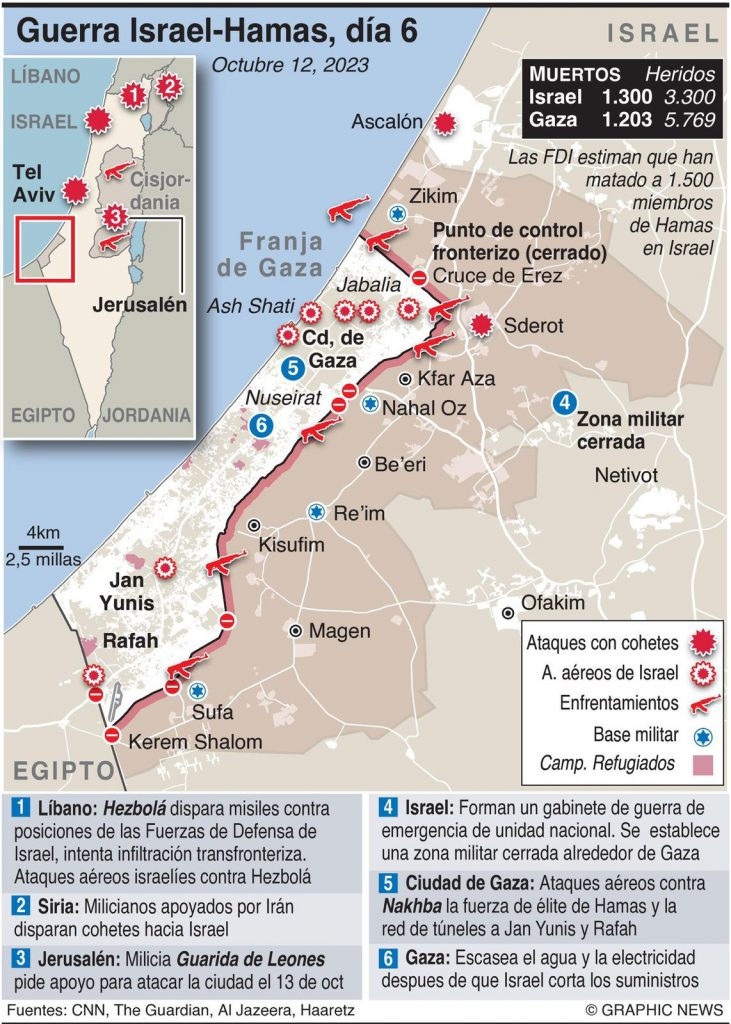
The huge surprise of Saturday, October 7, 2014, given by the irregular militia of Hamas to the IDF (Israel Defense Forces) was a confirmed evidence.

You do not prepare such a complex and extensive operation, almost in full view of many people, as if it were a country party. And, just like that.

You always have to do a general rehearsal of the total operation. And, subject the means to tests of duration and demands, at least equal, as in action. For example, a drainage motor must be tested, using it for the same number of hours that will be needed in the action. A combined arms operation must always be carried out, since, except between units that have already acted together before, implicit communication will not exist, and “mutual collaborative actions” are difficult to improvise.

The training space must have the same characteristics and complications as the real one. And, it would be convenient for it to be located far from the mission operations area, so as to be free of giving indicative signals to the enemy’s observation and espionage. Men, means and supplies must be moved to the training areas and returned to their bases of departure for the actions.

Communication between units must be practiced without failure, especially those of different arms (infantry with tanks, tanks with artillery, ground support aviation with those that have to support), that must collaborate in tactical subordination during the development of the attack.

Each important function must have a “reserve executor”. For example, a glider cannot be unique, in case the winds carry it down far from the target of attack:

German airborne forces attack on Fort Eben Emael, Liege, Belgium, in May 1940. It controlled, by means of heavy fire from a fortress (as well as several bunkers and armored and consolidated redoubts), the paved approach route towards Brussels for the combined German forces.

The airborne forces in gliders landed on the roofs of Eben Emael, closed the Belgian exits to the roof and used hollow-charge bombs-grenades (an Originality not used before) to overcome the roofs of the various redoubts of the fortress. The roofs were designed to withstand the fire of German heavy artillery. But the hollow-charge bomb concentrates the force of its explosion in a jet of fire and molten metal, which penetrates concrete and armor and whatever else is thrown at it.

The fortress surrendered as soon as the redoubts began to be blown up and assaulted.

In spite of all the needs and the long preparation time for the attack, all the Israeli intelligence agencies were surprised by the unexpected and sudden attack by Hamas irregulars, trained for this war action.

And the Israeli people realized that the protection of their lives and property by their unbeatable Army was not effective. And they remained frozen and seriously distressed for a long time. This vivid emotional wound does not heal easily or quickly. Because the possibilities of it happening again exist. And they are not inevitable as a quality. The psychiatrist has no arguments… only tablets ones…

And why did Hamas surprise?

The strongest, most powerful proxy of Iran and coreligionist of the Shiites in South-West Asia was Hezbollah, the Party of Allah. This one was guarded, it was infiltrated like a Gruyere cheese by Israeli agents and there were middle and high-level personnel from suppliers bought by them and the Israelis knew all the traces left by suppliers, collaborators, goons and relatives.

Israel‘s foreign action and special espionage means silently «occupied» Hezbollah. And, they were prepared to make it implode or explode unexpectedly.

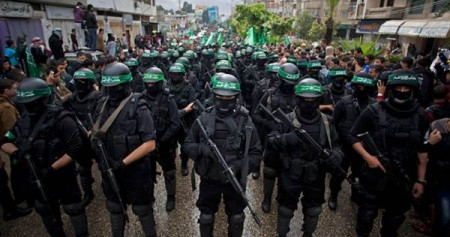
Hamas was the poor militia, squeezed into a very densely populated area. Capable of making a mobile or rigid Defense in Urban terrain against a trained, equipped, modern, motivated army. And, to endure the unbearable.

But, it was not supposed to carry out a more or less usual military attack, outside its external lines, keeping the objective won.

But, the Gaza attack did not intend to occupy, even for a couple of days, a tangible objective.

And, it was equipped with considerably fewer free-flying or guided rockets than Hezbollah was.

That is, it could pose a much less Orthodox threat to Israel than Hezbollah. It had tens of thousands of rockets of Iranian origin and acquisitions of very variable characteristics.

Hezbollah had a great political force in Lebanon and participated in its governance, and was a stronger and more motivated military force than the Lebanese national army.

There was plenty of information. Otherwise, it would have attracted attention and they would seek it out or implement it.

But, no one saw, detected, or heard of a Muslim militia capable of attacking Israel in the form of a “swarm” of “small units” (platoon or section type), operationally simultaneous. Trained as “reinforced mobile light infantry”.

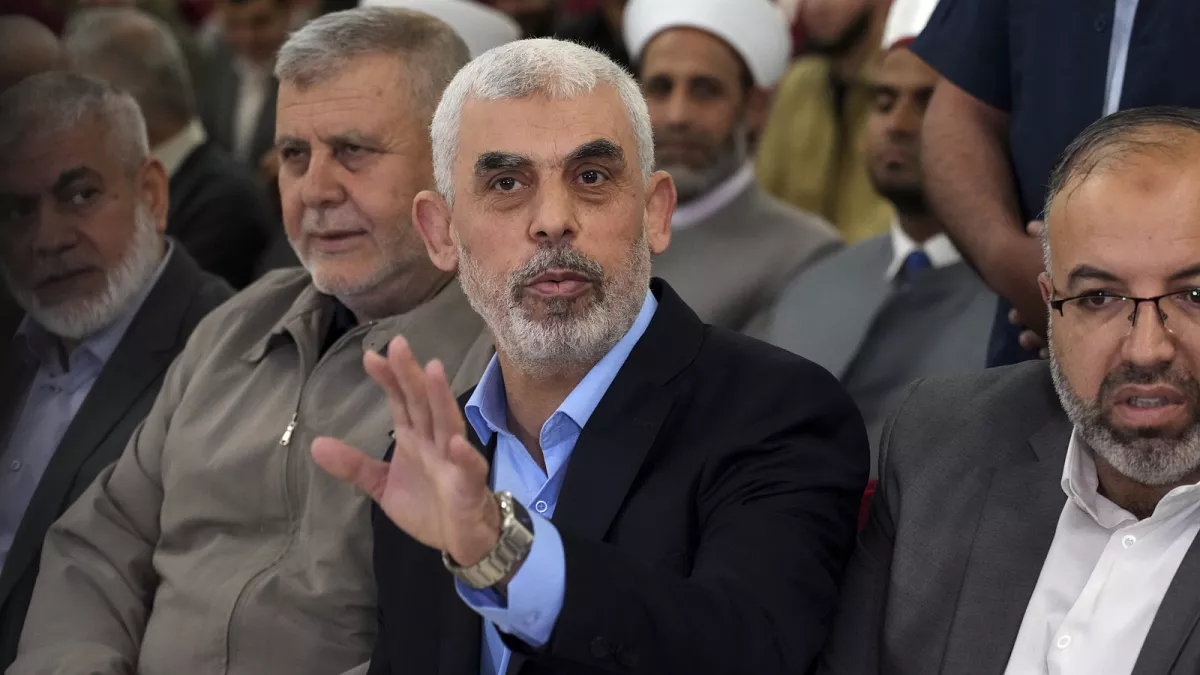
It seems that the Ideologist and Military Leader of the successful and unstoppable Attack on Israel (for a short time) was the late Yahya Sinwar. He was a prisoner of war in Israel for a long time as a young man. And, he was released in one of those agreed prisoner exchanges.

Sinwar had time to think and mature the plan. And then, to prepare it and carry it out. And, he had his advisors, from the Revolutionary Guard of the Islamic Republic of Iran.

General Qassem Souleimani, the original head of its Foreign Branch, in charge of supporting all internal Islamic movements in the countries of Southwest Asia, sureness participated in the military training of Yahya Sinwar. Souleimani was killed by an American attack drone, after landing confidently and safely at the Baghdad airport. And he received a salvo of powerful Hellfire II HE (high explosive) rockets.

And, Sinwar was impervious to Jewish (intelligence) penetration, even in a very poor population environment, prone by character and necessity to bribery.

And, in the early hours of Saturday, October 7, 2024, Hamas launched its thundering Lightning.

The ideological adaptation of the minor Jihad to current times.

Introduction.

Islam has to assume that the Jihad, as a “bloody effort in the path of Allah” was necessary for the establishment and defense of the primitive community of believers.

Muhammad took refuge in a cave near Mecca to meditate and pray. Around 610, he began to receive motions, visits from angels sent by Allah (God, in Arabic). “Prophet, hear and write,” they ordered him. But, he was illiterate and had to dictate the verses to his collaborators. They were the Meccan verses of the Khoran, eminently religious. The first to believe his preaching were his wife, Abu Baker al-Sidrique, his father-in-law, Ali, his cousin, and then his son-in-law, his slave… About 40-45 followers formed the Muslim group that lived with him in Mecca.

Towards 615, a group of Arabs from Medina came to see him. The Jews had taken power in the Arab city and they wanted to reconquer it. But they had no guide, no motivating sense or ideology.

Muhammad understood this perfectly. “The Arabs of Medina were a force without ideology” and “he was an ideology without force”. So, “Let us use his force for our ideology”.

The authorities in Mecca were increasingly concerned about visits to the Prophet by foreign Arabs. And, from the beginning, the leaders of the Arab community in Mecca saw the behavior and religious rites of the Muslims as strange.

The situation had to lead to violence. And, they decided to kill the Prophet, at least.

Warned, Muhammad and Abu Baker fled the city. It was the Hegira or march of the Islamic Community from Mecca to Medina (the city of the Prophet) in 622. The small Muslim community followed the longest coastal route, as directed by Muhammad.

When Muhammad arrived in Medina, he pitched his tent on the outskirts. Soon the Arab chiefs came out to greet and receive him as their leader.

An embassy from Mecca went to the Medinan authorities to have Muhammad handed over to them. But, “they have reaped the green,” the chiefs warned the Meccan envoys.

The Jews saw the threat from Muhammad and attacked them. Muhammad defeated them and expelled them from Medina. Here the Prophet received the Medinan chapters or suras of the Koran, of an eminently political nature and of the governance of the peoples.

From Medina, the Muslim forces attacked and plundered several caravans of merchants, some from Mecca and others on behalf of the neighboring Jews.

The Muslims were growing in military capacity and good relations with the neighboring populations. Their tactics using very mobile light units and reiterative attacks, looking for enemy weaknesses or creating them, were effective and novel in combating their enemies.

However, on the other hand, Mecca and other towns in western Arabia were languishing and losing influence. It was the pendulum of History.

From Mecca they ended up sending a contact group to agree with Muhammad on peace and the acceptance of Islam as the religion of the Arabs. The leaders of Mecca accepted Muhammad‘s conditions.

On November 1, 630, Muhammad entered Mecca victoriously. He suppressed the Jahiliyya, the state of idolatry and chaos in Mecca, prior to Islam, and turned the Kaaba, one of the existing idolatrous points, into a center of Islamic piety. Until then, the Muslims practiced Salat, their daily canonical prayers, directing their position towards Jerusalem.

Disconnecting himself further from the Jews, Muhammad ordered a change of direction towards Mecca, specifically towards the Kaaba, and established only 5 prayers a day, according to the solar positions of activity of the Muslims.

Soon the new religion will spread throughout the Arabian peninsula, with Caliph Abu Bakr (632-634) using weapons against the last arabs idolatrous tribes. In 632, the Prophet died in Medina, his favorite city, he was barely 62 years old.

Developments.

Now comes what I call the First Transformation of Islam. Outwardly, its followers denote a continuous (in historical measures, not in chronography) conquering and expansionist activity. This will last until the year 750, at the end of the Umayyad dynasty. These successes are associated by the Muslims with the fact that Allah is with them. It is a growing Muslim century.

In a series of conquests, the Muslims destroy and take the Sassanian Empire, from Anatolia to Persia, through Asia. And, from Palestine, through Egypt, Libya, Ifrigia, the Rif and Hispania, throughout North Africa and the western European peninsula.

Their attempts to penetrate into Central Europe were cut off on October 10, 732, in the battle of Poitiers by Charles Martel, in command of the Frankish troops. Forcing the Islamic light cavalry to face solid defense forces, in a practical adaptation of the phalanxes, supported by archers from their rear. And, with their own heavy noble cavalry attacking the Muslim light cavalry by shock.

The five daily prayers of Salat, composed of standing and bowing, kneeling and lying down, with head turns and the repetition of verses from the Koran, exert an increase in religious piety, love of Allah and belonging to the prayer group among the faithful.

Here would end the historical emergence of the lesser Jihad. The historical opportunity for which does not exist today.

The proof is that the lesser Jihad is not named in the Koran, it does not exist directly in the commands of Allah. It is not necessary, nor transcendent. It is occasional and temporary in the plans of Allah.

And, it must be replaced by “another suitable type of effort in the path of Allah”.

This would be the effort of personal inner development (ascetic), seeking the purification and inner improvement of believers.

This concept exists in the Sunna, where it is called the Greater Jihad and could be promoted by the pious ulemas (ideologists) and muftis (jurists).

Since the emergence of the four main Sunni ideological schools, from the year 750 until after 1000, the principle of the effort of Personal Reflection, the ICHTIHAD, also gained strength in Islam.

These are 250 long years, because in History the facts are unraveled. Without rigid borders that cut their temporal and mental spaces. In which the Second Transformation of Islam will occur: the Ideological one. Where the body of doctrine will be elaborated for the practical application of Islam, in all areas of men’s lives.

The Ichtihad will allow the development of Arab culture, both in relation to civil aspects (science, commerce, art, literature), as well as the enrichment of its «ideology». And it is the basis of ideologues and jurists such as the Palestinian al-Chafii, in Cairo, founder of the most elaborate and brilliant Islamic school.

Ichtihad is a source of lucidity, creativity, enrichment, progress and peace, on the path of personal and collective effort towards Allah (who is really the religious core and reason of Islam), when the Umma (Arabic name of the Islamic community) has already spread and multiplied enormously throughout the world.

But, towards the 11th century (5th century of the Hegira), the ulemas and muftis close the door to ichtihad.

The methodological approach of Islamic progress is altered. And, from then on, it is imitated, repeated, creativity is slowed down, sypnosis are abused.

At the same time, the arts, sciences, civil and social studies of Muslims are languishing. The fear (always paralyzing) of fulfilling the demands (real or forced) of Islam arises. Perhaps the appearance of the fifth ideological school of Islam has an influence here. The last, the hardest and most intransigent, the violent one. Without it, Muslims would not have INSTITUTIONAL ideological support to evolve locally and temporarily to violence. The Salafi school, which wants to imitate the Salaf or the pious predecessors, because they were supported by Allah in their extraordinary successes, for their fidelity and piety.

(To be continuing)

Russia and its Super Hypersonic Ballistic Missiles

Introduction.

Russia, the predatory Empire, which sells raw materials, oil, natural gas, electricity, rare minerals, and buys and copies technologies of all kinds and more sophisticated goods and maintains an incomplete Armed Forces. In 2024, they totaled some 900 thousand active troops.

The structure of these has an immediate officialdom, Junior Officials and Officers, in charge of carrying out the orders of the battalion commander. The orders of the battalion commanders are received from their brigade commanders (general brigadier), where the operational action of the forces is specified: making the tactical actions of the subordinate forces have a transcendence, an already operational importance, in the «higher plans».

The non-commissioned officers, corporals and sergeants, rise from the troops, from among the most active, experts and, perhaps, loyal. There are no non-commissioned officer academies in Russia, which would prepare them for their duties in the ranks. And these “classes” (the non-commissioned officers) are the ones that accompany, inspire and directly command the soldiers in all kinds of military operations.

The troops see them “as one of their own, not necessarily always the best.” And they consider this promotion to be their merit, distinguishing them from the troops. The officers, in turn, maintain their training status, command and prerogatives.

It is difficult to find here the weft and the plot for the forces of an army to always function in harmony, efficiency, training and professionalism.

We exclude the Rocket and Space Forces, Special Forces, Engineers and part of the Artillery and Armored Forces. They are an elite that boasts of it. And, on which Russia and its ruling class depend for its survival.

Valery Gerasimov is the Chief of the General Staff. And, in view of the successes that Russian soldiers were achieving in their combats and other operations in Ukraine, Putin also appointed him Chief of the Special Military Operation Forces in Ukraine. And, practically, Valery disappeared from the sight of the public and journalists.

A Chief must have his Advanced Command Posts so close to the active enemy, that it facilitates the leadership of the Chief.

During the Polish-Soviet War, from February 1919 to March 1921, Mikhail Tukhachevsky, Chief of the Red Army in the Field, had his command post in Kyiv, 500 km from the Front. And, Jozef Pilsidski, the Polish Supreme Commander, continually visited his divisions on the Warsaw front, half surrounded by the Reds. The Reds acted like an Asian horde, living off the territory they trampled, for their vital human needs. Suddenly, Pilsudski counterattacked and the Workers’ and Peasants’ Red Army retreated to Vilnius, the capital of Lithuania.

There are four stages in the trajectory of offensive missiles in which an anti-missile system could act.

They could be destroyed in flight in the atmosphere (even over enemy territory), shortly after their launch. The smoke trail that the engine throws out and the burning flames that accompany it can be detected immediately by satellites and reconnaisance aircraft.

Some attacking missiles could be altered in their trajectory by the strong and punctual action of an electromagnetic field, which acts on their control and guidance device. And it can do so throughout the post-launch stage.

Once fragmented or not, active warheads with multiple ogives, when the targets are already close, can be acted upon, by following final ballistic trajectories. These are easily calculated by the defense against aircraft (DCA).

In the final phase of flight, both missiles and their active multiple warheads can be intercepted by friendly missiles and aircraft, during descent or approach to their target.

An interested perceptive reader can already glimpse the crux.

One of the most important effective factors of the defense system is the Time of Arrival at the Enemy Target.

Current combat systems work up to speeds of Match 3, perhaps 4, more than 3700 km/h.

The Oreshnik (Hazel) 9M729 attack missile, launched from the Kapustin Yar cosmodrome in the Astrakhan region, reached the Ukrainian city of Dnipro, on the Dnieper River.

The Russians (Putin) wanted to show clearly what they have.

We must keep in mind that propaganda tends to deceive the enemy as best as possible. One way is by magnifying real, possible and uncertain successes.

The Hazel weighs about 50 tons and its approximate theoretical speed is Match 11, more than 13,500 km/hour. It is not an intercontinental missile, because its characteristics make it difficult to make a parabolic journey as short as the one in fact (Kapustin Yar-Dnipro).

Short-range missiles, up to 500 km, are considered part of reactive or rocket artillery and their attack operations zones are in the enemy tactical zone and in its operational rear. Here the enemy units reform and recompose, rest, supply themselves, advance to occupy combat positions or retreat towards their operational rear in that sector of the front. And, here there are almost no Units in Combat Readiness, for the defense of those areas.

Apparently, the Hazel is capable of carrying 6 submissiles, each of which would carry up to 6 attack warheads, with or without nuclear charge. The Hazel would fly at an impossible speed for the defense against aircraft (DCA) to work with. Because, simply, the data from radars, detection aircraft, would arrive already outmatched, no aircraft or missile of its own could reach and destroy it. It would be like the fox seeing and reaching the Road Runner.

In the Beginning it was the long range. The great enemies were the United States versus China and Russia. Both groups of enemies being geographically far away. The Europeans were stammering in the military nuclear field.

But everything evolves. France, Great Britain and Germany, the latter with its American military bases, were and could be, at first, effective aviation bases with nuclear capabilities.

Russia realized this and began to prepare its medium-range nuclear warhead missiles, capable of destroying nuclear vectors in Western Europe and attacking factories and logistics hubs and cities on the subcontinent.

This was achieved by vectors with a range of 500 km to 5,500 km. A new field of military air operations was born, unthinkable a few decades ago.

It soon became necessary for everyone to control and regulate medium-range vectors. On December 8, 1987, Ronald Reagan and Mikhail Gorbachev signed the Treaty on Intermediate-Range Nuclear Forces, which stopped the proliferation of these weapons.

But on 02/01/2019, under Trump, the United States suspended the Treaty, accusing Russia of continuing to test-launch this type of medium-range missile. The next day, Russia also abandoned the Treaty.

And a new battlefield was left open, messy and unfinished.

The Soviet Union is “no longer that”. The Russian Federation is a corrupt and backward country, to which a market economy has been applied. Its military industry is quite suited to its interests.

The Hazel supposedly has a range of 6000 km, which puts it squarely in the category of an intermediate or medium-range missile. And its capabilities crown it as the “Queen of the Party”.

How much does it cost? How many Hazels can they manufacture in a given period of time? Will they dare to use it with atomic nuclear warheads? Do they all work equally well? Is there reproducibility in the manufacturing series? These are fission bombs with a capacity of “tens of thousands of kilotons” of destruction.

Quite sufficient, quite sufficient.

THE WAR BETWEEN ISRAEL AND IRAN. An apocalyptic war? First Part.

Introduction.

We have before us, face to face, the two most dangerous and extraordinary rivals that exist on Earth. They are the Jews or Israelites and the Shiite Islamists.

What gives them similarity? Both have a strong religiosity, resistant to anything, which is part of their identity and the essence of their life.

The Jews or Israelites.

The Jews are a small people, who have survived the vicissitudes of History in a truly unique and special way: persecutions, pogroms, genocides, collective exiles, attempts at religious assimilation, collective guilt received, deportations.

According to their ideology, they are the people Chosen by God to guard and carry through History the Plan of Yaweh for Humanity. They hold, treasure the promises of God to Abraham, Isaac, Jacob, Moses. This is where their merit, stamp and superiority are consecrated.

The Israelites have deviated from this many times, but Yahweh‘s anger has always been appeased. Among other things, because God needs them to complete his plan for men. Yahweh has been sending his warners, messengers or prophets to correct them, and he has punished them collectively with exiles, famines, nomadism, a sign that it was the people who had turned away from Him.

For the sons of Israel, God is not a Father. This is implausible. God is a “Great and Powerful Creator Lord”, with all the characteristics in superlative. He leads them along his paths, rewards and punishes them. He made them at his image and likeness; but that does not mean that God has eyes, ears, legs and hands. And, He is Loving with all his creatures.

Only Christians see and feel in God a Father, in Jesus a Brother Redeemer and in the Spirit, the Guide and Consoler of their earthly life, gently and serenely.

This belonging gives the Israelites a reassuring security. They are not proselytizers, they do not seek to spread their religion to others, even to their foreign cohabitants. The others do not belong to the people of God and have nothing to do with Salvation. This is the marrow, the central essence and the core of everything.

This gives the Israelites an unprecedented, solid and secure courage in the face of a terrifying Nuclear War. Which Israel, from the start, does not seek, nor desire. They advance in the battles, without worrying about the greater number of enemies, because Jahweh Fights at their Side.

If God wants it will happen and they will be taken by the angels to Jahweh, at the culmination of History.

The Shiite Muslims.

There is a great ideological and practical difference between Sunnism and Shiism.

The latter feels persecuted, because of the dynastic orthodoxies (it defends the rights of the Prophet’s family to lead Islam) and ideological orthodoxies (it admits fewer sources of revelation, limiting the Hadiths, the sayings and deeds of the Prophet, by their origin – who communicated them- and line of transmission), which the Shiites proclaim and defend.

A’isha, the third and most cultured of the Prophet’s wives, would have been a caliph if she were a man, and Ali, cousin, son-in-law, husband of Fatima, the favorite daughter of Mohammed, are the two main and reputable creators of Hadith for Sunnis and Shiites. They begin like this: I saw…; I heard…; I knew… and the successive transmitters are also added. This chain guarantees the traceability of the hadith.

Omar, the second caliph after Abu Bakr, worked to purify and organize the Hadiths and the texts of the Khoran.

The schism of Islam was consolidated on October 10, 680, when the troops of Yazid, the second Umayyad caliph, defeated and killed Hussein Ben Ali, grandson of Mohammed, in the battle of Kerbala, in Iraq. The total number of casualties on both sides in the decisive battle of Kerbala was seventy.

The supporters of Hussein “son of Ali” (that is, Ben Ali, pronounced in English as Bin Ali. And then we call him as we hear his name, Bin Ali), were called in Arabic shi’at Ali, in short, Shi’is.

Everyone knows, from the displays on the news, the rituals of self-flagellation that devout men practice on certain Iraqi Shiite holidays.

A powerful reason for this sense of sorrow and suffering may be the great demographic inferiority of the Shiites. 90% of Muslims are Sunnis, who occupy the Holy Places of Islam and are spread throughout the world. Of the remaining 10%, the vast majority is Shiite, more than 86%, and the rest corresponds to small fractions, such as the Alawites of Syria, the Turkish dervishes. All of the latter are “heresy within the heresy” for Sunni Muslims.

In effect, the Shiites are like an island (Iran, Iraq, Syria, Lebanon, Pakistan, which are bordering and with a majority only in Iran and Iraq) surrounded on all sides by the ocean of the Sunnis.

(To be continued)

ACTION INTERFACES as Zones of TACTICAL DEVELOPMENT against the Enemy. Part One.

Introduction.

The action interface is a spatial concept that defines the zone and space where we develop violent action against the enemy and his means, following tactical criteria adapted to the nature of our objectives. The effective action factor in the action interfaces is the combined arms or inter-arms system.

In a penetrating attack, for example, the surface of the interfaces is quantitatively limited and these are selected in the enemy’s depth, according to their critical points and those that hinder the advance of our forces, for example, observatories and anti-tank firing points. In defense, we quantitatively increase the potential interfaces in our depth and in a somewhat laminar way.

The interface is what makes tactical action and the destruction of the enemy possible, applying a pure, chosen, selective and favorable attrition. The absence of interfaces, on the contrary, gives a certain security to any force. With the presence of the enemy, even close by, being a threat.

The interface is not only linear or frontal and with the depth of the range of heavy infantry weapons and tanks. But is extended superficially and spatially by the action of indirect artillery, surface destruction means (reactive artillery) and combat and bombing aircraft. The smaller the interface in an area of ​​operations, the more the operational maneuver criterion will work and in a larger interface. We will seek from advantageous positions and with effective and synergistic means (combined or inter-arms) to annihilate (incapacitate) the enemy.

The speed of exchange (actions and effects) in the interface is qualitatively variable and is conditioned by the transitability of the terrain and by the nature of our intention. In the attack we seek the fluidity of tactical actions. In defense, we wish to add a thickening to them, which will help us break the enemy in front of the front limit of the defense position and in the various ambushes and prepared fire pockets, both main and alternative as well as supplementary, preferably before their irruption.

In the interfaces there are certain critical points, where our tactical interaction with the enemy will be especially effective. These are their tactical vulnerabilities, their gaps in protection or combat capacity or their neglected means of defense, even if they are only so for a time. Combat reconnaissance is essential to detect them and it is the tactical leader’s mission to decide which one or ones to act on, seeking in the tactical decision, the operational significance of the higher command.

Combat capacity is applied on an interface with a variable depth depending on the weapons. Combat capacity has a maximum, useful, relatively stable value for the different weapons or weapon systems, which we can measure in men per meter of action interface.

For the shock, for example, it is not possible to use more than one man per 1.5 ms. of contact interface. For rifle fire, considering a platoon of 50 men useful for about 300 ms of interface, its value drops from 0.6 to 0.15 men per m. of front. Artillery would produce a blinding, disruptive, neutralizing or destructive effect, added to the action in the interface, but complementary to it and never a substitute. Machine gun fire would not substantially lower the proportion, since its fire “equivalent” to that of a certain number of infantry, depending on the terrain and its ability to acquire targets, in rapid fire of 15 rounds per minute and marksman.

Development.

However, from the wars of antiquity to the wars of the 1980s, dispersion has increased from a proportional value of 1 to 5,000 on the battlefield or tactical field. For modern static organized defense, it is equivalent to a battalion of 750 men in 3 km2. Mobile or nuclear defense can triple that surface. This dispersion has emptied the battlefield, now covered by direct fire and indirect fire support, and has allowed the operational terrain of large units to be greatly deepened, up to 50 to 75 km.

An obstruction, a gorge, a river in which the interface was reduced or altered, would limit the real possibilities of the attacker and greatly empower the defender. Thus, the defensive battle of King Leonidas in the Thermopylae gorge would be an example of containment of overwhelmingly superior forces, due to the absolute limitation of the interface of action between the Persian and Spartan armies and not being able to apply it to the critical Greek centers, for example, an exposed flank, until a shepherd served as a guide to a Persian contingent to reach it.

All this operational complication simultaneously makes most of the forces employed in an action unproductive or inactive at a given time.

Given that there is this practical limitation to the use of our available combat capacity, due to the disproportion between tactical space and combat interface, the issue of achieving the maximum application of our force arises.

To achieve this we must:

Increase as much as possible our favorable interfaces with the enemy, especially on the weak and critical points of his deployment; adequately rotate the units in tactical contact; maintain an adequate space for maneuver in our tactical rear, which allows us to push forward the necessary spears of attack or maintain the different possible defensive interfaces in the face of enemy irruption or penetration.

And employ each weapon in the most favorable possible interface of action:

Thus, the weight of the effort will be borne by the infantry in prepared attacks against an enemy ready to repel (for example, an anti-tank front), at long advance distances and in terrain with limited visual control, such as forests, built-up areas and broken terrain, with the tanks supporting them with fire and advancing by covered jumps. The tanks can go ahead in encounter attacks, in slightly undulating terrain and if the enemy has a poorer combat readiness, but taking care that the infantry closes the distance quickly. For short distances, we use the joint attack in the same sector; both weapons can advance from different positions in a convergent attack in encounter combats and in enveloping combats, the synchronization of both being fundamental. Inside the enemy position, the tanks attack the firing positions with their fire and the infantry clears the positions from their flanks.

It is also possible to structurally increase our favorable action interfaces with the enemy.

This is achieved in the attack by breaking through and penetrating favorable sectors and always by encirclement, reversal of fronts and encirclement and by coordinated frontal and overflow pursuit. The attacker’s successive echelons can, in turn, create a favorable action interface against an enemy that is not sufficiently defended, for example, artillery positions or communication centers or logistics parks, and also by a flank attack from our depth with mechanized or armored units, on an enemy counterattack against our penetration.

In the defense, the opposite will occur. The breach of the defense zone, even if it is mobile, will be avoided by increasing the possible unfavorable interfaces for the enemy along its «range».

This is achieved by the echelon in depth of active defensive means and by their preferential placement on the counter-slopes, in covered, hidden, preferably flanking, alternative and supplementary positions and received by a local infantry defense and seeking good and intersecting firing sectors. Also by the increase in interceptions (reinforced cuts, quickly placed minefields, natural obstacles more or less perpendicular to their sectors of advance) defended by fire, which channel the attack towards zones of convergent fire or which delay and erode it. And, finally, by the timely use of local counter-shocks and counter-attacks by mobile or, at least, rapid, tactical or operational reserves. These constitute the extraordinary and unexpected force that acts on enemy vulnerability, which is then in disorganization, dispersion and neutral morale before the consolidation of its gains from the attack.

The effective action factor in the action interfaces is the combined arms or inter-arms system. Each of them individually presents “action characteristics” and more convenient transitability, which give them a preferable target profile and tactical deployment qualities, from whose combination in the system arises the synergy of the whole.

(To be continued)

THE ART OF WAR OF GENGHIS KHAN. 2nd Part.

(Continuation)

The positional Dislocation of the Enemy.

Genghis and his army marched safely, crossing more than 500 km of the seemingly impenetrable Kizil Kum desert. And at the beginning of April 1220, Genghis Khan unexpectedly appeared in the city of Bukhara, some 500 km inside Transoxian territory, near the Amur Daria river.

Without having yet fought a major battle, the numerically inferior Mongol army had positionally dislocated the bulk of the Turkmen army and cut Mohamed II‘s line of connection with his western provinces, where many Turkish forces still remained immobilized for this war.

Idealized description of Lieutenant Subidai Bahadur

A “shock wave” swept through the Kharizmi field army, overwhelming it. Mohamed‘s troops remained in the various fortified positions and cities they occupied, defending them, but with a broken spirit. The operational unity of the forces, which is required for successive tactical battles to have significance, had disappeared. It was in the hands of the Great Khan to go waging the necessary combats to liquidate, as would happen in an «imaginary encirclement«, limited by the Sir Darya to the east, by its imposing and unexpected presence to the west, by the desert to the north and south, to the different enemy tactical groups in Transoxiana, already disjointed and disappointed.

Xenophon had already pointed out: “Whatever happens, pleasant or terrible, the less it has been foreseen, the greater joy or terror it causes. This is nowhere better seen than in war, where any surprise strikes terror into even the bravest.»

Mongolian combat idealization

Let’s see some passages from «My Reflections on the Art of War» by Marshal Mauritiusof Saxony, published posthumously in 1757. In them, a deep insight into tactics and human motivations is evident, greater than in any other work by a European author. since the Romans.

“Men always fear the consequences of danger more than the danger itself. I can give a multitude of examples. Suppose that column storms an entrenchment and its point reaches the edge of the ditch. If a handful of men (from the entrenched side) appear a hundred paces outside the entrenchment, it is certain that the head of the column will stop, or that it will not be followed by the elements of the ranks further back. Why? The reason must be sought in the human heart. In turn, let 10 men climb over the breastworks and everyone behind will flee and entire battalions will abandon their defending position”.

“When one has to defend entrenchments, all the battalions must be placed behind the breastworks, because if the enemy manages to gain a foothold on them, those battalions a little further back will think only of saving their lives. This is a general rule of war, which decides all battles and all actions. She is born in the heart of man and is what has led me to write this work. I do not believe that up to now nobody has tried to investigate the reasons for the lack of success of some armies”.

The Caedes.

Genghis and Subidai left one of the Bukhara gates uncovered. With this they sought to attract a large part of the garrison outside the city, to fight in the open field. Most of the garrison, made up of about 20,000 men, went outside, pretending that they were going to face the Mongols. But they really escaped to the southwest. The next day they were blocked on the Amur Daria and the Mongols overtook and destroyed them.

The rest of the Turkish forces locked themselves in the citadel, while the inhabitants surrendered the city. The Mongols advanced thousands of civilians ahead of them on the citadel and soon took it. During all the fighting, a large part of Bukhara burned and finally Genghis Khan ordered the demolition of its walls.

The aforementioned 3 Mongol armies then quickly converged on Samarkand, while Mohamed fled to the western confines of his empire. Some 50,000 men from the garrison of the capital went out to meet the Mongols and were isolated from it, which was left unprotected. And finally they were surrounded and massacred by the Mongols, who did not accept their requests to desert and join the forces of Genghis Khan, since he said that «whoever betrayed once, could do it again.»

Samarkand was inexorably at the mercy of the Great Khan, who took only 6 days to occupy it. Its remaining 20,000 defenders concentrated on the citadel, leaving all its inhabitants defenseless against Mongol looting. One night a group of about a thousand Turks slipped out and managed to flee. The Mongols soon stormed the citadel and killed the rest of the garrison.

After this, the fall of Transoxiana and the territory of Khorrasan (north of Persia) precipitated, without major combat, into the hands of Genghis Khan and with it hundreds of thousands of km2 of a great Islamic empire. This only survived until the year 1231, after its new defeat at the hands of the Seljuk Turks on its western borders.

A Mongolian special force under the command of Subidai went after Mohamed, who, abandoned by everyone, had become a fugitive and an outlaw. In January 1221 the Shah died of pleurisy on an island in the Caspian Sea, without the Mongols having been able to capture him.

Summary of the campaign and results.

In a rapid campaign of almost a year, the Mongols managed to defeat without great losses a seasoned army, which mobilized against them at least double the number of men, but which remained expectant in a static defense.

Employing a brilliant operational strategy, alternating their tireless capacity for operational movement with their proven and irresistible combat capacity and their terrifying techniques of consummate predator, Genghis Khan and his men maintained the initiative and freedom of action. Thus, they deceived their enemies about their plans, discovered their vulnerabilities and went eagerly for them. And dislocated enemy deployments, before attacking them or rendering them irrelevant and surrendering them.

(The End)

Military and National Intelligence, failures and results.

Introduction and Development.

The intelligence services of large countries are often correct in their opinions and forecasts.

The specific intelligence tasks to which a few modern agents are dedicated usually end with partial or total success.

Complex works with ramifications and developments, which hide an estimable but not certain future, fail miserably. Because of this complex and future peculiarity. And, because the ability to observe and measure a parameter of the human soul is something elusive, doubtful and uncomfortable. Next we will see several specific cases.

The reasons for the divergence of successes between singular cases and the projection into the future (foreseen solution) of complex issues, transcending time, are partly in the difficulty of their conception, in the risk that is run in venturing and in the non contrasted exposure to the commands. Obviously, there is a dialectic here between the concealment carried out and the cognitive and intuitive process of its imagination, development and projection (estimated solution).

Only analysts freed from Scholasticism and field manuals are capable of placing themselves in the free, impartial and lucid mental state or position. To capture anomalous, complex and difficult enemy situations. Since they are paid for results and speed, which are contradictory variables, the luxury of putting an analyst agent in a “quiet position” for an unpredictable, indefinite period of time is not usually acceptable.

The new techniques for detecting, observing and tracking targets should not be underestimated. Based on computers, electronic sensors, Artificial Intelligence. But, the presence of field agents should not be suppressed, but rather supported and increased. Cyber monitoring can specify for our spy the precise area of investigation and study.

BRIEFING OF A FIELD AGENT

The field agent is an infiltrator in a neutral or hostile environment. Able to approach and penetrate the government, business or social media of the rival. And capture relevant, important information in a consistent and sustained manner. The field agent gives a seal of verisimilitude or even reality to the information captured from the enemy.

It is not easy to recruit, train and insert your own field agent. Hence, in an era of haste, superficiality and intellectual complexity, technological means have been favored over field agents for espionage work.

Afghanistan 2021.

We all remember the moments of the change of government in Afghanistan in August 2021.

During almost 20 years of staying there, the United States had spent enormous sums of money on said stay, providing various support to the Afghan State and to choosing, training and equipping the Afghan National Army. The Americans even boasted in their public communications, especially from the Defense Department, that they were making progress in the anti-terrorist fight against the Taliban.

MARINES GUARDING KABUL AIRPORT

This turned out to be like the “Potemkin villages.” That the Russian minister of that name prepared in the path that Tsarina Catherine the Great would follow on a trip. So that her trashy inhabitants would appear happy and shiny as her Imperial Majesty passed by.

As soon as the last American troops had to withdraw, the Afghan soldiers, who also turned out to be shoddy, began to surrender their weapons and escape the feared wrath of the Taliban. US forces were only able to secure a defensive perimeter of the Kabul airport. But, the “friendly Afghans” and their families had to get there to board a flight. Fleeing the tidal wave of the barbarity of the Taliban (scholars of the Koran).

As it had been negotiated with the Taliban to accept control of the airport by Western soldiers for a few days, this was not enough for many «collaborators» of the Westerners (translators, drivers, cleaners, etc.) and their families. Many had to make a painful journey to Pakistan to gain their freedom and their lives.

Vietnam War. American stage,

In the United States, during the Vietnam War, the “Igloo White” program was established, endowed with 1.7 billion US dollars, between 1966 and 1971, for the tasks of collecting information on the North Vietnamese and Vietcong supply routes in South Vietnam. The route started from North Vietnam, entering Laos, near the common border, and was the line of all kinds of supplies for the aforementioned forces, operating in South Vietnam. The route was strewn with devices that simulated a plant and were transmitters of information for US intelligence. They measured 1.2 ms. and their battery lasted 50 days. Many times an unmanned flying object, a drone, was used, which collected information from the ground and transmitted it via television to a distant plane.

A SECTION OF THE HO CHI MINH ROUTE

With the data collected from traffic on the roads, the Americans decided on interdiction bombing actions, carried out by their different aerial devices, including the invisible, inaudible and precise B-52 strategic bombers. In early 1971, data from aerial photos after the bombings, taken from planes flying after the attack formations, allowed analysts to assume that the “truck war” was causing a very severe strain on the industrial capacity of North Vietnamese suppliers (China and the USSR).

Historia Desterrada: La ruta Ho Chi Minh: Eje logístico clave en la Guerra  de Vietnam

But, if it was true that so many trucks and equipment were destroyed, how was it possible that the communists maintained the initiative in South Vietnam? On the other hand, where were the tens of thousands of remains of trucks and other materials that literally plagued many of the roads and logistics parks on the Ho Chi Minh Route? Who bothered to remove them?

A more primitive stretch of the Ho Chi Minh Route

Another embarrassing issue was that the total number of vehicles counted by the US aviation as destroyed, exceeded several times the total number of cargo transport vehicles that North Vietnam had, according to Intelligency.

The answer to this essential mystery was soon given by the young American officers (juniors): they were eaten by a monster called the “Great Laotian Truck Eater”; a horrendous scavenger that rose towards dawn and devoured the vehicles destroyed by aviation during the night, after the required photographs for the “wreck count”, the count of debris achieved. Because Americans are very scrupulous with statistics and consider lying a «social sin» that is almost unforgivable for officials.

(TO BE CONTINUED)

Hamas attacks Israel in 2023.

General introduction.

Hamas commandos knew they would fight deep in Israeli territory. Very far from their supports, supplies and other Hamas units. Their targets were there: Israeli civilians and military personnel killed or taken hostage. And they knew that once 2 or 3 days had passed, the Israeli forces, superior in human and material resources, would attack, pursue, and ambush them. Their end, in general, was death. Since the Israelis would in this case still have a surplus of captured enemies. To interrogate and learn the parameters that Hamas used, to surpass them for a time: surprise them and establish combat superiority over their troops in many parts of Israel.

The various attackers carried out a “swarm attack” on positions in central and southern Israel. Several of the principles or norms of military forces in a conventional attack were disregarded. For example, the unity of the objective and the unity of command of the forces and the maintenance of a structure, of a deployment for all attacking forces. Here, each small Islamist “unit of action” had its own leader and its own objective. And, it is the set of actions of the “attacking swarm” that defines the strategy and complex real objective of Hamas.

YAHYA SINVAR, PALESTINIAN MILITARY CHIEF OF THE GAZA STRIP.

Here, Hamas forces attacked divided into a multitude of independent groups, small and sufficient, in charge of striking and/or destroying. Or occupy the Israeli military post, kibbutz or cooperative, and take Israeli or Western foreign hostages to send them to Gaza.

All of this reveals and shows us that the military effect sought by Hamas‘s multi-objective attack is an Internal Moral Shock, increased by the surprise factor of the action, already installed in the military establishment and in the populations of Israel. The aura of invincibility of the Israeli Armed Forces and the effectiveness attributed to Mossad and other affected security agencies, not so conspicuous, have been broken.

It is the set of «action units» of the militias, composed of variable weapons or branches of the FA: infantry, airborne, anti-tank, light armor, health, military police, which carries out, through these multiple and quasi-simultaneous actions on the Israeli Nation: The effect of shock, shattering, heartbreaking material and moral.

SEMI IRREGULAR HAMAS TROOPS PARADING

This multiple and general effect is inexorably transmitted to Israelis in arms through social mechanisms. The effects of damage to people and property not protected by the army, the invasion of cruel and vengeful Palestinian forces, which occupy and destroy different points in Israel, commotion and produce shock and disorientation of the troops.

Israel says it has mobilized almost 300,000 reservists to attack the Gaza Strip. They are not the best troops to maintain combat readiness and combat alert.

The geographical and military social scenario of the Islamist radicals.

The so-called Gaza Strip is a narrow, flat and small coastal corridor next to the Mediterranean Sea, located south of Israel. More than one and a half million people live crowded together in its approximately 363 km2 of surface. 99% of the inhabitants are Muslims and Christians number between 15 and 20 thousand souls. The strip reaches a demographic concentration of around 4,150 people per km2, which is one of the highest in the world. Its shape is that of an elongated rectangle, about 45 km long, measuring 12 km at its widest part. At the south is its border with Egypt of about 11 km, around the strategic city of Rafah.

To the east and north the Gaza border with Israel extends for about 51 km. The most important population of the strip is the one that gives it its name, Gaza, located in its northern third. The other prominent towns in the strip actually constitute “districts”, “peripheral neighborhoods” or “satellite towns” of the “ecumene” of Gaza. Among those not yet mentioned we will highlight Beit Hanoun (in the extreme north), Beit Layla, Sheikh Zaid, Dayral Balah (in the center), Jabalia and Kan Yunis (in the south, but not on the border with Egypt).

The unemployment rate of the population is between 35-40%. This makes it very dependent on external aid. And, furthermore, it excites their identity and social demands and defines as “solely” responsible for their evils the most visible, socially and culturally different, and close enemy, Israel. The search for a quick and utopian solution for this population necessarily requires a sufficient defeat of Israel, the oppressive and imperialist power. This makes its population very inclined to embrace “radical Islamist militants” doctrines and parties (the RIM). They allow them to glimpse and evaluate a solution, even in an indefinite and imprecise future. And at least they give them the hope they all need. Islamic Jihad and Hamas are the two main Islamist organizations with implant in Gaza.

Ideology of radical Islamist Palestinians.

Hamas, as a totalitarian socio-political-religious organization, exercises extensive power in all areas of civil coexistence of the inhabitants of Gaza. This power is also conditioned by the nature of the struggle in conditions of isolation, encirclement and hardship. This allows Hamas to invoke in its “general defense” the oppression to which the entire Palestinian population of Gaza is subjected, whether real, felt and/or magnified. Without, in practice, the tremendous suffering of the Palestinians being clearly distinguished from the victimhood wielded by Hamas or the Islamic Jihad. Between 100 and 200 thousand are the actual active militants of both radical organizations. In addition, there are their sympathizers and collaborators, with different degrees of involvement in the services and time dedicated to supporting Hamas and Islamic Jihad.

ISRAELI SOLDIERS DISCOVER FIRST HAMAS TUNNEL SINCE 2014 WAR

Hamas mesmerizes, tenses and grows due to the prospects of a more or less close confrontation with Israel. A people cannot be kept permanently in arms, much less in “combat readiness.” But, the reason for being of Hamas is to recover and imitate doctrinally, socially and militarily the epic and glorious times of the first century of Islam, which approximately coincides with our 7th century and the first part of the 8th. It was the era, after the death of Muhammad, extended in time beyond the first 4 caliphs, from Abu Baker to Ali, called by the Sunnis the Rashidun, the “rightly guided (by God)”.

Because its radical totalitarian ideologists have decided that, when Islam practiced armed Jihad and was rigorous in its faith and customs, Islam convinced, overwhelmed, spread prodigiously across three continents and was almost invincible… And they believe that by reproducing the “basic conditions” of that social context, of that booming civilization, today’s Muslims will once again be great, feared, respected and accepted. There is nothing more and nothing less.

We verify that every few years a “casus belli” occurs or is caused, worthy of its name and with its pernicious effects for the corresponding populations. Thus, there are not many possibilities of being able to truly dialogue with this, to reach common ground and reach peace agreements that are consistent and acceptable to all.

Operational considerations of the Defense of Gaza against Israel.

The land defense of Gaza is very difficult to sustain over time. The strip lacks geographical space to establish a flexible, mobile and echelon in depth defense. This is necessary to give power, solidity, continuity and support to the rejection struggle.

Furthermore, the external supply of weapons, ammunition and military equipment to Hamas would be strangled by Israel. To ensure the sealing of Gaza, the Tsahal could establish “locks”, located transversely in the strip and occupied with reinforced mechanized infantry. They would prevent the transit of military equipment from Egypt. Iran‘s weapons and equipment have their hub or logistics center in Yemen. From here they are transported across the Red Sea to northern Sudan, from where they depart in caravans of trucks. They cross into Egypt halfway along its southern border and head to Rafah.

The Israelis sporadically carry out bombing raids on this “evil route”, concentrating on the intermediate depots along the route and on cargo vehicles. In October 2012, an unexpected explosion destroyed a weapons factory near Khartoum, the capital, and other times, truck convoys are destroyed. The naval persecution of this smuggling flow, through detection and exploration drone flights over the Red Sea, is carried out by the USA. And it is the scarce and reluctant collaboration of the three countries involved, Yemen, Sudan and Egypt, which does not allow the transit (traffic is merchandising) of heavy reactive artillery weapons to be made excessively burdensome for intermediaries and with little return for the end user.

(to be continued)