THE INFANTRY FIGHTING: EAST VS WEST.

The last tens of meters up to reaching a determined enemy or gullible in his positions, form the fighting zone of the infantry. And she has yet major validity and importance in the actual wars. With the approximation to the combat from the brigade, the last global direct human possible vision of the units and resources, and the division, the western doctrines tend to be fixed in the dominant characteristics of the area and of his transitability or ground ongoing throughout the day and of the years seasons and according to the climate, to realize his plans.

But they neglect the use of the microarea at the levels of squads, teams, companions pairs and weapon servants. In the microarea, by means of the cover, the patience, the secrecy and the concealment, those «combats groups» might use against the enemy, his capacities of resistance (to the surprise), of mobility or concealed tactical «activity» (in the defense), of initiative and of freedom of action. Operating over him in minuscule «action interphases» (or microsectors). This is specially actual and necessary in the fight against regular and irregular «nobody» enemy, which lack the modern military technological advances and the economic resources to provide them. And that search for need and/or idiosyncrasy, to compensate his asymmetries with the domain of this infantry fight, seeking to see this way the white of the eyes of the enemy.

The military American Doctrine for the modern Wars.

The news that are received since years from the war operations zones in the countries in conflict, proceeding from the journalists inserted in the fighting forces, of the correspondents detached in the different populations of those (Kabul, Baghdad, Saigon, Hue) and those that the armies in presence issue, are revealing a series of characteristics that are common to the forces of the different western modern armies. They all are following the trend initiated by the Americans of having the enemy less nearby, more seen and observed and more beaten by the heavy air and artillery fire. It is not looked with this, in increasing effects order, to blind it, to disturb it, or to neutralize it, but to destroy it. That is the costliest and improbabliest of his effects and that demands an increased and deficient expense of the resources. And the worse thing is that does not always exist his direct connection with the offensive maneuvers of the ground forces. That often do not come to beating the broken enemy after the fires blows. The ground deployments are «secondary» and, therefore, also are his movements, dispersions and concentrations. The heavy fire has turned into a «economic and industrial» substitute (it changes military effort into dollars) of the maneuvers and the assaults of the ground forces. And the reason of all that is known by the poor and asymmetric enemies of West: the horror to the risk in combat and to assuming falls.

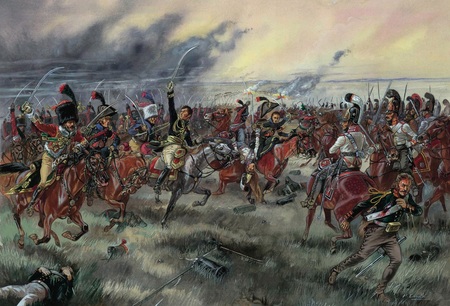
Resultado de imagen de deep battle american doctrine MONGOLS SOUGHT FOR THE ENEMY DISRUPTION, ATTACKING ITS VULNERABILITIES, PENETRATING ITS EMPTY REARWARDS, MOVING FASTER AND CREATING APPEARANCES FOR THE ENEMY.

The massive employment of the heavy fire is the principal «argument» of the Pentagon. His doctrine (Field Manual of the US Army 100-5, Operations) does not emphasize the initiative and rests in enemy reacts to the «real or potential action» from protected positions in the whole operations zone. The USA has created a ground forces with few capacity and skill in his small units for the combat in the infantry fighting zone, where more risk take the men. The trend of the doctrine looks for a formation (knowledge, education and command) and an intelligence (as elaborated, sufficient and constant information) excellent and abundant for the chiefs and officials. They are the managers of conceptualize the combat and the persons in charge of the fulfillment of the mission of his units and small units. It is supposed that the soldiers will do well and will work well, being able to use his sophisticated equipments and those of his companions of unit and fulfilling the orders of his subofficials and officials. These are supposed elaborated at the sufficient level, to give them perspective and cohesion with the intention of the high controls.

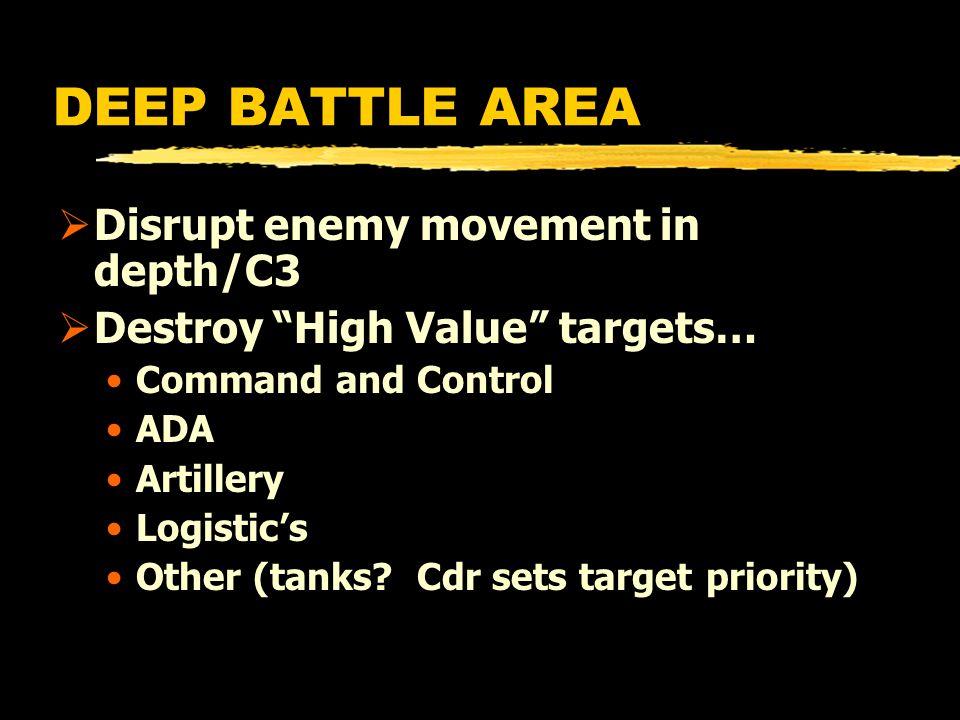
Resultado de imagen de deep battle american doctrine GOOD AGAINST A II GENERATION ARMY AND MORE CENTRALIZED THAT OURS: THAT OF SADAM HUSSEIN.

One of the operation principles that gathers strength in this renewed doctrine is that of the simultaneity. This establishes to beat at the same time, with heavy fire of artillery and aviation, the first and second enemy attack echelons and even his reserve, using against her the aviation and the tactical rocketry. The infantry and tanks forces are designed to attack or to counter-attack this now beaten enemy in all his depth and to assure the battle decision. Here does not exist the detection and the assault to the enemy weak points. Nor the «general saving» (an essential, universal and original principle of the war, according to Fuller) of means and of human lives. Nor the skilful, risky and fruitful maneuvers of functional and/or positional dislocation of the enemy. In opened area, the infantry cannot attack without indirect and/or direct heavy fire support and without concealment (night, fogs, smokes, draggings). But this complementary support has been hypertrophying, up to turning into a «weapon» for itself (as decades ago it was tried to do with the tanks) in the mix of the military resources and in one supposedly «maneuvers warfare». About which speak, but not well applied, the updates of the FM 100-5 from 1985. The such promising, already omnipresent and wished “not driven planes” of exploration and/or bombardment or «drones» are not more than the global projection in scope, safety of employment for the user and game of possibilities of the heavy fire, about which we speak. The marshall von Hindenburg designed the adage: «A battle without Schwerpunkt (the place where or the unit that applies our “principal effort”) is like a man without character». The North American army acts generally evoking a heavy, forceful mace, hammering and excessive. The Afrika Korps, by the contrary, reminded us an elegant, agile, unforseeable, (almost) sufficient and effective foil.

The Employment of a IIIrd Generation Army in the “military asymmetric” Enviroment.

The wars of fourth generation are the counterinsurgency wars or guerrilla wars or irregular wars or armed revolts or national liberation wars or organized banditry, which always have existed, coexisting with the conventional variants where only regular forces combat. They are those that the USA has lost or not won lately: Vietnam, The Lebanon (Marines’ peace disembarkation, then demolished in his barrack), Somalia (the uncontrollable and unforseeable wasp’s nest of «all against all» of the tribal masters of the war and the militias of the Islamic Courts, now of al-Shabab), Iraq and Afghanistan. They are very unequal wars against an enemy of lower technological military level man relative to the own regular forces, taken root almost always in the own or occupied civil population, militarily low intense and extensive or long in the space and the time. With awkward frequency, when the human (own or local agents) or technological Americans «sensors» detect some probable rebel activity of the yellow ones, muhaydins or hostile foreigners, they first devastate the building, the «block», the zone. What for them is really a surface target. And then they are going to wipe off and to do the corpses inventory, the «body count». Sometimes between the rubbles they can meet the corpses of a yellow, blackish or innocent and numerous Muslim family. It abuses of the attrition, when the enemy fuses with the civilians. It is careless the active, unexpected patrolling work, who needs proportionally less material and human means. But that bases In the military trade, the physical and moral courage, the freedom of action and the creativity in the low and intermediate commands and in the men.

Imagen relacionada OBAMA FIRED CENTCOM GENERAL MATTIS WITHOUT A PHONE CALL.

The western soldiers have exchanged or forgotten the «principles» or rules of the good to do in the war, for the simultaneity and the depth of the distant fire, covering the whole enemy highly probable zone. With it there is neither means economy, nor principal effort, nor the necessary discrimination between soldiers and the potentially enemy civilians. The armies look eagerly for the safety and the confidence in his decisions and missions. Precisely when the environment in which they are and act in the last 5-years periods, the guerrilla or asymmetric wars, is variable, fleeting, without definite limits, confused and hard to grasp. The uncertainty, the chaos, the mistakes, the friction and the failures, the scanty means and the partially fulfilled plans, the weariness and the fear are the «omnipresent demons», that characterize and concern this neutral «magma» of the war. And it is neutral because it leaves being drive and guide largely by the human superior «plans and actions». That are stimulated by the «correct sense» of the commands, the determination, the will, the physical and moral courage, the motivations (ideological, religious, ethnic, social…), the suitable training, the sufficient equipment, the commitment with the tasks and missions and the respectable and respected commands.

Resultado de imagen de obama got away from iraq and afghanistan SOME DEADLY RECORDS.

George Bush’s strategic national doctrine established, but without being due explained, not tacitly accepted by both American parties, that the «asymmetrical wars» (irregular and with low level of military equipment) were supported and necessary, to remove of the American territories and those of his allies, the threats of the fundamentalist foreign terrorism of any origin, religion or ideology. It justified the ill-fated post war bad oriented occupations of Iraq and Afghanistan. But, with a fiscal and exterior deficits ran away and with a Democrat Administration, it is necessary for the USA to save in military resources. To dedicate them «to construct a nation here, at home», as defined Obama. This way, the USA lowered qualitatively the bar of the exterior terror, putting al-Qaeda as almost the only one violent not national enemy. This internationalist salafist terrorist «network», with delirious and impossible ideas, without own territory, with his operational chiefs known, fled and not wished as guests in a normal country, is a more attainable, adaptable and manageable aim for his forces and means of «rapid punctual incursions». This justifies the increase of the use of the drones, spy satellites, own or local agents in the hostile areas, operations of assaults by elite units and small expeditionary forces and of Marines amphibious assault. These transported by «ships of control and transport» of strategic projection with his naval escort. The deployments of tens of thousands of military men and his luggage and specific equipment for several years in an operations theatre, they are indefinitely rejected by the new «doctrine» of the «diminishing defense».

(TO BE CONTINUED)

El Combate urbano contra la Insurgencia moderna.

Introducción.

Las tropas estadounidenses y europeas están preparadas para luchar contra un enemigo militar regular, dotado de un ejército de masas. O incluso más moderno, de III generación, con medios más elaborados tecnológicamente y hombres mejor entrenados para soportar las soledades y tensiones de los esperados campos de batalla actuales. En definitiva, su “medio”, su espacio de actuación, es el enfrentamiento directo y abierto en presencia de una gran profusión de probables blancos enemigos. Su instrumento es la atrición, la destrucción de los objetivos que presente el enemigo y puedan ser detectados y adquiridos en toda la profundidad de su dispositivo de marcha o de ataque. Los dos últimos escalones enemigos, modernamente cada vez más alejados o profundos, son alcanzados por la aviación de apoyo táctico de largo alcance o con la cohetería balística o autónoma de medio alcance.

Resultado de imagen de Russian Ordnance fire in Middle East

¿Cuál es aquí el papel del hombre? Detectar y confirmar los blancos enemigos, intentar fijarlos si se trata de una patrulla o pequeña unidad de combate y llamar a su “ordnance” para que los arrase. Sólo sus unidades de élite, siempre escasas y, por tanto, excepcionales y preciosas, son formadas en la lucha cercana de infantería empleando sólo sus medios orgánicos.

En Irak y en Siria las bases islamistas están siempre en las ciudades y poblaciones más favorables a la actividad de sus distintas bandas. Y ellas están rodeadas o permeadas por fuerzas militares locales y foráneas. Ya al principio de la guerra, la inteligencia norteamericana interceptó un memorándum de 17 páginas escrito por Abu Musad al-Zarqawi, anterior jefe de Al-Qaeda en Irak, y dirigido a Osama ben Laden. En él le expresaba su preocupación por su supervivencia: “En Iraq no hay montañas donde podamos refugiarnos, ni bosques en cuya espesura nos podamos esconder. Hay ojos avizores en todas partes. Nuestras espaldas están expuestas y nuestros movimientos se realizan a la vista de todos”. Y este espacio geográfico militar es similar en Siria.

La Actuación de las Fuerzas militares contra la Insurgencia actual.

En los libros sobre la guerra de guerrillas, se trata de la táctica del cerco a las posiciones militares fijas o semipermanentes. Las guerrillas, privadas en las primeras fases de una revolución ideológica armada (Estado Islamico, al-Qaeda, Frente Moro, milicias de al-Shabab, comunistas, de lucha contra el ocupante extranjero) de suficiente capacidad militar, tienen sus pautas para atacar a dichas posiciones militares.

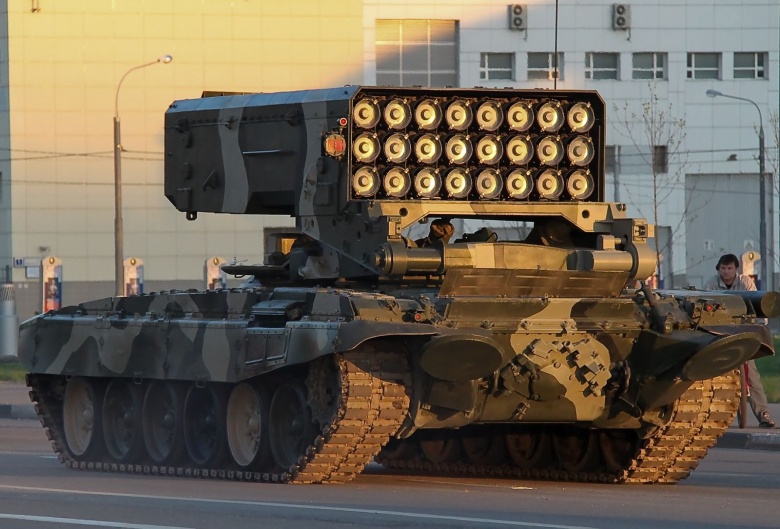
Resultado de imagen de Russian Ordnance fire in Middle East ARTILLERÍA REACTIVA RUSA EN SIRIA

En las zonas no dominadas por las guerrillas, pero limítrofes a las áreas bajo su control, es donde se desarrolla la lucha de aquéllas por desalojar al enemigo militar. Buscando también controlar esas áreas y realizar en ellas su adoctrinamiento ideológico de las poblaciones. Las bases guerrilleras sólo pueden crecer en espacio o aumentar su número, cuando el enemigo militar se retira. O cuando sus posiciones (puestos avanzados, cuarteles) son sometidas a un cerco más o menos cercano y ferreo. Que debe ser continuo en sus efectos: o sea, controlando las vías de aproximación y de salida de aquéllas. Para amenazar, hostigar, probar y atacar en su momento a las fuerzas cercadas. Y a las columnas de refuerzo y aprovisionamiento que acudan en su auxilio, mediante asaltos limitados, emboscadas y trampas y bolsas de fuego registrado.

En las regiones infestadas por las guerrillas, no necesariamente ocupadas por ellas, las posiciones militares son fortalezas protectoras, extensas y poco numerosas. Su guarnición es elevada. El conjunto militar evoca allí un bunquer ciego, torpe y poco móvil. Los militares realizan desde ellas operaciones de fuerzas especiales de exploración y contra posiciones guerrilleras y de marcha al combate sobre objetivos de zona, a cargo de columnas nutridas. Para ocuparlas y defenderlas, según las capacidades de las fuerzas militares. En esto es decisivo el compromiso y la moral de ellas.

Resultado de imagen de Bombing in Middle East BOMBARDEO DE SATURACIÓN DEL GOBIERNO SIRIO
En la guerra irregular contra las bandas del Estado Islámico, las fuerzas armadas y sus auxiliares utilizan en su estrategia operativa, algunos de los 10 principios militares de Mao Ze Dong para dirigir las tacticas de las guerrillas y de los semirregulares chinos. Aquellos fueron enunciado por Mao el 25 de diciembre de 1947 en su discurso ante el Comité Central del PCC. Veamos, en orden no necesariamente original:

1) Atacar primero a los enemigos aislados y esparcidos y después a las fuerzas enemigas más fuertes. 2) Tomar primero los pueblos pequeños y, finalmente, las poblaciones grandes. 3) No luchar poco preparados en combates, ni presentar combates en los cuales la victoria no sea segura. 4) Concentrar siempre para cada combate fuerzas absolutamente superiores a las del enemigo. 5) Aprovechar para destruir al enemigo mientras se mueve y es más vulnerable. 6) Usar los intervalos entre campañas para descansar y reagrupar y entrenar a las tropas…pero no permitir que el enemigo tenga una pausa, ni un respiro. 7) Tomar primero los pueblos pocos defendidos. Y, cuando las condiciones nos sean favorables, aquellos con defensas medianas. Y esperar a incrementar nuestras ventajas, para asaltar las ciudades mejor defendidas.

Esta estrategia operativa perfilada por Mao, empleando normas simples, didácticas y efectivas, es de un nivel militar bajo. Como corresponde a una insurrección que tenía que crecer, desarrollarse y extenderse. Y que empleaba a fuerzas campesinas iletradas y se armaba principalmente con las armas enemigas capturadas. Mao decía que él “tenía una opción de compra en los arsenales británicas”.

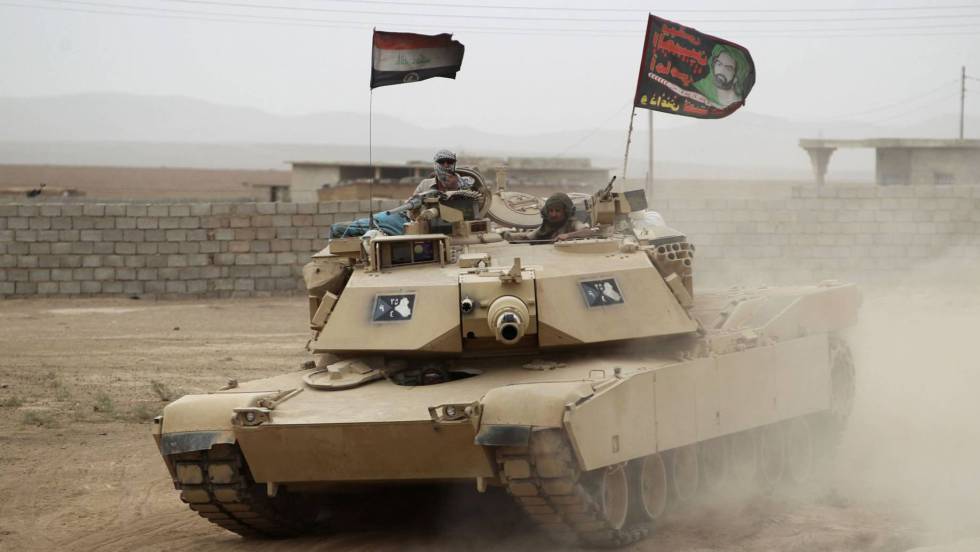
Resultado de imagen de ejercito iraquí chií TANQUE IRAQUÍ CON ESTANDARTE CHIITA…

Pero esta misma estrategia operativa ortodoxa del débil insurrecto contra el fuerte militar, es la que van a emplear las fuerzas aliadas aglutinadas y apoyadas por los EE UU y Rusia (en Siria), para combatir a una insurgencia islamista, atrincherada en sus bases urbanas. Y manteniendo el empleo masivo, reiterado y abrumador del fuego pesado moderno aéreo y terrestre sobre los insurrectos. Tanto en las batallas y combates que se planteen, como para el desgaste e interdicción de las posiciones islamistas, sus instalaciones y movimientos.

Buscando como objetivos estratégicos derrotar a los insurrectos y ocupar sus bases o posiciones. Que serían saneadas finalmente por una labor de policía. Bases que son los únicos objetivos duros, definidos y estáticos, que tienen los guerrilleros. A diferencia cualitativa de los objetivos difusos, elusivos, fugaces y escurridizos que ofrecen los guerrilleros en movimiento. Bases que se atacan directamente, empleando las fuerzas militares (a las que se supone mejor entrenadas y equipadas y, al menos, igual de motivadas, que los rebeldes) y su enorme potencia de fuego directo e indirecto.

El problema militar y social que hay aquí es que los grupos rebeldes árabes aliados, los peshmergas kurdos y los militares iraquíes y sus milicias leales, carecen de las virtudes militares de los ejércitos nacionales cabales. Y han adquirido hábitos no militares sobre la preservación de sus hombres en combate. Evitándoles a ultranza la mutilación y la muerte. En ello han influido decisivamente los orígenes religiosos y sociales de los distintos grupos combatientes “aliados” y sus intereses y objetivos divergentes, cuando no antagónicos, dentro de esas dos guerras civiles. Elementos y parámetros sociales contaminados, espurios y, aún extraños, ante el concepto de la Umma de fieles de un mismo dios, Allah.

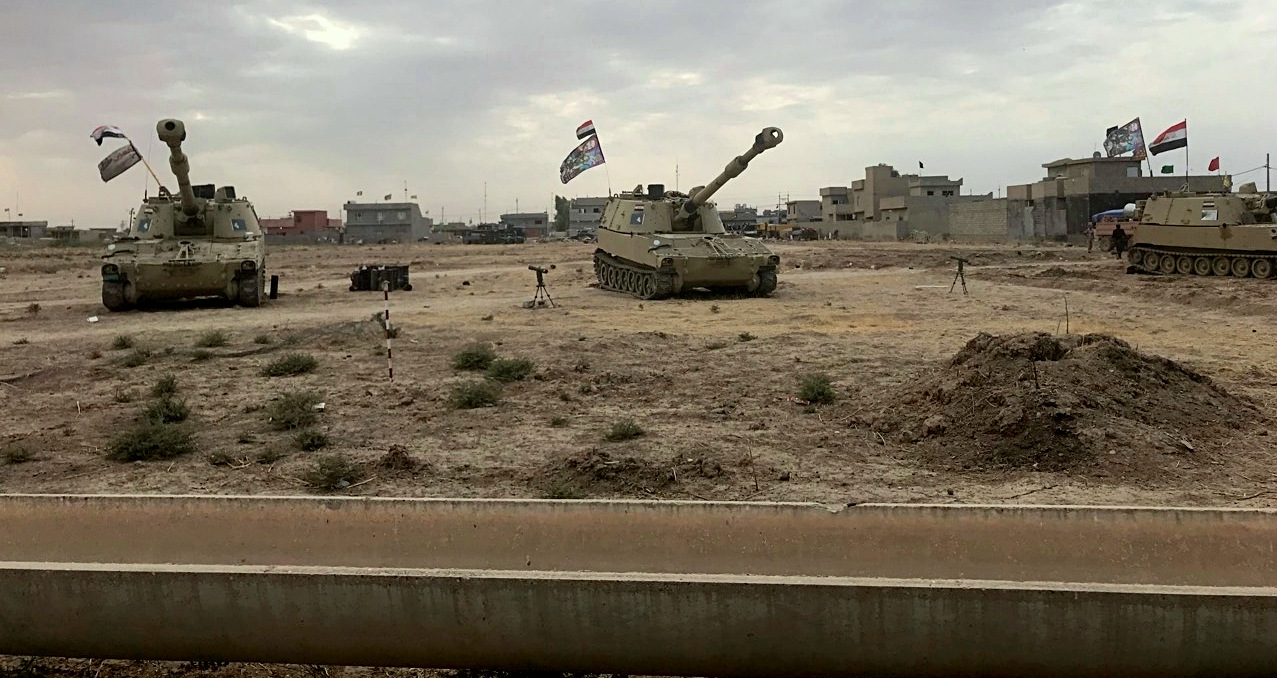
 Resultado de imagen de shia tanks against isis ARTILLE-RIA  MECANIZADA IRAQUÍ EXHIBE SUS INSIGNIAS CHIÍES…
Siguen para ello esa estrategia operativa de ir muy poco a poco, ocupando primero las posiciones islamistas más débiles que rodean y defienden a las más grandes. Arrasando con el fuego pesado desde la distancia las posiciones islamistas descubiertas, que están entreveradas con las casas y refugios de los civiles. Porque la guerra la sostienen, tanto los estadounidenses como los rusos y todos sus aliados, en los terrenos urbanos de lucha que son las poblaciones ocupadas islamistas de Irak y Siria. Y la prolongación de la guerra, el mayor tiempo que emplearán para conseguir sus objetivos militares, preservando a sus hombres en el combate, lo pagarán los civiles. Con su sangre, con la destrucción de sus medios materiales y edificios y con masivos desplazamientos, buscando ya sólo salvar la vida y sin saber quién les acogerá y ayudará.

Veamos un ejemplo histórico de la actuación de fuerzas contrainsurgentes, en condiciones desfavorables para ellas. Las fuerzas antipartisanas alemanas en la URSS intentaron siempre no ser forzadas por los guerrilleros a la pasividad de la guarnición o la escolta. En su manual de “Guerra contra las Bandas” establecían que “la iniciativa debe ser siempre nuestra. Incluso si el comandante solamente tiene una pequeña fuerza a su disposición, no debe mostrar fallos en su resolución. Si es posible, cada acción de las bandas debe ser contestada”.

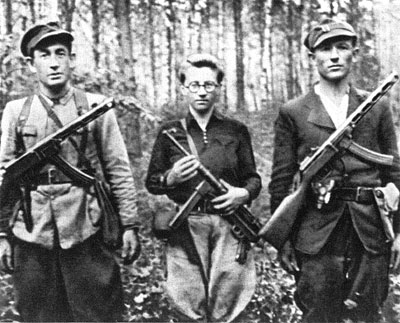
Resultado de imagen de german anti partisan operations PARTISANOS SOVIÉTICOS.

Los alemanes no sólo estaban obstaculizados en sus operaciones contra guerrilleras por una habitual inferioridad de hombres. Sino, también, por la heterogénea calidad de las que disponían. Sus tropas antipartisanas consistían en una siempre variable combinación de fuerzas de diversos orígenes y calidades: tropas de fronteras y tropas de seguridad y policía alemanas; tropas de seguridad de sus aliados en el frente del Este, especialmente italianos y rumanos; y una mezcla variopinta de fuerzas “rusas” aliadas de seguridad y de autodefensa, a veces, inseguras. El núcleo duro de las unidades eran los alemanes. En los puestos no se solían poner tropas homogéneas. En ellos las calidades se entreveraban, para que la presencia del fuerte animase al más flojo o novato, y le alejase los pensamientos de debilidad o deserción.

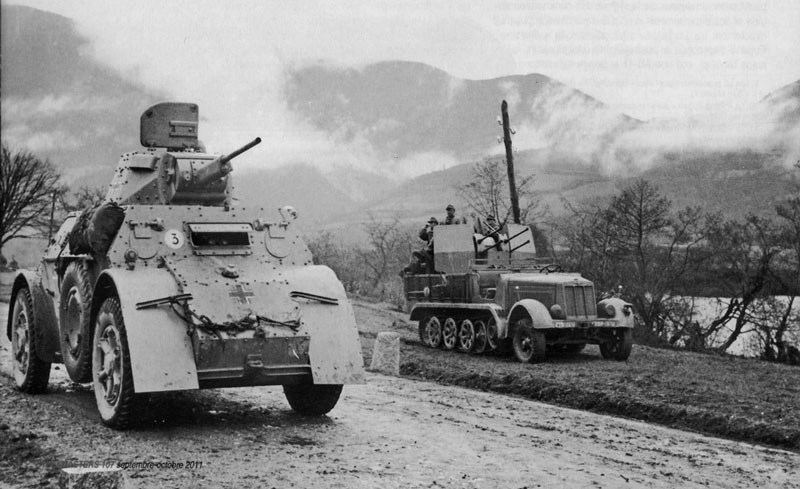
Resultado de imagen de german anti partisan operations BLINDADOS LIGEROS DANDO APOYO DE FUEGO EN UNA OPERACIÓN ANTI PARTISANA EN RUSIA.
Ante la imposibilidad de guarnecer su retaguardia en todo el territorio conquistado a la URSS, al oeste de una línea imaginaria trazada entre Leningrado y Stalingrado, los alemanes tenían que seleccionar muy bien los puntos de guarnición. Éstos pocas veces contaban con más de una sección de fuerzas contraguerrilleras. Además, se consideraba que con 4 o 5 hombres, el puesto podía ser defendido por un tiempo. Mientras, los otros, en 1 o 2 patrullas, salían a perseguir a los partisanos en las aldeas cercanas, a vigilar la vital línea de comunicaciones o a apoyar a otros puestos. Cuando se creaban nuevas unidades o si había un “sobrante” temporal de fuerzas antipartisanas, se formaban patrullas de exploración y combate, algo así como unas fuerzas de reconocimiento en fuerza, para localizar y hostigar a los guerrilleros. Cuando era necesario realizar una acción ofensiva mayor, ante una amenaza guerrillera o la localización de una concentración importante, incluso se traían temporalmente tropas de primera línea (de la zona operativa) para el ataque y destrucción de aquélla, generalmente buscando su cerco y aniquilamiento.

Es cierto que los resultados alemanes fueron limitados. Y también es cierto que el principal objetivo operativo de sus fuerzas antipartisanas se cumplió. Se mantuvieron razonablemente abiertas las líneas de abastecimientos desde Alemania, Polonia y Rumania hasta las retaguardias de las fuerzas alemanas y de sus aliados en el Este. Y el flujo de hombres, armamentos, equipos, repuestos y mercancías que recibieron fue constante, para permitir el gigantesco esfuerzo de guerra contra los casi inagotables recursos de la URSS. Millones de prisioneros soviéticos fueron enviados al Reich y hacia allí retornaron incontables unidades y hombres de la Wehrmatch, en sus continuas rotaciones.

Modern Allied Urban Warfare against the Insurgency.

Introduction.

The American and European troops are prepared to fight against a regular military enemy provided with a masses army. Or even more modern, of the IIIrd generation, with more elaborated technologically means and better trained men, to support the lonelinesses and tensions of the awaited current battlefields. Definitively, his «way», his action space, is the direct and opened clash in presence of a great profusion of probable enemy targets. His instrument is the attrition, the destruction of the aims that the enemy presents and could be detected and acquired in all the depth of his march or assault deployment. The last two enemy echelons, nowadays increasingly remote or deep, are reached by the longe range support aviation or with the ballistic or autonomous missiles of medium range.

Resultado de imagen de Russian Ordnance fire in Middle East

Which is here the role of the man? To detect and confirm the enemy targets, to try to fix them, if it is about a patrol or a small combat unit and to call his «ordnance» in order that it devastates them. Only his elite units, always scanty and, therefore, exceptional and precious, are formed in the nearby infantry fight using only his organic means.

In Iraq and in Syria the islamist bases are always in the cities and populations more favorable for the activity of his different bands. And they are surrounded or permeated by military local and foreign forces. Already initiated the war, the North American intelligence intercepted a memorandum of 17 pages written by Abu Musad al-Zarqawi, former chief of Al-Qaeda in Iraq, to Osama bin Laden. In it he was expressing his worry for his survival: «In Iraq there are not mountains where we could shelter, nor forests in whose thickness we could hide. There are spies eyes everywhere. Our backs are exposed and our movements are realized in view of all». And this geographical military space is similar in Syria.

The Action of the military Forces against the current Insurgency.

In the books on the guerrilla warfare, it is discused of the tactics of the siege to the military fixed or semipermanent positions. The guerrillas, deprived in the first phases of an ideological armed revolution (communists, of fight against the foreign occupant) of enough military capacity, have their guidelines to attack the mentioned military positions.

Resultado de imagen de Russian Ordnance fire in Middle East RUSSIAN REACTIVE ARTILLERY IN SYRIA

In the zones not dominated by the guerrillas, but bordering the areas under his control, it is where develops the fight of those for removing the military enemy. Seeking to also control these areas and to realize in them his ideological indoctrination of the populations. The guerrilla bases only can grow in space or increase his number, when the military enemy moves back. Or when his positions (advanced positions, barracks) are submitted to a more or less nearby and ferreous siege. That must be continuous in his effects: that is to say, controlling the approximation and exit routes of those. To threaten, harass, check and to attack in its moment the surrounded forces. And the reinforcement and supply columns of that come to help. Using limited attacks, ambushes and traps and registered fire bags.

In the regions infected by the guerrillas, not necessarily occupied by them, the military positions are protective, extensive and few fortress. His garrison is high. The military set evokes there a blind, awkward and low mobile bunker. The military men realize from them special forces operations of reconaissance and against guerrilla positions and of march to the combat on targets of zone, at charge of strong columns. To occupy and then defend them, according to the capacities of the military forces. In this, the commitment and moral of them is decisive.

Resultado de imagen de Bombing in Middle East GOVERNMENT CARPET BOMBING IN SYRIA.

In the irregular war against the bands of the Islamic State, the armed forces and his auxiliary ones use in his operational strategy, some of Mao Ze Dong’s 10 military principles to direct the tactics of the Chinese guerrillas and semi regulars. Those were enunciated by Mao on December 25, 1947 in his speech before the Central Committee of the PCC. Let’s see, in not necessarily original order: 1) To attack first the isolated and spread enemies and later the stronger enemy forces. 2) To take first the small villages and, finally, the big populations. 3) Not to fight combats, if you are little prepared for, nor present combats in which the victory is not sure. 4) To concentrate always for each combat forces absolutely superior to those of the enemy. 5) To destroy the enemy while it moves and is more vulnerable. 6) To use the intervals between campaigns to rest and to regroup and to train the troops…but not allow that the enemy have a pause, not even a breather. 7) Take first the populations low defended. And, when the conditions are favorable to us, those with medium defenses. And wait to increase our advantages, to assault the better defended cities.

This operational strategy outlined by Mao, using simple, didactic and efective procedure, is of a low military level. As corresponds to an insurrection that had to grow, to develop and to spread. And that was employing rural uncultured forces and was arming itself principally with the enemy captured weapon. Mao said that he «had a call option in the weapon of the British arsenals».

Resultado de imagen de ejercito iraquí chií IRAQI TANK WITH SHIA BANNER…

But this same orthodox operational strategy of the weak rebel against the strong military, is that are going to use the Allied forces, agglutinate and supported by the USA and Russia (in Syria), to attack an islamist insurgency, entrenched in his urban bases. And keeping the massive, repeated and overwhelming employment of the modern air and ground heavy fire on the rebels. So much in the battles and combats that appear, as for the wear and interdiction of the islamist positions, his facilities and movements.

Seeking as strategic aims to defeat the rebels and to occupy his bases or positions. That would be finally select for a policeman’s labor. Bases that are the only hard, definite and static aims, which the guerrillas have. With a qualitative difference with the diffuse, evasive, fleeting and slippery aims that the guerrillas offer in movement. Bases that are directly attacked, using the military forces (to those that is supposed better trained and equipped and, at least, equally motivated, that the rebels) and his enormous power of direct and indirect fire.

Resultado de imagen de german anti partisan operations RUSSIAN PARTISANS.

The military and social problem that exists here is that the Allied rebel Arabic groups, the Kurdish peshmergas and the Iraqi military men and his loyal militias, lack the military virtues of the National complete armies. And they have acquired not military habits on the preservation of his men in combat. Avoiding them at any price the mutilation and the death. In It have influenced decisively the religious and social origins of the different «allied» soldiers groups and his interests and divergent aims, at times even antagonistic, within these two civil wars. Social elements and parameters contaminated, spurious and, even strange, before the concept of the Umma or community of faithfuls of the same god, Allah.

Resultado de imagen de shia tanks against isis IRAQI SHIA MECHANIZED ARTILLERY AGAINST ISIS

They follow for it this operational strategy of going very little by little, first occupying the weakest islamist positions that surround and defend the biggest. Devastating with the heavy fire from the distance the islamist disclosed positions, which are intermingled with with the houses and refuges of the civilians. Because the war they do, so much the Americans as the Russians and all his allies, in the urban fighting areas that are the islamist occupied populations of Iraq and Syria. And the prolongation of the war, the major time that they will use to obtain his military aims, preserving his men in the combat, the civilians will pay it. With his blood, with the destruction of his material means and buildings and with his massive displacements, seeking to save already only the life and without knowing who will receive and help them.

Let’s see a historical example of the action of counterinsurgents forces, in high unfavorable conditions for them. The German forces antipartisans in the USSR always tried not to be forced by the guerrillas to the passiveness of the garrison or the escort. In his manual of «War against the Bands» they were establishing that “the initiative must be always ours. Even if the commander only has a small force at his disposition, he must not show failures in his resolution. If it is possible, every action of the bands must be answered».

The Germans not only were prevented in his operations against guerrillas by a men’s habitual inferiority. But, also, for the heterogeneous quality that they were having. His antipartisans troops were consisting always of variable combination of forces of diverse origins and qualities: borders troops and German troops of security and policemen; security troops of his Allies in the front of the East, specially Italians and Rumanians; and a high-colored mixture of Allied «Russian» forces of security and of self-defense, sometimes, insafe. The hard core of the units were the Germans. The posts did not have homogeneous troops. In them, the men’s qualities were intermingled, in order that mop or novice was encouraging by the presence of the strong, and in him was removed the thoughts of weakness or desertion.

Resultado de imagen de german anti partisan operations LIGHT ARMORED VEHICLES GIVING SUPPORT TO AN ANTIPARTISAN OPERATION IN RUSSIA.

Before the inability to provide troops and security to his rearguard in the whole territory conquered to the USSR, at the west of an imaginary laid out between Leningrad and Stalingrado, the Germans had to select very well the points of garrison. These rarely had more than one platoon of counterguerrilla forces. In addition, it was thinking that with 4 or 5 men, the post could be defended for a time. While, others, in 1 or 2 patrols, were going out to chase the partisans in the nearby villages, to monitor the vital line of communications or to support other positions. When new units were created or if there was a temporary «surplus» of antipartisans forces, there were formed reconnaissance and combat patrols. Something like reconnaissance in force patrols, to locate and harass the guerrillas. When it was necessary to realize an offensive major action, against a guerrilla threat or the location of an important bands concentration, even there were temporarily brought troops from the forward line (of the operational zone), for the assault and destruction of that one, generally looking for his siege and annihilation.

It is true that the German results were limited. And also it is true that the principal operational aim of his antipartisans forces was fulfilled. The lines of supplies were kept reasonably opened from Germany, Poland and Romania up to the rears of the German forces and his allies in the East. And the flow of men, armaments, equipments, supplies and goods that received was constant. To allow the gigantic effort of war against the almost inexhaustible resources of the USSR. Millions Soviet prisoners were sent to the Reich and towards there there came back countless units and men of the Wehrmatch, in his continuous rotations.

LOS FACTORES TÁCTICOS Y LA SORPRESA MILITAR.

LOS FACTORES TÁCTICOS METT-TC DE LA MISIÓN RECIBIDA DEL MANDO CONDUCTOR.

La Misión (M) condiciona el empleo de la sorpresa, en cuanto define el “ambiente táctico”, por encima del componente meramente espacial, en que ésta se puede aplicar y donde se desenvolverá. El cumplimiento de la misión recibida determinará decisivamente las posibilidades de concepción y aplicación de la sorpresa. Al definir y expresar aquélla, el objeto de las acciones múltiples y convergentes de los esfuerzos y medios asignados por el mando superior a un jefe táctico. La detección por la exploración o las unidades de acción avanzadas de una posibleinterfase de acciónfavorable sobre el enemigo, no faculta per se al mando a apartarse del cumplimiento de la misión del jefe superior.

El Enemigo (E) es el objetivo esencial y principal de un mando. Y la sorpresa es un factor multiplicador esencial de sus potencialidades y medios, para cumplir la misión recibida y coadyuvar a ello. La sorpresa debe entonces buscar: la dislocación espacial o funcional del enemigo; o la merma económica de sus capacidades; o un cumplimiento más rápido y eficaz de la misión encomendada; o una ventaja posicional del propio despliegue, para maniobras propias inmediatas; o el ataque decisivo o el contraataque a las vulnerabilidades críticas o secundarias del enemigo, según el plan del mando superior.

El Terreno (T) y, por extensión, el espacio es el soporte esencial del “ámbito táctico” de la acción militar. Ésta lo debe emplear siempre en provecho propio, tanto en el ataque como en la defensa. En las maniobras rápidas, características de las sorpresas, se preferirá usar el terreno favorable a las armas empleadas, para que favorezca el ritmo o tempo y el impulso o momento de ellas.

Así, los tanques (cuyo modo de lucha es el ataque) se emplearán favorablemente en terrenos ligeramente ondulados y con gran dominio por las vistas, sin cortaduras, ni corrientes de agua o afloramientos rocosos importantes. Sin embargo, la sorpresa cabal puede necesitar el empleo de tanques en terreno difícil, no imposible, para ellos, con tal de que aquél no sea esperado por el enemigo. Incluso, empleando en la punta de avance menos unidades blindadas de las habituales, que, con la sorpresa, harían sentir con su presencia igual potencia de fuego y de choque.

Los terrenos dotados de cubiertas y/o ocultamientos y la noche y los fenómenos o meteoros atmosféricos (lluvia, nieve, granizo), que restan visibilidad y disposición combativa en los defensores, favorecen el movimiento al combate de los medios de la sorpresa. También permiten su ocultamiento temporal en zonas decididas de descanso y de partida. Los trozos de terrenos incómodos y/o desagradables facilitan el acercamiento final de los medios de la sorpresa: cunetas, bordes de las vías junto a las aceras, paredes verticales que sean practicables, sembrados, matorrales, humedales. A cambio de molestias y de tiempo en el avance, ganaremos en el empleo eficaz de la sorpresa.

En la defensa, se hará uso del terrano quebrado, con alturas ocultantes relativas y cubiertas para las pequeñas unidades (zonas urbanas y fabriles); apoyándose en parte en la pendiente posterior y en obstáculos naturales (ríos, manchas de árboles, etc.) paralelos al trazado de la posición defensiva; que dificulten o desvelen los grandes movimientos enemigos, rompiendo su impulso, y faciliten el rechazo desde posiciones propias favorables. El contraataque desde la profundidad de la zona táctica propia sobre el revés o el flanco de las puntas de avance enemigas, preferiblemente después de su empeño, será un empleo de la sorpresa muy eficaz. Las trampas de fuego (fire bags), los campos de minas dispersos y pequeños, los golpes de fuego desde los puntos de defensa y nidos de resistencia, retenidos hasta las distancias próximas con el enemigo, son sorpresas defensivas, pero más esperadas por el enemigo.

Basándose en las características del terreno y fijándose en las particularidades de alguna parte del ámbito táctico (enemigo, misión, terreno, oportunidad) se planeará y decidirá la sorpresa. Y se implementará su montaje despliegue, soporte y desarrollo, siguiendo un flujo suficiente, protegido y continuo.

Las Tropas (T) necesarias para ejecutar y cumplir la sopresa concebida y decidida, deben ser apropiadas para la misión por sus características. La sorpresa es una acción ofensiva sobre el enemigo, desarrollada inesperada, rápida y desconsideradamente, en general. El equipo de los hombres y el apoyo aéreo y artillero deben ser los necesarios y suficientes, conforme al plan decidido. Además de su entrenamiento general, los hombres deben recibir el entrenamiento específico, en función de las características de la misión y las acciones a desarrollar. Las características de obediencia e iniciativa, paciencia, resistencia y sobriedad, cualidades físicas, entrega y espíritu de grupo, compromiso con la misión tienen que ser las mejores en los hombres. Ya que ellos serán una parte importante de las acciones. Y actuarán como jefes y responsables de ellos mismos y de sus compañeros de misión, en determinados momentos.

Es importante un entrenamiento completo en tiempo real de la misión. Hay aparatos que fallan a las X horas de uso. La tensión sobre los hombres y sus esfuerzos sostenidos afectan a su confort y a su eficacia y rapidez de actuación. Con repercusiones en su disposición combativa, su alerta y la precisión de respuestas.

Muchas veces el fuego pesado se empleará para ocultar al enemigo nuestra sorpresa. La coordinación de distintas armas en una misma misión o sector, es un punto crítico de ésta. Por ejemplo, unidades de infantería, reforzadas por pelotones de ingenieros y apoyadas por unas secciones de tanques, cruzando un bosque no cerrado para alcanzar sorpresivamente una posición enemiga en la profundidad de su despliegue. Al actuar en un mismo sector de avance o ataque, la coordinación entre las pequeñas unidades debe ser ensayada y confirmada.

El Tiempo (T) de la misión es un factor decisivo de su éxito. Por un lado, debe ser el oportuno. Por otro, el tiempo debe ser suficiente y uniformemente acelerado en los “ciclos de acción” sucesivos del desarrollo de la misión. Para que la concentración, la secuencia o la simultaneidad de empleos y la contundencia de las acciones demuelan el objetivo humano al que se apliquen, una vez coneguida la sorpresa.

Es necesario considerar siempre que todas las acciones necesitan para ocurrir un tiempo planificado estimado más un tiempo complementario corrector. Éste dependerá del grado de complejidad de la misión: unidades, apoyo logístico, acciones demostrativas coadyuvantes, distancias a recorrer, dificultades de traslación, presencia e intención del enemigo, simultaneidad o secuencia de empleo, coordinación. Y se origina en los fallos que surgen en las actividades humanas cualesquiera y en los errores pequeños y medianos que se cometen por los jefes y hombres. Un error grave supondría que la sorpresa estuvo mal calculada o ejecutada y es un error operativo grave.

Los Civiles (C) no deben ser dañados en una misión sorpresiva. Incluso cuando el enemigo se mezcle y proteja en un ámbito civil, es posible definir y concretar un objetivo puramente militar. Para aislarlo, atacarlo y extirparlo con precisión y limpieza militares. Aquí es necesario el empleo de las armas orgánicas de la unidad terrestre atacante, que limitan los daños no deseados y concretan sus efectos en los blancos seleccionados.

Es de señalar que el fuego pesado indiscriminado aéreo y de artillería es un arma de resultados despiadados y desparramados para el empleo en medios urbanos. Su objetivo no es cegar, perturbar o neutralizar al enemigo. El fuego pesado excesivo e insistente busca destruirlo. Que es el objetivo más incierto y menos económico de todos. Tanto los soviéticos como los occidentales lo han empleado con profusión en las guerras civiles del Asia del suroeste. Su uso tiene como objeto destruir de lejos y previamente al asalto, las posiciones enemigas en los poblados. Evitando en lo posible que las fuerzas propias luchen a las distancias próximas con los rebeldes islamistas.

THE TACTICAL FACTORS AND THE MILITARY SURPRISE.

THE TACTICAL FACTORS METT-TC OF THE RECEIVED MISSION FROM THE DIRECT COMMAND.

The Mission (M) determines the employ of the surprise, because it defines the «tactical environment«, over the merely spatial component, in which this one can apply and where it will be developed. The fulfillment of the received mission will determine decisively the possibilities of conception and application of the surprise. On having defined and express that one, the goal of the multiple and convergent actions of the efforts and means assigned by the superior command to a tactical chief. The detection by the exploration or the advanced “units of action” of a possible «interface of action» favorable over the enemy, does not authorize “per se” to a command to separate from the fulfillment of the mission of the top command.

The Enemy (E) is the essential and principal aim of a command. And the surprise is a multiplier essential factor of his potentials and means, to fulfill the received mission and to contribute to it. Surprise must then to look for: the spatial or functional dislocation of the enemy; or the economic wastage of his capacities; or a more rapid and effective fulfillment of the entrusted mission; or a positional advantage for the own deployment, for own immediate maneuvers; or the decisive assault or the counterattack to the critical or secondary vulnerabilities of the enemy, according to the plan of the top command.

The Terrain (T) and, for extension, the space is the essential support of the «tactical area» of the military action. This must use it always in its own profit, both in the assault and in the defense. In the rapid maneuvers, typical of the surprises, one will prefer using the favorable area for the employed weapon, in order that it favors the pace or tempo and the impulse or moment of them.

This way, the tanks (which fighting way is the attack) will use favorably in lightly wavy grounds and with great domain by the sights, without perpendicular cuts or water currents or rocky important outcrops. Nevertheless, the complete surprise can need the employment of tanks in difficult, not impossible ground, for them, so they are not waited by the enemy. Even, using in the spear of advance fewer armored units than the usual ones, which, with the surprise, would make feel with his presence equal fire power and shock.

The grounds provided with covers and/or concealments and the night and the atmospheric phenomena or meteors (rain, snow, hail), that reduce visibility and combative disposition in the defenders, favor the movement to the combat of the units and means of the surprise. Also, they allow their temporal concealment in the decided rest and departure zones. The inconvinient and/or disagreeable grounds facilitate the final approximation of the means of the surprise: gutters, edges of the streets close to the sidewalks, vertical walls that are practicable, cultivated fields, bushes, wetlands. In exchange for inconveniences and of time in the advance, we will win in the effective employ of the surprise.

In the defense, we will use the broken ground, with concealment relative heights (CRH) and covers for the small units (urban and industrial zones); partly resting on the rear slope and in natural obstacles (rivers, trees spots, etc.) that run parallel to the tracing of the defensive position; that impede or reveal the enemy movements, breaking his impulse, and facilitate the rejection from our own favorable positions. The counterattack from the depth of our tactical zone on the reverse or the flank of the enemy spears of advance, preferably after his determination, will be a very effective employ of the surprise. The fire traps (fire bags), the dispersed and small minefields, the fire blows from the defense points and resistance nests, retained up to the close distances with the enemy, are defensive surprises, but more waited by the enemy.

Being based on the ground characteristics and paying attention to the particularities of some part of the tactical area (enemy, mission, area, opportunity) the surprise will be planned and decided. And it will implement his assembly, deployment, support and unfolding, following a sufficient, protected and constant flow.

The Troops (T) necessary to execute and fulfill the conceived and decided surprise, must be adapted for the mission by his characteristics. The surprise is an offensive action over the enemy, developed unexpected, rapid and thougtlessly, in general. The equipment of the men and the air and artillery support must be the necessary and sufficient, in conformity with the determined plan. Besides his general training, the men must receive the specific training, depending on the characteristics of the mission and the actions to develop. The characteristics of obedience and initiative, patience, resistance and sobriety, physical qualities, enthusiasm and spirit of group, commitment with the mission, must be the best in the men. As they will be an important part of the actions. And they will act as chiefs and persons in charge of themselves and of his mission companions, in certain moments.

It is important a complete real time training of the mission. There are devices that fail at the X hours of use. The tension on the men and his sustained efforts affect their comfort and their efficiency and rapidity of action. With repercussions in his combative disposition, his alert and the precision of answers.

Often the heavy fire will be used to conceal the enemy from our surprise. The coordination of different weapon in the same mission or sector, is a critical point of it. For example, units of infantry, reinforced by some squads of engineers and supported by a few tanks sections, crossing a thick forest to surprisingly reach an enemy important position in the depth of his deployment. Acting in the same sector of advance or assault, the coordination between the small units must be tested and confirmed.

The Time (T) of the mission is a decisive factor of his success. On one hand, it must be the opportune one. For other part, the time must be enough and accelerated uniformly in the «successive cycles of action» of the development of the mission. In order that the concentration, the sequence or the simultaneity of employs and the forcefulness of our actions demolish the enemy human aim at which they are applied, once gotten the surprise.

It is necessary to consider always that all the actions need to happen an estimated planned time plus a complementary corrector time. This will depend on the degree of complexity of the mission: units, logistic support, demonstrative helping actions, crossing distances, passage difficulties, presence and intention of the enemy, simultaneity or sequence of employs, coordination. And it originates in the failures that arise in all the human activities and in the small and medium mistakes that are committed by the commands and men. Some call these the tactical friction of war. A serious mistake would suppose that the surprise was badly calculated or executed and it is an operational serious mistake.

The civilians (C) must not be damaged in a surprising mission. Even when the enemy mixes and protects in a civil area, it is possible to define and to make concrete a purely military aim. To isolate, attack and extirpate it with military accurate and mopping-up. Here is necessary the employ of the organic weapon of the ground attacking unit, which limit the not wished hurts and make concrete his effects in the selected targets.

The heavy indiscriminate air and artillery fire is a weapon of merciless and spread results for the employ in urban areas. His aim is not to blind, to disturb or to neutralize the enemy. The excessive and insistent heavy fire seek to destroy it. That is the more uncertain and less economic goal of all. Both the Soviets and the western allieds have used it with profusion in the civil wars of the Southwest of Asia. His use has as goal to destroy from far off and before to the assault, the enemy positions in the villages. Avoiding as much as possible that the own ground forces fight at close distances with the islamist rebels.

La Ideología y el Poder en China

El Materialismo Histórico en China

En el siglo XVIII, los misioneros jesuitas llegados a China (singularmente, Mateo Ricci), que profundizaron en su civilización y modos de vida, informaron a Roma en sus cartas, al estilo de lo que hiciera San Francisco Javier sobre la India, el Japón y otras tierras, de la existencia en el Reino del Medio de un régimen político basado en el gobierno absoluto de un emperador, a través de una burocracia jerarquizada, extensa e instruida. Pero este esquema, que resultaba idealizado y simple, benevolente y confuciano, no se cumplía en la realidad. Los emperadores chinos y aún sus dinastías eran derrocadas; la guerra intestina era intermitente y recurrente en su historia; la burocracia necesaria y poderosa era elitista y cerrada y caía endémicamente en el vicio de la corrupción, el engreimiento y la auto satisfacción por sus obras y servicios.

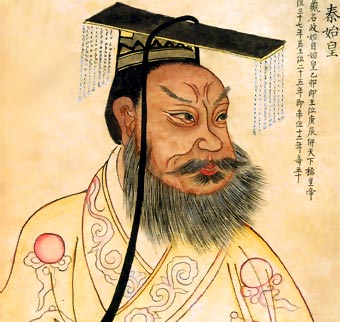
Resultado de imagen de chi huang ti SHI HUANG TI, PRIMER EMPERADOR DE CHINA

Y es más, la raíz y la enjundia de este estilo chino de gobernanza, estar y poder permanece hoy en día. Por encima de la revolución china de los años 30 y 40; de la II guerra mundial y de la corta guerra civil (1946-1949), tras la ocupación japonesa de gran parte de su territorio oriental; del “gran salto adelanteeconómico social de primeros de los 50, empleando en la producción microacerías y fabriquitas, a cargo de innumerables grupos de vecinos no cualificados debidamente, intentando una “revolución industrial comunal” y de la “revolución cultural” de Mao Ze Dong. Ésta fue una reconducción ideológica radical del proceso revolucionario, prevenida y preconizada en la “revolución permanente” de Trotsky. Que fue, paradójicamente, a ojos de los comunistas chinos, un “revisionista condenado”. Todo esto dicho constituye una etapa, un intento, un episodio histórico más, que, por más revolucionarios y radicales que fueran, terminarían siendo deglutidos, absorbidos e incorporados en la civilización y la idiosincrasia chinas, al ser accesorios y pasajeros en el devenir de la larga historia del Reino del Medio.

Al igual que el emperador sólo aceptaba la sumisión leal de sus súbditos, los dirigentes comunistas no admiten la más mínima crítica de propios o foráneos. Ellos tienen el monopolio y la certeza “científica” de la interpretación materialista y dialéctica de los hechos sociales de la historia. Aunque corrigen continuamente su “rumbo” en largas bordadas al avance. Y la nomenclatura, el aparatichik, la burocracia del P. C. chino y del Estado son exclusivistas y lejanos a las negociaciones y a las opiniones diferentes, desviadas o divergentes. En lo que se refieren a su orientación, su poder colectivo y personal y las objeciones a sus decisiones tomadas. Es en este ámbito cerrado del “mandarinato” moderno donde también se dirimen las cuotas de poder y los intereses en juego de jefes, mandos y regiones.

 Resultado de imagen de mao zedong            MAO ZEDONG, PADRE DE LA REPÚBLICA POPULAR CHINA
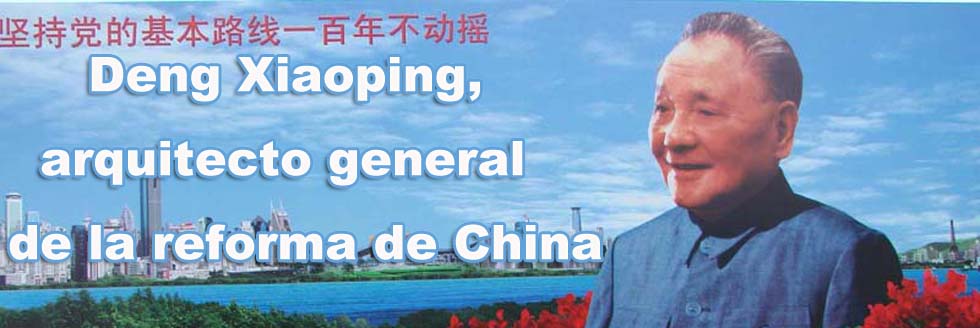
Así, cuando existe una divergencia entre el pueblo y ellos, éstos no reflexionan y dialogan, sino que reprimen directamente las discrepancias que afloran. En 1989, el “aperturista” Deng Xian Ping envió al ejército a aplastar y dispersar la protesta civil estudiantil en la plaza de Tiananmen, de Pekín. Y Zhao Zuyang, fue cesado como primer secretario del P.C. chino, por plantear simplemente que se negociase en un primer momento con los estudiantes. Estos “incidentes” surgen continuamente por toda China y suman varios miles al año. Pero, de ellos apenas se habla, porque no se conocen. El régimen y su aparato represor se encargan de hacerlos invisibles, o sea, inexistentes. Esto entronca con el pasado político clásico chino. Así, cuando existe una dificultad, una reclamación, una desviación se acudía y se acude hoy a la autoridad superior. Y la actual Constitución reconoce este derecho de petición popular y social. Pero, hoy en día los peticionarios son fácilmente golpeados y encarcelados. Estos “incidentes” suelen ocurrir con las autoridades locales y regionales de los pueblos y empresas. Las cuales actúan dela misma forma que los gobernantes centrales y los altos cargos del Partido, que son sus mentores, maestros y ejemplos.

Este estilo de gobernanza sería útil y plausible cuando los flujos sociales internos y externos de una sociedad estuviesen frenados por la compartimentación geográfica de los grupos, la ausencia de movimientos de personas por la carencia de vías y la escasez de medios y razones para ellos y la penuria de la información pública, trasladable generalmente sólo a viva voz. Pero en los tiempos modernos, esa gobernanza constreñidora hace que se pierdan la vivacidad y la audacia, la creatividad y la naturalidad en la gestión de la cosa pública. Y que los administradores se escondan bajos los papeles y las normas, actuando según una burocracia de cero defectos. Pero, los errores y deficiencias llevan a la generación de otros, porque éste es “el uso y el camino” elegidos. Porque, los errores pueden ser siempre empleados por algún superior o enemigo, siempre con algo de oportunismo y de conveniencia para un “grupo de colaboradores o compañeros”, para reprender, castigar, acusar o cesar. Se crea así una orquesta filarmónica falta de unidad, que puede funcionar con estruendo, pero sin interpretar las melodías.

Resultado de imagen de deng xiaoping reformas

Y se cae en la entronización de los jefes, que lleva a su exoneración de todos sus fallos, a la tolerancia de todos sus defectos y a la exaltación de todos sus pensamientos, decisiones y actos. En la ausencia de un verdadero contacto con la realidad, persiguen la acumulación de salvaguardias, distancias y privilegios en sus cargos y funciones. Buscando la necesidad de sentirse seguros, sin entender que la realidad es siempre más benigna y hóspita de lo que se teme. Se incurre en uno de los males político sociales que el presidente Mao señaló ya hace mucho y que, extraído de sus escritos originales, está resumido como cita en el Libro Rojo, verdadero catecismo marxista leninista de la Revolución Cultural china (1966-1976): “las tareas burocráticas aherrojantes suplantan la atención y dedicación al pueblo y a sus necesidades y opiniones, necesarias para realizar la verdadera revolución, basándose en un intercambio de pensamientos entre el pueblo y el Partido”. Ya que es la retroalimentación ideológica desde el pueblo a las autoridades, la que mantiene a éstas en el rumbo histórico correcto.

La actuación política en China.

La propia estructura y composición del P.C. chino revelan sus características elitistas y excluyentes. Administrativamente es un emulador del “madarinato” ilustrado y déspota de los tiempos imperiales. Apenas sus miembros son 92 millones de chinos en 2020. Pero su ubicuidad, penetración y alcance lo extienden como un “fluido social” por todos los rincones, sectores y recovecos de la sociedad china conducida. Esta “presencia total” engloba a los principales y más activos dirigentes del país, en todos los ámbitos y capas de la actuación social. Todo esto contrasta y se diferencia cualitativamente de la actitud en general de los P.C., en relación con su militancia comprometida: sus puertas están abiertas para todos los simpatizantes en todos los países donde no gobiernan. Que son la inmensa mayoría de ellos, exceptuando un puñado de añejas y ya caducas excepciones, reliquias de un pasado social y político superado desde finales del siglo XX. En estos países buscan alcanzar una “masa crítica” de presencia y actividad públicas, que es variable según las sociedades, pero que está entre el 10 y el 15% de su población. Y que les resulta necesaria para que las acciones de esas “ordenes militantes laicas” tengan notoriedad y trascendencia en su sociedad. Donde actuarían como su “levadura social revolucionaria”, hacia pensamientos y actitudes radicales. E incluso, al final del proceso, tomando las armas para rematar y suprimir a los gobiernos vaciados e inestables, cuando su debilidad institucional sea clara.

Por su parte, el presidente Xi Jinping ya excluyó cualquier deriva política del régimen comunista hacia las libertades modernas: “La democracia no es china”. Es decir, no existe la democracia china como tal sistema político. Sin embargo, las libertades económicas capitalistas las concedió el Partido: “Mantengamos la ideología, la orientación política y la estructura del Estado (y, por supuesto, del Partido). Y perfeccionemos el modo de producción y el reparto de los bienes y servicios obtenidos, abaratando los costes de los factores productivos en lo posible, buscando mejorar la productividad y la eficacia económicas, el volumen de producción y la riqueza y su extensión”.

Imagen relacionada PRESIDENTE XI JINPING, CREADOR DE LA CHINA GLOBAL.

Al abrazar las formas del capitalismo especializadas en la creación de bienes y sin aplicar la regulación central necesaria, esto ha traído derivas erróneas o perversas en las asignaciones de los medios y el reparto de los bienes producidos. Quizás estimular esas actividades capitalistas y controlarlas simultáneamente, sea más un “objeto” de filosofía social y suponga pedir demasiado a unos dirigentes no conocedores, ni experimentados en los temas. Así, se han creado unas clases económicas media y alta, que forman una nueva base social activa y potente del Partido. Se prospera con el Partido y nunca sin el Partido. Porque sus miembros confían entre sí y la pertenencia a él les da un sello de garantía y lealtad a las grandes líneas o parámetros diseñados y trazados desde la cúpula dirigente. Que pertenecen tanto a los pensamientos y las acciones generales, como a los ámbitos más prosaicos de la actividad económica capitalista y la dirección y la gestión de sectores y empresas. Ellos quieren ser comunistas ricos y disfrutar de bienes de consumo inmediato y duradero en propiedad y exclusivos. Es un camino que sirve, siempre hay uno, para distinguirse y destacar por encima de los demás, especialmente de los conocidos, vecinos y parientes.

Pero la enorme inflación de precios de los activos inmobiliarios, creada por una demanda excesiva y/o especulativa, frente a una oferta limitada por las ubicaciones deseadas y/o preferentes y la superficie disponible, tiene que llevar a la depreciación de esos “depósitos de valor y ahorro”. Ajustándolos a su valor real más moderado. Pero, numerosos chinos han prosperado mucho al invertir sus ahorros en la construcción urbana. Además, puede que ésta no sea la única desviación alcista de precios que se esté gestando en otros “depósitos de valor”, la bolsa, por ejemplo. Y es posible que la inmensa mayoría de los chinos toleren el dogal político, aliviado por los consuelos consumistas. Pero les escocerá enormemente la pérdida de gran parte de sus ahorros y de sus expectativas de progreso y riqueza. Decía Maquiavelo que los hombres toleraban mejor la pérdida violenta de su padre que la de sus bienes (ruina, confiscación). Curiosamente, un régimen teóricamente comunista y que consideraba a la URSS de los años 60 y 70 como “desviacionista” del marxismo leninismo y de la tradición revolucionaria pura, caerá, por orillarlos, en las desviaciones cíclicas inevitables del capitalismo más rancio. A las que la gran Europa ya embridó, desde hace 80 años, creando y afinando paulatinamente un cuerpo de doctrina económica de naturaleza socio liberal, con el que las eludía, aliviaba y superaba con eficacia y rapidez.

Imagen relacionada LOS CREADORES DE LA TEORÍA DEL MATERIALISMO HISTÓRICO.

Pero, al modificar radical y bruscamente las relaciones entre los agentes productivos (trabajo, capital, gerencia y cuadros y administración) se tienen que modificar también las relaciones sociales previas entre ellos. En efecto, el conocimiento y la aplicación de las modernas tecnologías de todos los campos en las fabricaciones de multitud de bienes, llevan al aumento cualitativo de la capacitación y la formación de los productores. Los cuales reclamarán, más pronto que tarde, el reconocimiento por el Estado chino de diversos derechos ciudadanos, aún no contemplados o en ciernes. La concentración en sus manos y en los mandos de las fábricas de crecientes cantidades de activos (ahorros, participaciones, bienes de consumo duradero, conocimiento esencial) les llevará a exigir a éstos nuevas vías y formas de participación en la vida pública china. Actuando así, como diría Mao, “una necesidad demandada del pueblo hacia el Partido y los gobernantes”.

Todo esto creará contradicciones entre las nuevas capas o “subclases” sociales así formadas, quebrando y alejando así la unidad monolítica idealizada del pueblo y el Partido en el Estado. Contradicciones que no necesariamente tienen que llegar a ser antagónicas, a resolver por la acción violenta entre los rivales. Pero que sí exigirán su “resolución” dialéctica y, por tanto, llevarán a la aparición de un nuevo equilibrio social estable. En el que los “sectores” más retrógrados, inmovilistas, parásitos o burocráticos tendrán que dar paso a: una administración sensible, flexible y eficaz en amplio sentido; un control diferente de las gerencias y los mandos de las empresas y servicios; una gestión sectorial e individual progresivamente diferente de los mismos; a un sistema de acceso a esos puestos citados, basado en la capacidad, la eficiencia periódicamente medida y los méritos; y a una mayor y más libre participación de los productores de todo tipo en las áreas sociales a desarrollar: educación, recreo, viajes, consumo, protección social, sanidad y acceso a la vida pública. Y esto es el materialismo histórico en acción

THE SPANISH NACIONAL POLITICS.

A STERILE AND INEFFECTIVE INSTRUMENT

Introduction.

The dispersion and inefficiency that the authorities show in the complex labor of uniting the popular wills and in implementing clear policies of reinforcement of the national unity and of control of the hackneyed and unsuccessful ideas of dissolution and substitution of that one, have different original reasons.

A nation does not congregate and galvanize, re-joins and advances with procedure, laws and regulations. Called to juridically confine the public thing. A nation is not governed in times of dangers and incipient decadences only by the economic and accounting ideas and policies. That only serve to create and preserve the material wealth. But that at least nowadays can not avoid the hardness and the cruelty of the phases of crisis and decadence of the economic successive cycles. That literally can crush the collaboration between the social strata and deepen their differences. And these policies are bored, affected and pissquiets. Because the action of the money, which is his essence, has these natural qualities.

Resultado de imagen de montoro  SECRETARY MR. MONTORO.

This makes and defines a rachitic, defensive politics and without worthy horizons of the best efforts. And, also, serious and reliable of the duty. As serious and reliable were Cervera’s, when they sank his fleet in Santiago de Cuba and Montojo’s, when the same thing happened to him in Manila to his Spanish fleet of the Pacífico, presences.

The lack of virtues in the exercise and the example of the power and the leaders, have drained and withered the right of the country, as political national instrument.

The attempts of social politician secession.

In the secessionist case that we have opposite to the face and at this point of his process of break with the Spanish nation, there present several incognitos on what we would have to make or be doing. Would an effective preventive action be useful or counter-productive? The parsimony and uselessness, rested on the fulfillment of the procedure, which the national authorities exhibit, will allow us to take, at least, in exchange future profitable decisions?

The president has said to his party, that already there is no economic crisis to arrange. And the surveys are discounting them voters, who do not seem to want to reward indefinitely the past results. The memory that feeds the collective gratefulness is fragile, interested and changeable.

Then, the Spanish have to be convinced by the ideas and actudes in the PP, that they must vote also for the party when the things are OK. But it will be if they perceive a PP radically different from the one that has governed till now. Capable of credibly exciting and stimulating them, in unit and cooperation, towards the social immediate future in peace and prosperity.

Resultado de imagen de politica nacional española

That it is not said only that in these moments, using as protection, resting and covering in the law and his possibilities, the government is taking already legal measurements against the secessionists. Because those who are applying the law are the courts and district attorneys, since it corresponds to the Judicial Power. And the government, as Executive Power, executes very little, in trying his fulfillment and dispersing the hostile actions against the law. Also on November 1, 2014 the Catalan secessionists realized actions against the unit of Spain and the sovereignty of the Spanish, which were of equal separatist and illegal quality that these of now. And the attitude and the action of the Administration against the popular Catalan consultation of that day, was deplorable, scanty and ineffective. The lenience, the tolerance and the delay in opposite the rebels by the national executives, makes these also partial responsible and necessary, but not sufficient, cooperators, in the crimes of «nation, motherland and sovereignty» attacked and damaged by those villains.

The prudence, the aplomb and the position characterizing the public thing.

The saying «pissquiety, shits small«, indicates that you should not ask the troubled long, big or important doings. To those who look with fruition at the meters and the details of the court, do not lead them to walk many kilometres of trip.

The pissquietism has the prudence and the patience as protective shield and supposed banner of valor. But rarely a pissquiet will hurl himself or take the initiative, because he will want to cover all the bets or possibilities. The necessary and present risk in almost all the actions and enterprises is his essential distaste. And his intimate disability is the absence of charisma and leadership, fundamental for the drivers or leaders in the times of crisis that we live. But this, for shame, he will never accept it, nor will speak about it. The pissquiety is comfortable with the bridle of a society well controlled by laws and regulations. That facilitates him to walk for sure rails towards definite goals.

The professional public vocation of the pissquieties is not that of politician, though often they are. His temperamental aspirations are that of civil servants without major responsibilities, good executors of the written thing and of the ordered by their superiors. To defend his position and to use his arguments, the pissquiety is usually a good talker or announcer. He knows that all the positions are, at least, moderately defensible. And, using the word, as his instrument in the dialectics of wills with his competitors, he can impose them. In the vicissitudes of such a ruled and definite society, which does not admit improper remarks, blows in the table, suden accelerations or brusqueness.

The social and political Nation.

A nation is a society of individuals provided with one social political selfconscience. Collaborate to creating and to arrange it the history, the tradition and the customs, and the own language and moral sense. And secondly contribute to it the etnia and the own territory, that not always exist, specially the first one. This way, the territory of a country is not a nation. Nor it is not even the inarticulate population of a territory under an only government. When the nation is loved by his components and there exists in them the desire to serve it and to defend her in community, the concept of the mother land appears. Both ideas are interrelated essentially. And, the absence of the patriotism or the shame practise it by members of a «social politicalcommunity», leads to the defenselessness and to the dismemberment of their nation, in major or minor degree, forming then «groups of associate individuals». So, it is not of surprising that are the Defense Forces of a nation, as institutions and in his members, which hoist, teach and practise the patriotism as one of his essential virtues. The Forces of Defense of a nation are the specialized set of the «citizens or patriots» for the belligerent and complete Defense of his «motherland nation«.

Resultado de imagen de bandera española

Our ideologics and socials fortitudes.

The attacks of ideological external agents, far from crowding us together concerning the threatened motherland, face us and, even, divide more us. Because our Politics is mediocre, envious and shortseeing in aims. And our invertebrate society is a sum of beings and isolated groups, without a common north and many of them sorrowful of the foreign good.

Our majority civilization coexists with others in the same soil. But it does not want to say that we could not have several social common virtues. And, together with the beliefs that are practised, they are the definers parameters of a society. This way, his unanimous observance and respect promote largely the creation and the integration of the social group.

Of the social crises it is only possible to go out fortifying in the values and virtues. These are the «actions and qualities» of human reference, regarded and valued permanently by the human societies. The virtues are very stable in the time. The values are the human «qualities and actions», estimated only temporary and/or locally by some societies. And, principally, by virtue of his idiosyncrasy, living conditions and pressures received from the exterior. The cultural and social values are usually being evolving with the contingencies, the displacements and the fortunes of the human societies.

The virtues are provided principally by the elaborated religions, and by Cicero’s Speeches and Plato’s Dialogs, within our extensive western ideology. We mention the principal ones, which are absorbed and assumed in the human soul:

Appreciation of the family, the social group and the motherland and the friendship and the nice and curious strangers who come to our environment. It is the “vital environment” that sustains us, our «social humus» fertile and indispensable.

Need of punishment of the conducts that are separated sufficiently of the social rules. To avoid the free, excessive or untied revenge, to dissuade the possible infringer, to satisfy in justice the damages and the hurts and to reform the mistaken conducts. Cuando esta “virtud” es complaciente o deficiente, se abre inevitablemente el camino a la injuria personal o colectiva y a la necesidad imperiosa y vital de tomar venganza. Venganza que, por tender a los máximos (como diría Karl von Clausewitz) y estar alimentada por la injusticia y la cólera, se apoyará y seguirá la Ley del Talión.

Need of the education, as mark and seal of the good doing and of the social citizenship. And the formation as set of the knowledge and professional skills, necessary for the service to the family and the society, with the exercise of a way of life decent and sufficient.

Appreciation of the respect and the worship to the divinity, as recognition and veneration of the Necessary Being who creates and supports us, and, in some cases, helps us frankly and directly. And it makes concrete according to the ideology and the social environment lived.

Valuation of the different duties to fulfill as necessary, vital and social counterpart, of the several rights to receive. Valuation of the sobriety, the effort, the saving, the commitment, the study and formation and the work, as necessary factors and means for the progressive and just attainment of the personal and collective aims.

And are our values and virtues recognized, taken again and reaffirmed those who can give us the force and the illusion to overcome the decadence times.

And let’s not forget the essential function of «command, management, impulse and example» of the social leaders of all kinds, present in the homes, the schools, the churches, the political parties, the barracks, the trade unions, the working centers, the associations in general, etc. These are the cores of the collective activity of the society. Where the indispensable “illusion and enthusiasm» will settle themselves and bloom later.

In the hard times, those leaders must accentuate their example. Because, the values and the virtues cannot be seen and felt as something artificial and/or remote, without real connection with a practical and lived code. And they are not acceptable as impositions of “cold rules and regulations», dictated from a «supposed moral and intellectual apex» of the society.

Our commands manage, but the impulse that we receive from them is weak and ineffective. They give the orders weakly, deciding for it everything that collectivly can. And his example is not estimated, not taken as deserving of the emulation and the follow-up. Without biology there is no family, far from it society will exist. Are fertile and solid the families of the social chiefs?

Exemplary leaders separated themselves from their public positions.

We will speak about leaders of the right, withdrawn from the public life for ideological disagreements with his companions. Or for estimating that did not exist then the sociopolítics conditions that were allowing them to carry out his beliefs and ideals. In the Spanish left, we think that to his commans only the chronic or serious disease and the unavoidable age have separated them from the duties of his post.

We only remember Gerardo Iglesias‘s case, which was elected general secretary of the Spanish Communist Party in November, 1982, defending then the reinnovating ideas of the comrades newly purged. For it, he faced the so called Eurocommunists of Santiago Carrillo, looking for the integration of the different communist existing groups. He took part in the creation of Left Joined in 1986, being chosen his general coordinator. In 1988, he resigned all his charges in the XII congress of the SCP, being progressively replaced in them by Julio Anguita. Iglesias, which was in extended leave for absence, joined later to his former miner’s work.

This selection, extracted of what we can detect and glimpse, is an example and summary. It represents what would be a rocky outcrop, the part not plunged of the iceberg, of all the innumerable persons who in politics strain for keep and show a coherent position with an exemplary and complete ideology.

Resultado de imagen de mayor oreja politico  MR. MAYOR OREJA.

Jaime Mayor Oreja is probably the paradigm of all the leaders that in the right have withdrawn from the public palaestra. His category are given by his characteristics: knowledge, exemplary and moral baggage, positions occupied in the public life, relations and age. Major Oreja has a solid political formation from Christian roots. Always he indicated and condemned ETA’S solvent, secessionist and communist strategy. That was acting, according to him, getting accommodated tactically to the changes of power in Madrid and using diverse attitudes and images.

Without never facing the power of the PP, he has supported a clear and serious political path. Condemning, this way, for example, the abortion, since «something proper of the Bolsheviks», and the euthanasia, which «is an old recipe of the totalitarisms that destroyed Europe in the first half of the 20th century». He never condemned the Franco’s regime in its entirety and on the occasion of the law of the Historical Memory, in the crisis of 2008, he alerted of the risks that already were threatening the concord and the unity of Spain. His ideology inspired the ideology of Maria San Gil, his companion of the Basque PP.

Alejo Vidal Quadras was president of the PP of Catalonia from 1991. In the autonomous elections of 1995 his formation obtained 17 deputies and the major number of popular suffrages up to today. By the agreement of the Majestic, in Barcelona between Convergence and Union and the PP, which allowed Aznar’s investiture as Prime minister of Spain (in the VI legislature of the current democracy, 1996 to 2000), he was immolated by the PP of his positions in Catalonia. Vidal Quadras was relocated as Eurodeputy of the PP. And he was a vice-president of the European Parliament. Nowadays is a militant of the small regeneracionist party VOX.

Maria San Gil initiates his political activity in 1991 in the of Guipuzcoan PP. When she was eating with Gregorio Ordóñez, the first lieutenant of mayor in San Sebastían, on January 23, 1995, she witnessed his murder by an ETA’S command in a restaurant of this capital. At the end of 2004, she was the chairwoman of the PP in the Basque provinces. In May, 2008, after the internal crisis of the PP on having lost the general elections, she presents her resignation as chairwoman and deputy of the PP in the Basque provinces. The motives were the strong discrepancies with the ideas and forms of Mariano Rajoy’s PP.

Jose Antonio Ortega Lara was a civil servant of prisons in the penitentiary center of Logroño. At the beginning of 1996, he was kidnapped in his house of Burgos by ETA. And he remained like that, in deplorable conditions, for more than 500 days. Until he was liberated in the last minute by the Spanish Civil Guard. He retired early at the end of 1997, initiating a political career in the PP. Always, he kept a line of defense of the democratic values of the family, the unity of Spain and of his strength and of fight against the terrorists of ETA. In the crisis of the PP in spring of 2008, he announced his march from the party for his ideological differences with him. In 2014, he joined the VOX party.

LA POLÍTICA NACIONAL ESPAÑOLA.

UN INSTRUMENTO ESTÉRIL E INEFICAZ

Introducción.

La dispersión e ineficacia que demuestran las autoridades en la compleja labor de aunar las voluntades populares y en implementar políticas claras de refuerzo de la unidad nacional y de control de las trasnochadas y fallidas ideas de disolución y sustitución de aquélla, tienen varias causas originales.

Una nación no se congrega y galvaniza, se reune y avanza con normas, leyes y reglamentos. Llamados a encorsertar jurídicamente la cosa pública. Una nación no se gobierna en épocas de peligros e incipientes decadencias solamente con las ideas y políticas económicas y contables. Que sólo sirven para crear y conservar la riqueza material. Pero que ni siquiera hoy en día pueden evitar la dureza y la crueldad de las fases de crisis y decadencia de los ciclos económicos sucesivos. Que literalmente pueden triturar la colaboración entre los estratos sociales y ahondar sus diferencias. Y esas políticas son aburridas, melindrosas y meaqueditas. Porque la actuación del dinero, que es su esencia, tiene esas cualidades naturales.

Resultado de imagen de montoro

Esto crea y define una política raquítica, defensiva y sin horizontes dignos de los mejores esfuerzos. Y, también, seria y cumplidora del deber. Como serias y cumplidoras fueron las presencias de Cervera, cuando le hundieron su flota en Santiago de Cuba y de Montojo, cuando le ocurrió lo mismo en Manila a su flota española del Pacífico.

La falta de virtudes en el ejercicio y el ejemplo del poder y de los gobernantes, han drenado y agostado a la derecha cabal del país, como instrumento político nacional.

Los intentos de secesión político social.

En el caso secesionista que tenemos frente al rostro y a estas alturas de su proceso de ruptura con la nación española, se nos presentan varias incógnitas sobre lo que tendríamos que hacer o ir haciendo. ¿Una acción eficaz preventiva sería útil o contraproducente? La parsimonia e inanidad, apoyada en el cumplimiento de las normas, que exhiben las autoridades nacionales, ¿nos permitirán, al menos, tomar a cambio futuras decisiones ventajosas?

El mismísimo presidente ya le ha dicho a su partido, que ya no hay crisis económica que arreglar. Y las encuestas van descontándoles votantes, que no parecen querer premiarles indefinidamente los resultados pasados. La memoria que alimenta el agradecimiento colectivo es frágil, interesada y voluble.

Entonces, los españoles tienen que ser convencidos por las ideas y actudes del PP, que deben votar también al partido cuando las cosas van económicamente bien. Pero eso será si perciben un PP radicalmente distinto al que ha gobernado hasta ahora. Capaz de ilusionarles y de impulsarles creíblemente, en unidad y cooperación, hacia el futuro social inmediato en paz y prosperidad.

Resultado de imagen de politica nacional española

Que no se diga solamente que en estos momentos, amparándose, apoyándose Y cubriéndose en la ley y sus posibilidades, el gobierno está tomando ya medidas legales contra los secesionistas. Porque quienes están aplicando la ley son los tribunales y fiscales, como corresponde al poder judicial. Y el gobierno, como poder ejecutivo, ejecuta muy poquito, en procurar su cumplimiento y dispersar las acciones hostiles contra la ley. También el 1 de noviembre del 2014 realizaron los secesionistas catalanes acciones contra la unidad de España y la soberanía de los españoles, que fueron de igual cualidad separatista e ilegal que las de ahora. Y la actitud y la actuación de la administración contra la consulta popular catalana de ese día, fue deplorable, escasa e ineficaz. La lenidad, la tolerancia y la dilación frente a los rebeldes, por parte de los ejecutivos nacionales, les hace estos también responsables parciales y cooperadores necesarios, no suficientes, en los delitos de lesas “nación, patria y soberanía” de aquellos malvados.

La prudencia, el aplomo y la postura caracterizando la cosa pública.

El refrán “meaquedito, caga poquito”, indica que a los cuitadillos no les pidas largos, grandes o importantes haceres. A los que miran con fruición los metros y los detalles del patio, no los lleves a recorrer muchos kilómetros de viaje.

El meaqueditismo tiene a la prudencia y a la paciencia como escudo protector y supuesto estandarte de valentía. Pero pocas veces un meaquedito se lanzará o tomará la iniciativa, porque querrá cubrir todas las apuestas o posibilidades. El riesgo necesario y presente para casi todas las acciones y empresas es su aversión esencial. Y su incapacidad íntima es la ausencia de carisma y liderazgo, fundamental para los conductores o líderes en los tiempos de crisis que vivimos. Pero esto, por vergüenza, nunca lo aceptará, ni hablará de ello. El meaquedito está cómodo en el embridaje de una sociedad bien controlada por leyes y reglamentos. Que le facilita el andar por carriles seguros hacia metas definidas.

La vocación profesional pública de los meaqueditos no es la de político, aunque muchas veces lo sean. Sus aspiraciones temperamentales son la de funcionarios sin mayores responsabilidades, buenos cumplidores de lo escrito y de lo mandado por los superiores. Para defender su posición y usar sus argumentos, el meaquedito suele ser un buen hablador o locutor. Él sabe que todas las posiciones son, al menos, medianamente defendibles. Y, usando de la palabra, como su instrumento en la dialéctica de voluntades con sus competidores, puede imponérseles. En los avatares de una sociedad tan reglada y definida, que no admite salidas de tono, golpes en la mesa, acelerones o brusquedades.

La Nación social y política.

Una nación es una sociedad de individuos dotada de una auto conciencia socio política. Colaboran a crearla y vertebrarla la historia, la tradición y las costumbres, y la lengua y el sentido moral propios. Y contribuyen en segundo lugar a ello la etnia y el territorio propios, que no siempre existen, especialmente la primera. Así, el territorio de un país no es una nación. Ni lo es la población inarticulada de un territorio bajo un único gobierno. Cuando la nación es amada por sus componentes y existe en ellos el deseo de servirla y defenderla en comunidad, aparece el concepto de la patria. Ambas ideas están interrelacionadas esencialmente. Y, la ausencia del patriotismo o la vergüenza de profesarlo por miembros de una “comunidad socio política”, lleva a la indefensión y a la desmembración de su nación, en mayor o menor grado, formando “grupos de individuos asociados”. No es de extrañar que sean las Fuerzas de Defensa de una nación, como instituciones y en sus miembros, las que enarbolen, enseñen y profesen el patriotismo como una de sus virtudes esenciales. Las Fuerzas de Defensa de una nación son el conjunto especializado de los “nacionales o patriotas” para la Defensa beligerante y cabal de su “nación patria”.

Resultado de imagen de bandera española

Nuestras fortalezas ideológicas y sociales.

Los ataques de agentes ideológicos externos, lejos de apiñarnos en torno a la patria amenazada, nos enfrentan y, hasta, nos dividen más. Porque nuestra Política es mediocre, envidiosa y cortoplacista en objetivos. Y nuestra sociedad invertebrada es una sumatoria de seres y grupos aislados, sin un norte común y pesarosos del bien ajeno muchos de ellos.

Nuestra civilización mayoritaria convive con otras en el mismo suelo. Pero eso no quiere decir que no podamos tener unas virtudes sociales comunes. Las virtudes son los valores permanentes e indefinidos de un grupo humano. Y, junto con las creencias que se profesan, son los parámetros definitorios de una sociedad. Así, su observancia y respeto unánimes fomentan en gran parte la creación y la integración del grupo social. De todas las decadencias y problemas sociales solamente se puede salir fortaleciéndonos los valores y virtudes.

Éstas últimas son las “bondades y cualidades” humanas de referencia, apreciadas y valoradas permanentemente por las sociedades y los grupos humanos. Las virtudes humanas son muy estables en el tiempo. Los valores son las “cualidades y bondades” humanas, estimadas de forma temporal y/o local por algunas sociedades o grupos humanos. Y, principalmente, en virtud de su idiosincrasia, condiciones de vida y presiones recibidas desde el exterior. Los valores culturales y sociales suelen ir evolucionando con las contingencias, los desplazamientos y las fortunas de las sociedades humanas. Por ejemplo, para los blancos de Suráfrica, la beligerancia activa fue un valor cultural y social necesario e imprescindible durante décadas. Para mantener su independencia y su dominio, frente a la mayoría negra en la que estaban embebidos.

Las virtudes son aportadas principalmente por las religiones más elaboradas, y por los discursos de Cicerón y los Diálogos de Platón, dentro de nuestra extensa cultura occidental. Podemos citar las principales y evidentes, que están embebidas y asumidas en el alma humana, sin buscar ser exhaustivos, sino demostrativos:

Aprecio de la familia, el clan, la tribu, la nación, la amistad y los forasteros amables y curiosos que llegan a nuestro entorno. Es el “entorno vital” que nos sustenta y es soportado por todos, nuestro “humus social” fértil, rico en capacidades y matices  e imprescindible.

Necesidad de punición de las conductas que se aparten suficientemente de las normas sociales. Para evitar la venganza libre, excesiva o desordenada, disuadir a los posibles contraventores, satisfacer en justicia las injurias y los daños y reformar las conductas erradas. Cuando esta “virtud” es complaciente o deficiente, se abre inevitablemente el camino a la injuria personal o colectiva y a la necesidad imperiosa y vital de tomar venganza. Venganza que, por tender a los máximos (como diría Karl von Clausewitz) y estar alimentada por la injusticia y la cólera, se apoyará y seguirá la Ley del Talión.

Necesidad de la educación, como marchamo del buen hacer y de la ciudadanía sociales. Y de la formación, como conjunto de los conocimientos y habilidades profesionales, necesarios para el servicio a la familia y a la sociedad, con el ejercicio de un medio de vida digno y suficiente.

Aprecio del respeto y del culto a la divinidad, como reconocimiento y veneración del Ser Necesario que nos crea, nos sostiene y, en algunos casos, nos ayuda directamente. Esto se concreta, según la educación, la cultura y el ambiente social vividos, en distintos credos y religiones.

Valoración de los distintos deberes a cumplir como contrapartida necesaria, vital y social de los varios derechos a recibir. Valoración de la sobriedad, el esfuerzo, el ahorro, el compromiso, y el trabajo como factores y parámetros necesarios para la consecución progresiva y justa de los objetivos personales y colectivos humanos.

Y son nuestros valores y virtudes reconocidos, retomados y reafirmados, los que verdaderamente nos darán la fuerza y la ilusión para superar los tiempos de decadencia.

Y no olvidemos la función esencial de mando, gestión, impulso y ejemplo de las autoridades y los dirigentes sociales de todo tipo, presentes en los hogares las escuelas, las iglesias, los partidos políticos, los sindicatos, los centros de trabajo, las asociaciones en general, etc. Éstos son los núcleos de la actividad colectiva de la sociedad. En los tiempos difíciles, elos deben actuar mucho más desde el ejemplo. Los valores y las virtudes no pueden verse como algo artificial y remoto, sin conexión real con un código práctico, vivido y conocido. Tienen que ser percibidos y aceptados por los ciudadanos, para que puedan seguirlos. Y no pueden ser imposiciones de normas, códigos y reglamentos fríos, dictados desde una supuesta cúspide moral e intelectual de la sociedad.

Nuestros mandos gestionan, pero el impulso que recibimos de ellos es débil e ineficaz; mandan débilmente, decidiendo para ello todo lo colectivamente que pueden; y su ejemplo no es apreciado, ni tomado como merecedor de la emulación y el seguimiento. Sin biología no hay familia, ni mucho menos existirá sociedad. ¿Son fértiles y sólidas las familias de los jefes sociales?

Líderes ejemplares que se apartaron de sus posiciones públicas.

Hablaremos de líderes de la derecha, retirados de la vida pública por desavenencias ideológicas con sus compañeros. O por apreciar que no existían entonces las condiciones sociopolíticas que les permitieran llevar a cabo sus creencias e ideales. En la izquierda española creemos que a sus mandos solamente la enfermedad crónica o grave y la edad ineludible les han apartado de los deberes de su cargo.

Sólo recordamos el caso de Gerardo Iglesias, que fue elegido secretario general del PCE en noviembre de 1982, defendiendo entonces las ideas renovadoras de los camaradas recién purgados. Por ello, se enfrentó a los llamados eurocomunistas de Carrillo, buscando la integración de los distintos grupos comunistas existentes. Participó en la creación de Izquierda Unida en 1986, siendo elegido su Coordinador General. En 1988, renunció a todos sus cargos en el XII congreso del PCE, siendo sustituído progresivamente en ellos por Anguita. Iglesias, que estaba en excedencia, se incorporó posteriormente a su puesto de minero.

Esta selección, sacada de lo que podemos detectar y vislumbrar, es un ejemplo y resumen. Representa lo que sería un afloramiento rocoso, la parte no sumergida del iceberg, de todas las innumerables personas que en política se esfuerzan por mantener y mostrar una posición coherente con un ideario ejemplar y cabal.

Resultado de imagen de mayor oreja politico

Jaime Mayor Oreja es quizás el paradigma de todos los mandos que en la derecha se han retirado de la palestra pública. Su categoría se la dan sus características: conocimientos, bagaje ejemplar y moral, posiciones ocupadas en la vida pública, relaciones y edad. Mayor Oreja tiene una sólida formación política de raíces cristianas. Siempre señaló y condenó la estrategia disolvente, secesionista y comunista de ETA. Que actuaba, según él, acomodándose tácticamente a los cambios de poder en Madrid y usando diversas actitudes e imágenes.

Sin enfrentarse nunca al poder del PP, ha mantenido una clara y seria trayectoria política. Condenando, así, por ejemplo, el aborto, como “algo propio de los bolcheviques”, y la eutanasia, que “es una vieja receta de los totalitarismos que asolaron Europa en la primera mitad del siglo XX”. Nunca condenó al franquismo en su totalidad y con motivo de la ley de la Memoria Histórica, en la crisis de 2008, alertó de los riesgos que ya amenazaban la concordia y la unidad de España. Su ideología inspiró el ideario de María San Gil, compañera del PP vasco.

Alejo Vidal Quadras fue presidente del PP de Cataluña desde 1991. En los comicios autonómicos de 1995 su formación obtuvo 17 diputados y la mayor cifra de sufragios populares hasta hoy. Por el pacto del Majestic (el hotel del Paseo de Gracia, en Barcelona) entre Convergencia y Unión y el PP, que permitió la investidura de Aznar como Presidente del Gobierno de España (en la 6ª legislatura de la democracia actual, 1996 a 2000), fue inmolado por el PP de sus cargos en Cataluña. Vidal Quadras fue reubicado como eurodiputado del PP. Y fue vicepresidente del Parlamento Europeo. Actualmente milita en el pequeño partido regeneracionista VOX.

María San Gil inicia su actividad política en 1991 en el PP guipuzcoano. Cuando comía con Gregorio Ordóñez, primer teniente de alcalde de San Sebastían, el 23 de enero de 1995, presenció el asesinato de éste por un comando de ETA en un restaurante de esa capital. A fines de 2004 era presidenta del PP en el País Vasco.

En mayo de 2008, tras la crisis interna del PP al perder las elecciones generales, presenta su dimisión como presidenta y diputada del PP en el País Vasco. Los motivos fueron las fuertes discrepancias con el fondo y las formas del PP de Mariano Rajoy.

José Antonio Ortega Lara era un funcionario de prisiones en el centro penitenciario de Logroño. A primeros de 1996 fue secuestrado en su casa de Burgos por ETA. Y permaneció así, en condiciones deplorables, por más de 500 días. Hasta que fue liberado in extremis por la Guardia Civil. Se jubiló anticipadamente a finales de 1997, iniciando una carrera política en el PP.

Siempre mantuvo una línea de defensa de los valores democráticos de la familia, de la unidad de España y de su fortaleza y de lucha contra los terroristas de ETA. En la crisis del PP de la primavera de 2008, anunció su baja del partido por sus diferencias ideológicas con él. En 2014 se unió al partido VOX.

The Ambushes against military Patrols and Units.

Introduction.

One of the principal tasks of the military men of the International Forces in Support of the Security, deployed in the Southwest of Asia, in the countries menaced by the islamist terrorism, is the motorized patrolling by the dusty ways that interlace the zone of influence of their barracks. These areas almost lacks Tarmac roads. When there exist they are not a great thing. The caps of asphalt have between one and two fingers of thickness; and the heats soften them and pot-holes and bubbles are easily formed. Usually, this is not an aggressive patrol. It is an exhibition, routine and of visual and logistic link patrolling, between their principal and secondary positions and with the nearby population centers.

When the military men think that there can be problems, they receive the support of the air observation. They are reconnaissance not manned planes (the UAV, in his initials in English), whose use spreads in these asymmetric conflicts. They can detect (in ideal conditions) at 5 thousand meters if a person is armed. The Americans use the Predator model (which is armed also) and the the Searcher (without attack capacity), being able both to operate up to 350 km from his base.

Resultado de imagen de Guerrillas sunníes JAISHALADL SUNNIS IRAQIS GUERRILLA POSING…

In some cases the rebels and bandits have dared to attack some of the military marching columns. Fighting from fixed and spread, hasty fortified positions, forming a fringe like a half moon or crescent, which was embracing the march way. Their problem was that the rebel weapon were of tense fire and so their fighting positions were in the forward slope. So, the armed light armoured vehicles with foreign infantry, could combat profitably with the guerrillas in their reinforced fox holes, small trenches and folds of the ground. In effect, their targets acquisition and machine-guns fire control systems, were allowing them the selection and the precision of their fires against the punctual targets of the irregular rebels. And were forcing them to move back and to hiding in the near hamlets.

There are more others cases in which the rebels use the explosive handcrafted artifices (in English, «improvised explosive devices») in the ways crossed by the military men in patrol. They usually place them setting off from the villages, as their improvised forward base, and taking advantage of the concealment and the protection of the nights. There is a high afraid to these artifices, already famous from the postwar period of Iraq. Because they are unexpected, unpredictable and hard to detect. Also, are enervating (the mental perspective of a possible, though improbable explosion, burdens much more than the real probability of the hurts in the attack) and they put the men in the passive defense and in the wait, knowing that active measurements to avoid them are not taken.

Resultado de imagen de improvised explosive devices

The explosive hollow charges that form the majority of these artifices, attack the “low guts” of the military foreign vehicles, their most vulnerable and less protected part. Down there, they cannot carry the reactive charges of repulsion or a multiple layers “shield” with ceramics, like the hulls of the main battle tanks. It is calculated that the Afghan Taliban and the members of the ISIL rebels can place and activate during a year, more 10 thousands of these handcrafted mines. Some correspondents call the artifices, the most effective weapon of the insurgency. Though they are, in their operational set, like an immense minefield; but that are not simultaneously placed and super widespread, improbable and without being covered by the enemy fire.

The Technologies and Tactics to eliminate the Danger of the Ambushes and Explosive Traps in the Tracks.

There are several, the passive or reactives and the actives, assuming that the initiative and the aggressiveness, against worse prepared and trained rebels, is with the military men. They all are «defensive». Since the Department of the War passed to be named long ago of the Defense, everything is “defense”.

Between the passive ones can be to increase the visual recognition of the tracks, observing protuberances and changes of color that should not correspond, in the soils of those. The «travel times» of the columns would diminish a lot. It is necessary to cross those more slow, looking at the soil and looking over the horizon, searching also for careless observers, not very distant. They do not use too much cable activators. These are expensive and weigh, and the rebels are in isolated zones and their logistics is weak and complicated.

The devices are activated generally by the pressure of the vehicle or by a transmitter of a given frequency and range; it can serve an opening doors device. With their frequency inhibitors, the military men try to offset the radio waves of the probable frequencies in the zone. Being the most expensive and complicated transmitters, that with more range, power and frequencies range of use. It is the game of the cat and the mouse. The problem arises when the guerrillas of an area receive a transmitter activator that uses an unforeseen frequency.

Also the columns might be harassed by registered mortar fire during the stops that they were doing to confirm or to eliminate some possible artifice, as some of them might be simulated.

Resultado de imagenGENERAL VALERIANO WEYLER.

Another way would be to move out of the tracks, cross-country running. For the wheel vehicles, this not always is possible. And, in addition, their wear of the pieces and the consumption of fuel increase very much, as also the march schedules. At the same time, it diminishes the comfort and increases the weariness of the travelers in missions of long range and routine patrolling.

That it is not said that it is impossible or very difficult to do. Since this was what the general Valeriano Weyler did, to frighten the Cuban mambises of the surroundings of the ways and tropical paths. On February 10, 1896, the general was taking charge of the government of Cuba and of the headquarters of the Spanish army deployed in her. The president of the Cabinet, Antonio Cánovas del Castillo, restorer of the Bourbon monarchy, was supporting the politics of keeping the colonial domination in Cuba, up to «sacrificing the last man and the last peseta». And named Weyler for the mentioned positions, in substitution of the general Arsenio Martínez Campos, the peacemaker of the war from 1968 to 1978. Which this time failed in bringing positions over with the armed rebels.

Imagen relacionada GENERAL ARSELIO MARTÍNEZ CAMPOS.

The Cuban guerrillas, in this new war, were taking advantage of the concealment of the “manigua” (tropical jungle) and his nearness to the ways, to harass with rifle fire the Spanish columns and to cause them some falls, without getting involved in a fight. Weyler prompt designed the tactic of rejection the enemy. A reconnaissance with combat capacity was going suitably forward to the Spanish columns in march. It was moving by the jungles (autochthonous bushes) that were surrounding the routes of march, without moving away too much from the paths. The “mambises” or Cuban armed rebels, forming variable and scanty harassment forces, were this way raised from their ambushing positions and drove away from the principal Spanish forces.

Particularities of the mountainous zones and their inhabitants.

The mountainous areas of the geopolitical region of the Southwest of Asia are specially dangerous for the foreign military units of any size in maneuver. The spurs of the heights are frequently crossed by wadis or seasonally dry riverbeds of brooks and springs. In them it can conceal a group of men. That will not become visible until his opportunity of harassment by the fire arises, from rapidly reinforced and camouflaged positions, of the military units. Or have an encounter skirmish with some military group that comes out to the hollow without precautions.

Also it is easy to approach some rocky outcrop, adorned or not by a small thorny bushes, without detecting any enemies patiently crouched down behind it. That will attack the carelessness soldiers, using their knives or cutlasses. Even, when the men return to the principal way, after establishing and keeping a defense position to secure the march of the principal column, giving them the back.

The tribes who live there have as characteristics in their identity and customs, the belligerence and the intertribal brawls. The most important and widespread are the etnia pashtun and the baluchis.

The surprise, which is an effective multiplier of the «specific combat capacity» of a given unit, is constantly and systematicly employ by the irregular fighters. This way, it happens that, «in this wide, ocher and arid valley, they have never attacked us», because the mountains that frame it are at 300 or 400 m. in the horizon. Well, today they are going to attack you with short bursts (2 to 6 shots) of machine gun with bipod, when you advance gullible and spread in that dull and known valley. Without bothering for establishing the march security with pickets, which protect the principal column. And offering multiple small targets to the tenacious, thoughened and poisonous enemy.

Military Tactics in the counterinsurgency fighting.

Finally, some specific tactics and techniques exist for the fight against irregular rebels, that can be used here. It looks to keep the initiative, the creativity and the law of the action in our side. It is a question of the independent employment of light infantry small units (at first, type plattoon or section) in reconnaissance and attacks tasks of the enemy bands.

For the defense of the own communications, they can be used aggressively against the bands that scourge or that hinder them (the artifices are like more spread and selective mines). For example, they can advance and conceal in a sector where the terrorists or local bandits bands are active. In the night, when those are usually placing in the tracks their explosive artifices, they will attack thoughtlessness them (with the maxim surprise and for the major effect). This demands of all the men of the patrols and units: formation, motivation, commitment with the mission, specific training, initiative, creativity, self-sufficiency, sobriety, patience, serenity, alert of the senses, silence and quietude.

An advantage that will multiply the combat capacity of the military patrols, resides in that these bands usually neglect their security in what they think that it is their rear. As soon as a combat has taken place with the rebels, the patrol must be extracted or return to his barracks. To rest, report or brief, return to train, to be equipped and to move to another sector, when it be appropriated, in another mission.

Epilogue.

Any ambush that turns out to be effective involves a failure, a deficiency, a carelessness in the security of the attacked. The routine of the actions; the softness of the men; the sufficiency and conceitedness of the direct and top commands; the scanty formation of the soldiers; the insufficient motivation of all the military men and his lack of commitment with the tasks or missions. They constitute serious departure faults to the creation and the maintenance of an effective march security. In the reconnaissance and of combat patrols and in the movements of the units and small units.

And, though the security does not appear frequently in the «lists» of the principles of the war, specially in the most short, the security has come to remain. And the failure to keep this principle will concern in major or minor degree and extension the efficiency of other «companions or partners principles». Since the whole of the principles forms a holistic, synergic, concurrent and convergent group, on the military actions. Defining all simultaneously the «what to do» in the war or in the armed conflict.

Las Emboscadas contra Patrullas y Unidades Militares.

Introducción.

Una de las tareas principales de los militares de las Fuerzas Internacionales de Apoyo a la Seguridad, desplegadas en el Suroeste de Asia, es el patrullaje motorizado por los caminos polvorientos que entrecruzan la zona de influencia de sus acuartelamientos. Estas zonas casi carecen de carreteras asfaltadas. Y cuando las hay, no son gran cosa. Las capas de asfalto tienen un par de dedos de espesor; y los calores las ablandan y se forman fácilmente baches y burbujas. No es aquél un patrullaje agresivo. Es un patrullaje de exhibición, rutina y enlace visual y logístico entre las posiciones militares principales y secundarias y con los núcleos de población cercanos.

Cuando los militares piensan que puede haber problemas, reciben el apoyo de la observación aérea. Son aviones de exploración no tripulados (los UAV, por sus siglas en inglés), cuyo uso se extiende en estos conflictos asimétricos. Algunos pueden detectar (en condiciones ideales) a 5 mil metros si una persona va armada. Los estadounidenses usan el modelo Predator (éste va también armado) y el Searcher (sin capacidad de ataque), pudiendo ambos operar hasta los 350 km de su base.

Resultado de imagen de Guerrillas sunníes GUERRILLAS IRAQUÍES SUNNÍES «JAISHALADL» POSANDO…

En algunos casos, los insurrectos y bandidos locales se han atrevido a atacar a alguna de las columnas militares de marcha desde posiciones fijas y espaciadas, formando una franja o luneta como una media luna, que abrazaban el camino de marcha. Su problema es que las armas rebeldes son de tiro tenso y sus posiciones se sitúan en la pendiente anterior. Por tanto, los “vehículos blindados ligeros armados” de la infantería extranjera pueden trabar combate ventajosamente con los guerrilleros en sus pozos de tirador, pequeñas trincheras y pliegues del terreno reforzados. En efecto, sus sistemas de adquisición de blancos y control de fuego les permitían la selección y la precisión de sus fuegos ametralladores contra los blancos puntuales de los rebeldes irregulares. Y les obligan a retroceder y a esconderse en las aldeas más cercanas.

Hay otros muchos más casos en que los insurrectos utilizan sus artificios explosivos artesanales (en inglés, los “improvised explosive devices”) en los caminos recorridos por los militares en patrulla. Los suelen colocar generalmente partiendo desde las aldeas cercanas, como su base improvisada operativa adelantada, y aprovechando la ocultación y el amparo de las noches. Se les tiene mucho miedo a estos artificios, famosos ya desde la posguerra de Irak en 2003. Porque son inesperados, impredecibles y difíciles de detectar (pueden estar en el camino que ayer se recorrió y examinó), enervantes (la perspectiva anímica de la posible, aunque improbable explosión, grava mucho más que la probabilidad real de los daños del ataque) y ponen a los hombres en la defensa pasiva y a la espera. Sabiendo que no se toman medidas activas para evitarlos.

Resultado de imagen de improvised explosive devices

Las cargas huecas explosivas, que forman la mayoría de esos artificios, atacan el bajo vientre de los vehículos militares extranjeros, su parte más vulnerable y menos protegida. Ahí no pueden llevar las cargas reactivas de repulsión o un blindaje múltiple con cerámicas que usan los cascos de los tanques. Se calcula que los insurrectos talibanes, de al-Qaeda y del Estado Islámico en Afganistán, pueden colocar y activar durante un año más de 10 mil de estas minas artesanales. Algunos corresponsales llaman a esos artificios, el arma más efectiva de la insurgencia. Aunque son, en su conjunto operativo, como un inmenso campo de minas, pero que no se colocan simultáneamente, y superextendido, improbable y sin estar cubierto por el fuego enemigo.

Las Tácticas y Técnicas para Eliminar el Peligro de las Emboscadas y Trampas Explosivas en los Caminos.

Hay varias, unas pasivas o reactivas y otras activas, asumiendo la iniciativa y la agresividad contra insurrectos peor preparados y entrenados que los militares. Todas son “defensivas”. Desde que el Ministerio de la Guerra pasó antaño a denominarse de las Fuerzas Armadas y, por último, más modernamente, de la Defensa, todo es “defensa”.

Entre las pasivas pueden estar el incrementar el reconocimiento visual de los caminos, en los suelos de aquéllos, observando protuberancias y cambios de color que no correspondan. Los “tiempos de recorrido” de las columnas disminuirían bastante. Hay que recorrer aquéllos más despacio, mirando al suelo y oteando el horizonte, buscando también observadores al descuido, no muy lejanos. No suelen usar activadores de cables. Estos son caros y pesan, y los rebeldes están en zonas aisladas y la logística es débil y complicada.

Los artefactos se activan generalmente por la presión del vehículo o por un emisor de frecuencia y alcance dados; puede servir hasta un dispositivo de apertura de puertas. Con sus inhibidores de frecuencia, los militares intentan contrarrestar las ondas de radio de las frecuencias probables usadas en la zona. Siendo los emisores más caros y complicados, cuanto más alcance, potencia y gama de frecuencias usen. Es el juego del gato y el ratón. El problema es que los guerrilleros de un área reciban un emisor activador que use una frecuencia imprevista.

También las columnas podrían ser hostilizadas con fuego de mortero registrado durante los altos que hicieran para confirmar o eliminar algún posible artificio, ya que algunos podrían ser simulados.

Resultado de imagen GENERAL VALERIANO WEYLER.

Otro medio sería trasladarse por fuera de los caminos, campo a través. Para los vehículos a rueda, esto no siempre es posible. Y, además, el desgaste de las piezas y el consumo de combustible aumentan mucho, como también los horarios de marcha. Al mismo tiempo, disminuye la comodidad y aumenta el cansancio de los viajeros en misiones de patrullaje largas y/o rutinarias.

Que no se diga que es imposible o muy difícil. Ya que esto fue lo que hizo el general Valeriano Weyler, para espantar a los “mambises” cubanos de las cercanías de los caminos y veredas tropicales. El 10 de febrero de 1896, el general se hacía cargo del gobierno de Cuba y de la jefatura del ejército español estacionado en ella. El presidente del Consejo de Ministros, Antonio Cánovas del Castillo, restaurador de la monarquía borbónica, propugnaba la política de mantener la dominación colonial en Cuba, hasta “sacrificar el último hombre y la última peseta”. Y nombró a Weyler para los cargos citados, en sustitución del general Arsenio Martínez Campos, el pacificador de la guerra de 1968 a 1978. Que fracasó esta vez en acercar posiciones con los rebeldes en armas.

Imagen relacionada GENERAL ARSENIO MARTÍNEZ CAMPOS.

Los guerrilleros cubanos, en esta nueva guerra, aprovechaban la ocultación de la “manigua” y su cercanía a los caminos, para hostilizar con fuego de fusilería a la columnas y causarles algunas bajas, sin empeñarse en la lucha. Weyler pronto diseñó la técnica de rechazo del enemigo. Una exploración con capacidad de combate se adelantaba convenientemente a las columnas españolas en marcha. Se trasladaba por las maniguas (matorrales autóctonos) que circundaban a las vías de marcha, sin alejarse excesivamente del camino. Los mambises o rebeldes, formando fuerzas de hostigamiento variables y escasas, eran así levantados de sus posiciones y ahuyentados de las fuerzas principales españolas.

Particularidades de las zonas montañosas y sus habitantes.

Las áreas montañosas de la región geopolítica del Suroeste de Asia son especialmente peligrosas para las unidades extranjeras en maniobra de cualquier tamaño. Las estribaciones de las alturas están cruzadas frecuentemente por wadis o cauces estacionalmente secos de arroyuelos y veneros. En ellos puede ocultarse un grupo de hombres. Que no se harán visibles hasta que surja su oportunidad de hostigamiento por el fuego, desde posiciones rápidamente reforzadas y camufladas, de las unidades militares. O tengan una escaramuza de encuentro con algún grupo que se asome a la hondonada sin precauciones.

También es fácil acercarse a algún afloramiento rocoso, adornado o no por un pequeño matorral espinoso, sin detectar tras él algunos enemigos agazapados y pacientes. Que atacarán al descuido a los soldados, usando sus cuchillos o alfanjes. Incluso, cuando los hombres regresan al camino principal, tras establecer y mantener una posición de defensa para proteger la marcha de su columna principal, dándoles la espalda.

Las tribus que las habitan tienen como características en su identidad y costumbres, la belicosidad y las reyertas intertribales. Las más importantes y extendidas son la etnia pashtún y los baluchis.

La sorpresa, que es un multiplicador eficaz de la “capacidad de combate” específica de una unidad dada, es empleada continua y sistemáticamente por los combatientes irregulares. Así, ocurre que, “por este valle amplio, ocre y árido, nunca nos han atacado”, porque las montañas que lo enmarcan están a 300 o 400 m. en el horizonte. Bueno, pues hoy te van a atacar con ráfagas cortas (2 a 6 disparos) de ametralladora con bípode, cuando avances confiado y desparramado por aquel valle anodino y conocido. Sin molestarte por establecer la seguridad de marcha con piquetes, que protejan a la columna principal. Y ofreciéndole múltiples pequeños blancos al enemigo tenaz, curtido y venenoso.

Tácticas militares en la lucha contrainsurgencia.

Por fin, existen tácticas y técnicas específicas para la lucha contra rebeldes irregulares, que pueden ser empleadas aquí. Ellas buscan mantener la iniciativa, la creatividad y la ley de la acción de nuestra parte. Se trata del empleo independiente de pequeñas unidades de infantería ligera (en principio, tipo pelotón o escuadra) en tareas de exploración y de ataque a las bandas enemigas. Para la defensa de las comunicaciones propias, pueden emplearse agresivamente contra las bandas que las hostigan o que las obstaculizan (los artificios son como minas más dispersas y selectivas).

Por ejemplo, se pueden internar y ocultar en un sector donde las bandas islamistas o de bandidos locales estén activas. En la noche, cuando aquéllas suelen colocar en los caminos sus artificios explosivos, las atacarán desconsideradamente (con la máxima sorpresa y para el mayor efecto). Esto exige de todos los hombres de las patrullas: formación, motivación, compromiso con la misión, entrenamiento específico, iniciativa, creatividad, autosuficiencia, sobriedad, paciencia, serenidad, alerta de los sentidos, silencio y quietud.

Una ventaja que multiplicará la capacidad de combate de la patrulla militar, reside en que estas bandas descuidan su seguridad en lo que creen que es su retaguardia. Una vez que se ha producido un combate con los insurrectos, la patrulla debe ser extraída o volver a sus cuarteles. Para descansar, informar, volver a entrenarse, ser equipada y trasladarse a otro sector, cuando proceda, en otra misión.

Epílogo.

Toda emboscada que resulta efectiva implica un fallo, una deficiencia, un descuido en la seguridad del atacado. La rutina de las acciones; la molicie de los hombres; la suficiencia y el engreimiento de los mandos directos y superiores; la escasa formación de los soldados; la insuficiente motivación de todos los militares y su falta de compromiso con las tareas o misiones. Ellos constituyen graves defectos de partida para la creación y el mantenimiento de una seguridad de marcha eficaz. En las patrullas de reconocimiento y de combate y en los movimientos de las unidades y pequeñas unidades.

Y, aunque la seguridad no figure frecuentemente en las “listas” de los principios de la guerra, especialmente en las más cortas, la seguridad ha llegado para quedarse. Y el incumplimiento de este principio afectará en mayor o menor grado y extensión a la eficacia de los demás “principios compañeros o socios”. Ya que el conjunto de los principios forma un grupo holístico, sinérgico, concurrente y convergente sobre las acciones militares. Definiendo todos simultáneamente el “qué hacer” en la guerra o en el conflicto armado.

¿QUÉ OCURRIRÁ TRAS EL ESTADO ISLÁMICO DE IRAK Y SIRIA…?

INTRODUCCIÓN.

Tras el aniquilamiento de las bases guerrilleras del Estado Islámico (la dispersión y la pérdida de la voluntad de defensa, no la desaparición física) en Irak y pronto en Siria, el panorama político social que se presenta en el Suroeste de Asia es desolador, encrespado y sombrío.

Los posibles “aliados” de las potencias globales o regionales, que existen en el maremagnum geopolítico de Asia del Suroeste son complicados y enredados internamente y están muy necesitados de “ayudas” para su recuperación y para su mantenimiento durante bastante tiempo. Son “aliados” vacíos, gravosos, parásitos y sin enjundia.

Aquí se podría parafrasear al embajador español Agustín de Foxá, conde de Foxá, cuando, en cierta ocasión, durante la II guerra Mundial, asistía a un convite en Roma. Durante el mismo, el conde Ciano, yerno del Duce y ministro de Relaciones Exteriores italiano, con la aviesa intención de pisar y reírse de los españoles, le preguntó: “Por cierto, Foxá, ¿cuándo piensa España incorporarse, por fin, a la lucha internacional contra el bolchevismo, que estamos sosteniendo las potencias del Eje?” Don Agustín le respondió: “Conde Ciano, ¿cree Ud. que el Reich puede permitirse tener (mantener) otro aliado?…” Al día siguiente, se le indicó a Foxá que abandonase Italia.

Esos posibles “aliados” fallidos permiten establecer “bases militares permanentes” a unas potencias regionales con ambiciones de expansión (Irán, Rusia). Pero que no les sirven como bases militares de partida para desplegarse por ningún otro país a la redonda. También se pueden establecer en ellos “bases temporales” para el apoyo de fuego pesado en sus operaciones a sus aliados y para desasnarlos o entrenarlos (Estados Unidos). Pero que tampoco tienen ninguna trascedencia operativa fuera de sus fronteras porosas.

No hay aquí, en estos países desgarrados, fuerza, vigor y solidez como naciones.

Los actores nacionales.

Las contradicciones irreconciliables, que definían las relaciones de poder y creencias entre las etnias y los países del Suroeste de Asia antes de la última aparición de los yihadistas salafistas en los años 90, no están resueltas. Antes bien, el recurso a la violencia armada total para aniquilar al Estado Islámico, ha enconado algunas diferencias antagónicas. Y ha alentado los afanes separatistas de algunos actores de esta tragedia sin par: sunníes y kurdos sirios e iraquíes. Argumentando la discriminación político social que sufren en ambos estados, los méritos de guerra y los derechos a tener un estado nacional, basado en la soberanía sobre un territorio suficiente y defendible. Aunque dicha violencia total haya sido aplicada en las acciones coordinadas de unas coaliciones nacionales más o menos voluntarias e integradas.

El régimen alauí de al-Assad ha roto sus lazos políticos y sociales con su pueblo. Y ha perdido la legitimidad que otorgan los países musulmanes, como parte temporal de la Umma, a sus déspotas y gobernantes más o menos absolutos. Que surge de un equilibrio de cuidado, protección y bienestar del pueblo por parte de los gobernantes, con el acatamiento y el apoyo necesario (esfuerzo, impuestos, levas) que les brindan sus súbditos. Porque ha machacado y destrozado a su pueblo con el fuego pesado indiscriminado en los combates en terrenos urbanos. Que estaban atestados de innumerables civiles, aterrorizados, reducidos a la miseria y sin salida, muchas veces, de los cercos de las poblaciones. Y que tanto el Ejército Nacional de Siria como sus aliados foráneos emplearon sistemáticamente como arma de guerra: para ahorrar bajas propias y por la carencia de fuerzas propias entrenadas en el ataque a las poblaciones, se pulverizaban a las distancias lejanas y medias de combate las posiciones reales, alternativas o ficticias de los rebeldes y el habitat urbano que las cubría y envolvía. Los civiles y sus propiedades afectados eran “daños colaterales”, que asumían sin gran pesar, sobre todo las fuerzas aliadas extranjeras.

La política vacilante y huidiza de los EEUU en Oriente Medio y concretamente en Siria, creó un “vacío de poder” real, en forma de apoyo y patronazgo, que el presidente Putin se propuso ocupar. Esta vez, el autócrata ruso esperó, para asegurarse que los EEUU no estaban allí, ni se les esperaba. Con su intervención militar en Siria, Rusia buscaba acreditarse un papel mediador y relevante en el dámero maldito de las potencias regionales del Suroeste de Asia. También aquella intervención le iba a asegurar un patrocinio aumentado sobre Siria, con la elevación a “permanente” de sus bases naval (en Tartus, Latakia, en el Mediterráneo oriental) y terrestres en el país. Y ni la vida, ni las posesiones, ni los sufrimientos personales y familiares de los sirios le importaban. Si se convertían en un obstáculo a su estrategia político militar en defensa de Bashar al-Assad.

Resultado de imagen de putin ¿LO QUIERE MÁS QUE A LOS SIRIOS?

Los turcos están intentando aumentar su protagonismo y su influencia en esta zona geopolítica. Buscando convertirse en una gran potencia regional. A ello les llevan los sucesivos inconvenientes planteados por la Unión Europea durante lustros por la Unión Europea a su incorporación de derecho a Europa. Y, les empuja definitivamente el gobierno de Erdogan. Que juega sus bazas a largo plazo, por aproximaciones sucesivas, en envites cortos, intentando islamizar la república de Ataturk, sin que los militares, garantes constitucionales de ella, se le encabriten y lo derriben.

Sus renovadas preferencias estratégicas les llevan a mirar por bastante tiempo al Este. Turquía, con casi 80 millones de habitantes, puede intentar hacer un papel moderador sunní hacia la República de Irán. El gran problema operativo para Turquía es que fue la potencia dominante de la zona hasta hace menos de un siglo. El Imperio otomano extendido duró desde el siglo XV al inicio del XX. Y los turcos no son étnicamente árabes y su cultura es diferente.

Resultado de imagen de atatürk DIÓ DESTINO Y ORGULLO A SU PUEBLO, DERROTADO EN LA PRIMERA GUERRA MUNDIAL. ADONDE LE LLEVARON LOS ERRORES DEL SULTANATO OSMANLÍ (CALIFATO).

El ministro de relaciones exteriores turco, Ahmet Davutglu, declaró categóricamente que “intervenir en el norte de Siria es un derecho natural de Turquía”. Y Erdogan remachó que “los que ataquen a Turquía, sentirán en su nuca su aliento”. Los turcos no permitirán que grupos terroristas como al-Qaeda o el PKK (reconocidos por la ONU) se establezcan allí. Pero Turquía sabe que el Kurdistán es largo en Kms. Y que sus rebeldes kurdos actúan desde el Kurdistán iraquí, con bases seguras en los montes Candil. Donde tienen cobertura en su contrapendiente sur y abastecimientos de sus habitantes kurdo iraquíes.

Las armas son instrumentos de mal agüero”; “No fomentéis el asesinato”; “La peor política consiste en atacar las ciudades”, son consejos del maestro Sun en los Trece Capítulos del Art de lac Guerra, del siglo IV a. C.

Los hermanos separados enfrentados.

Sigue planteado, si no se ha exacerbado más, el conflicto dentro del Islam entre chiíes y sunníes. Conflicto que es, en sí mismo, una aberración ideológica, una contradicción antagónica, desgarradora y esencial. Si ha habido una Revelación de Allah, destinada a todos los hombres, ésta debe ser clara y sencilla. Para que los hombres comunes y normales la entiendan y la acepten. Y esto fue más necesario tras la Hégira, en los inicios “iletrados, nómadas y pobres del siglo VII”. Porque Allah ama mucho al hombre común, ya que lo ha creado y crea en tan gran número.

El Corán, fuente religiosa común de los chiíes y sunníes, no es muy revelador acerca de las “disputas internas armadas” (DIA) dentro de la comunidad universal de creyentes o Umma. En la época del Profeta este problema ni se contemplaba. Y si aquéllas hubiesen existido, al juntarse con el acoso externo que sufrían los musulmanes, probablemente llevasen juntos a la dispersión y a la desaparición del grupo de los fieles. En la Sura (capítulo) 49, aleya (versículo) 9 se les ordena: “Cuando se hacen la guerra dos naciones de creyentes, procurad reconciliarlas… Los creyentes son tus hermanos (la máxima relación de consanguinidad). Arreglad, pues, las diferencias de vuestros hermanos y temed a Dios, a fin de que tenga piedad de vosotros.” Y en 4, 33: “Oh, creyentes,… no os matéis entre vosotros…(o, no os matéis a vosotros mismos)”. El inicio del versículo va dirigido contra la codicia y la apropiación ilícita. Y el Legislador ha podido extenderlo al asesinato (muerte del inocente) y sus variantes (por ejemplo, el suicidio).

Un problema fundamental para un acercamiento fraternal de los “hermanos separados enfrentados” lo constituyen los conceptos del legítimo origen del mando, del control y desarrollo del “dogma y la moral”. Y de las inmensas estructuras económico político religiosas, con vida e intereses propios, creadas por ambas expresiones del Islam, casi desde el inicio del mismo.

Otro grave origen de agravios y distanciamientos irreconciliables, sobre todo a nivel nacional, son las formas de luchas violentas entre ambas creencias. Cuando se atacan entre sí, se procura hacer el mayor daño posible, llegando hasta la intimidad del parentesco. Y así se buscan los objetivos en las mezquitas, mercados, peregrinaciones, concentraciones y en los tránsitos frecuentes o en masa de las gentes. Sitios siempre donde están varios miembros de una misma familia. Es la violencia incontrolada y llevada a sus extremos innecesarios, impúdicos, vesánicos y paradójicos (¿no profesan la misma religión?). Entre los clanes y tribus, hablando sólo étnicamente, esta ola de asesinatos, atropellos y daños en los bienes, genera siempre una cadena intergeneracional de vindicaciones ineludibles para los ataques, las represalias y los agravios de sangre sufridos. Este nudo gordiano esencial e indestructible, por lo que parece, sólo se puede cortar con la espada de la generosidad, del altruismo (buscando no lo que nos “falta”, sino mirando adelante) y del perdón, que debería ser más asequible entre hermanos de confesión.

Resultado de imagen de qassem soleimani con ali jamenei ALÍ JAMENEI LE LLAMÓ: «MARTIR VIVIENTE» DE LA REVOLUCIÓN IRANÍ.
Al extremo este de Asia del Suroeste está la teocracia chií de los ayatollahs. Éstos, cuando quieren resultados importantes y rápidos contra sus vecinos, emplean a comandos o a unidades de la Guardia Republicana, que pueden entrenar, equipar y apoyar a sus aliados de Siria y de Iraq. Y que son capaces de luchar a las distancias próximas y de asalto, como una infantería ligera especialmente entrenada. La Guardia Republicana está imbricada en el régimen, formando el brazo armado incondicional y eficaz de la República Islámica de Irán, actuando como los Inmortales de los Shas de Persia. El régimen está enraizado en un complejo de consejos y asambleas, ideados, creados y organizados para asegurar, mantener y perpetuar su funcionamiento oligarca socio religioso. Pero es incapaz, hasta ahora, de desarrollar moderna y económicamente a un país con los recursos y la exuberancia demográfica de los iraníes. Irán se galvaniza mejor, como casi todas las dictaduras absolutas, frente a los problemas exteriores, que para el trabajo diario, paciente y eficaz del desarrollo político, social y económico de un país. Que exige un ambiente de paz y serenidad que las tensiones sociales enajenan.

Resultado de imagen de qassem soleimani con ali jamenei

Irán es una Gran Isla chií en un enorme Mar sunní. Que lo abraza, desde el oeste al este, por todo el sur, desde Turquía a Pakistán, pasando por Afganistán, Arabia, Jordania, Palestina. Sus “islas y cayos adyacentes” son El Líbano, Siria, Iraq y Bahrein; teniendo más pujanza Irak y El Líbano. Los resultados de la llamada “primavera árabe” no han sido favorables a los chiíes, que se mantienen inmersos en el “océano hostil” sunní.

Y la pérdida del régimen de los Assad de Siria no sólo les restará un aliado de conveniencia, que no de religión. Ya que los alauís sirios son considerados por los sunníes, “la herejía dentro de la herejía (chií)”. Sino que entorpecerá mucho toda la logística del inmenso y estratégico apoyo a Hezbolá y a Hamas, en la franja de Gaza. Esto se ve confirmado por la entrada en la guerra siria de las milicias regulares de Hezbolá y de voluntarios fatimíes afganos a favor del gobierno. Buscando recuperar el progresivo desgaste social del régimen, consiguiendo victorias militares.

Epílogo.

Las espadas seguirán en alto. El Estado Islámico es una infección contagiosa y grave, que afectó a una situación enrevesada y hasta explosiva, de una región geopolítica con demasiados intereses y problemas por resolver. La difícil y poco agradecida Asia del Suroeste. Como hemos descrito anteriormente.

Egipto será un competidor sunní potente de Turquía y de sus pretensiones. Y Arabia Saudí y los países de la gran meseta árabe lo apoyarán. Irán habrá mantenido a flote a los países con influencia chií, que ya existían. Y por el horizonte aparece Trump y sus golpes de timón. Que son más temibles por lo impredecibles que por lo rápidos. Putin quedará encajonado en la región en un país destrozado y derrotado socialmente. Se ha abrazado últimamente a Turquía; pero, ya no le servirá de nada. Cuando se extinga verdaderamente la guerra civil en Siria, entre Rusia y Turquía existirán desavenencias, porque no habrá qué repartir. Y las antiguas repúblicas soviéticas centroasiáticas, que forman una cadena ininterrumpida entre el mar Caspio y el mar Negro, son de etnia turcomana. Aunque Putin desea hacerlas socias de su «proyecto» de Unión Comercial.

THE MILITARY SURPRISE AS ART AND HETERODOXY

Almost all the technologies, tactics and operations directed to obtaining the tactical or operational surprise over the enemy, can be benevolent considered at the edge of the regulations and existing procedure. That are practised in the different countries and groups of them or supranational alliances.

Between other reasons, to fight only according to the «book» is usually too much acquaintance and predictable. In addition, many of the general «knowledge» gathered in them are shared by different blocs and nations, even antagonistic. And it is necessary, to respect the regulations and ordinances and to look for the aim indicated by the command, as the goal to obtaining.

But the creative and decisive action must follow the one that we call the «way of the surprise«. As guide, compass, of our decisions and actions. Looking for that fleeting and juicy opportunity that arises in the development of the mutual actions between the armed rivals; those careless or vulnerable enemy weaknesses, in conditions that we can create sometimes, equally more unforeseen and unusual. To obtain our goals with more forcefulness, efficiency, elegance and rapidity. Achieving it with fewer loss of time, of men and of means. Let’s remember the basic and universal principle of the economy of the means.

Sure that following always the «book» they will be able to approach and to take to good term the common operations. But, apart from the fact that the enemy has an essentially equal doctrine and regulations, a way of fighting will be first known and then learned or dominated and, probably, up to overcome finally by the enemy. The triumphant Germans in the first period 1939-1941, with the extension of the war, allowed the knowledge and the learning of his war of combined weapon by his enemies. That finally overcame them in technologies, tactics and operations and drove them to their thunderous defeat in 1945.

And this «guide» is of special need and affection in the bureaucratized and crystallized armies. Where the unforseeable, not guilty failures, are not only a contingency to be overcame by the set. But they can be also an administrative or political weapon against the persons in charge. And where the follow-up of the «book» and the superiors orders to the letter, armour and protect the low commands of the responsibility of their acts and results.

Martin Van Creveld said that was the anteroom, before the final unworkability and prostration, of «the military organizations that were not getting up-to-date and renewing». Martin Van Creveld was expelled as lecturer, many years ago, from Israel’s Military High College.

Then, the results will be obtained increasingly at the cost of the wear and the men means and materials losses. Tending to triumph then the rival that more demographic and economic capacity has.

There arises then a corollary of this way of thinking the military thing. The zeal to avoid human falls, extended to all the modern armies or of IIIrd generation, will lead to the preventive, protective and therapeutic employment of the own heavy fire. Looking that the own forces do not have to fight at close ranges. This is called military modern technology and is highly regarded by the national armament industries. This is not more than the perversion and trick of the heavy fire. Whose functions or tasks, in increasing order of action and efficiency, are: to blind, to disturb, to neutralize or cover and to destroy the enemy in the different fighting forms and situations.

And the action over the aim will tend to the physical destruction, as guarantee of the security of the men. In the actual civil wars in Iraq and Syria, we have the examples in the exagerate and methodical bombardments on the enemies. Armed and civilians; real and suspects.

The Military surprise, looking for the enemy dislocation and shock

During his operations, the enemy deployment is conforming in the direction and with the intention that he has decided and determined, for his military echeloned means and for his logistic routes. This way, he is showing his «cards» to his rival, depending on his action tempo and he is commiting, according to those.

Our surprise can create «per se» a new «exposed flank«, another more or less critical «vulnerability» in the enemy. That he was not considering yet, that he was not waiting, nor was prepared to defend her by some of the fighting forms. That are the attack and the defense, in their varieties and combinations.

Our surprise «penetrates» in the enemy deployment, seeking to shock and dislocate functionally or positionally it. And, at least, to cause him losses, to occupy profitable positions for our operational development, to diminish his tempo or operational pace and to confuse, delay and disturb him in his plans and deployments. Using for it, by our part, the minimal means expense and seeking to achieve the maximum possible effect on the enemy. With which we optimize the effort of our actions, following the general principle of the economy of the available means.

When the enemy reacts, to offset and overcome the effect of our surprising action, he is adapting necessarily to our intention. And, if that one is serious, he moves away more or less from his interests and plans. With his reacting movements for the rejection and the attack to our forces, the enemy is disregarding his intention and his mission. In relation to these, the enemy is removed from them and also unbalanced. This way, a right conceived, planned and realized surprise can «prepare» the enemy for us. So, he face in disadvantage, with fewer available resources and a worse deployment, our offensive principal action. That would be already more direct, massive and orthodox.

In such a way that exist a whole range of possible effects to obtaining over the enemy with our surprising actions. That will change also according to the means destined to obtain our surprise, the conception, the preparation and the accomplishment of it and the available time, considering also the set of our operations.

EN BUSCA DE LA EXCELENCIA MILITAR.

UNA TEORÍA INCOMPLETA Y SESGADA.

El autor, citado abajo, realiza una crítica metódica y profunda de las distintas formas de lucha en cada una de las épocas históricas.

Es especialmente duro y mordaz con la forma de lucha de los alemanes durante la II guerra mundial. Su objetivo es degradarla y empequeñecerla, para restarle enjundia y validez en la historia de las operaciones terrestres. Privando así a la evolución de la teoría estadounidense sobre dichas operaciones, de cualquier influencia o deuda intelectuales con la doctrina de la guerra alemana.

A la que el autor considera más oportunista y táctica, que cabal y científica. Y opina que fue favorecida en sus resultados por las carencias y los errores de sus enemigos. Es posible que un análisis académico de la forma de lucha alemana, se acerque a rendir ese veredicto.

Pero, la evidencia es la piedra de toque de la realidad sin apariencias. Y el caso es que los alemanes triunfaron amplia y extensamente con aquella, durante la primera etapa de la II guerra mundial en Europa: 1939 a 1942. Durante la cual, sus enemigos pudieron aprender de las tácticas, técnicas y de la estrategia operativa alemana. Ya que se prolongó demasiado en el tiempo, al multiplicarse los teatros de la guerra.

Imagen relacionada

Y que, en la última fase de la guerra: 1943-1945, los alemanes fueron sobrepasados, abrumados y, finalmente, derrotados. A lo que contribuyeron las diferencias cualitativas y cuantitativas en los flujos logísticos, que apoyaron a los dos bandos; la enorme sangría de los mandos y cuadros alemanes, que resultó irrecuperable y mermó las cualidades de sus unidades; y la demografía cuantitativa de los Aliados.

Shimon Naveh concede amplia calidad y estima a la doctrina militar de los soviéticos. Que considera científica, porque seguía un proceso lineal de argumentos, lógica y resultados (que durante mucho tiempo, fueron sólo ansiados o previstos). Y que se adaptaba y guiaba específica y realmente, a un ejército de masas, poco instruido y nutrido por una demografía apabullante. Que siempre tuvo un apoyo logístico insuficiente, cuando no era precario. La mecanización de la infantería para colaborar con los tanques, fue siempre un anhelo y una esperanza, más que una capacidad media real.

Resultado de imagen de germany military power ww2

En los primeros tiempos tras la revolución bolchevique, incluso dirigidos por el joven teórico de la maniobra profunda, general Mijail Tujachevski, los ejércitos rusos recordaban en sus marchas, a “hordas lentas y esquilmadoras”. Que vivían para el sustento del territorio por el que avanzaban, propio o extraño. Los hombres más instruídos relativamente, siempre escasos, eran alistados en las armas técnicas, artillería, ingenieros, aviación. O en las más eficaces y necesarias para la penetración y la explotación de la retaguardia operativa enemiga, tanques, infantería de la Guardia.

Por último, Shimon Naveh concentra sus esfuerzos, resumen y alabanzas en el largo proceso de desarrollo de la doctrina estadounidense Air Land Battle y sus siguientes actualizaciones. Cuyas bondades y eficacia se materializaron en la ofensiva aérea y terrestre contra el régimen iraquí en la guerra del golfo de 1991, buscando la liberación de Kuwait del poder de Saddam Hussein. Guerra que fue la piedra de toque de aquella doctrina supuestamente culminada.

Iniciada la ofensiva terrestre, las fuerzas estadounidensesy sus aliados se enfrentaron con rapidez con prácticamente todas las fuerzas iraquíes que ocupaban y defendían Kuwait. Desde el golfo Pérsico actuaron las fuerzas navales, amenazando con un desembarco anfibio en las estrechas costas del emirato. Por el sur, los marines se encargaron de fijar a las fuerzas iraquíes del flanco sur de la defensa. Confirmando así, para los iraquíes que el frente de ataque de los aliados serían el sur y el este.

Resultado de imagen de soviet polish war LA GUERRA RUSO POLACA DE 1920.

Pero, al sur de Irak/Kuwait, el grueso mecanizado de los aliados penetró en tromba a lo largo del frente occidental del despliegue iraquí. Para seguidamente dividirse este despliegue aliado en varias puntas de avance, sobre todas las unidades iraquíes de ese flanco.

La campaña era una gran operación de atrición del más fuerte contra el fuerte, por los mayores medios tecnológicos y capacidades de los aliados. Donde se buscó, al estilo soviético, un ataque simultáneo a todos los escalones del orden de batalla enemigo y en la profundidad de su despliegue defensivo rígido. En el sur de éste existían divisiones blindadas o motorizadas iraquíes, dispuestas a contraatacar cualquier penetración aliada. Hacia el centro y norte, estaba el grueso de la Guardia Republicana, dispuesta a contraatacar cualquier acción operativa aliada.

Las concentraciones, las maniobras, las acciones no buscaban, ni tenían, un centro de gravedad del esfuerzo. Que fuera definido sucesivamente y aplicado conforme se desarrollaba la campaña. Sino que, sirviéndose de las ventajas ya citadas, las fuerzas aliadas buscaban enmpeñar, fijar y arrollar a las unidades enemigas a su alcance, de una forma directa y casi conjunta. Creando realmente así, una batalla de cerco y aniquilación, de la familia de Cannas y Tannenberg, donde la liquidación del cerco se hacía por partes y era uniformemente acelerada en el tiempo.

Resultado de imagen de soviet polish war ARROLLANDO LAS HORDAS SOVIÉTICAS.

Las divisiones iraquíes al este estaban sometidas al control central y directo de Saddam Hussein y su Estado Mayor. Que las privaban de iniciativa, flexibilidad y libertad de acción. Si no, algunos cuerpos o divisiones de los Aliados hubieran podido ser puestos en dificultades por la actuación de alguna gran unidad iraquí. Tras iniciarse el ataque terrestre y gozando los aliados de la supremacía aérea, solamente se ocultó a los iraquíes, privados de la exploración operativa, la maniobra envolvente de los aliados por el oeste, hacia su retaguardia.

La Estrategia operativa en la Guerra Irregular.

Naveh, sin embargo, no se acerca, ni mucho menos se interna y analiza, un tipo de guerra que ya existía desde mucho tiempo atrás. Antes de la génesis y maduración de la estrategia operativa estadounidense. Y que es la guerra de guerrillas, palabra tomada del español por todos los idiomas. A la que, pomposamente, le llaman guerra de IV generación los anglosajones. Aunque es casi tan antigua como el conflicto humano. Los ejército modernos tecnológicos encuentran dificultades para enfrentarse a esa forma de lucha. Empleando los medios, la doctrina y sus reglamentos, el orden de batalla y los entrenamientos de que están dotados.

La guerra de guerrillas es sinónimo de conflicto prolongado y enraizado en la sociedad civil, donde aparece y se desarrolla. Es de baja intensidad militar, salvo en su última etapa (si la alcanza) y de gran politización y polarización ideológicas de los rivales. Estas características hacen que inevitablemente los civiles estén involucrados en ella y que el conflicto militar sea arbitrario, duro y cruel. Se enfrentan posiciones e intereses antagónicos, que, en el uso de la violencia, derivan hacia los límites de ella y del sufrimiento de quienes la padecen y protagonizan.

Naveh podría hablar de la aplicación de la estrategia operativa en la guerra de guerrillas. O empleada en la dirección y las operaciones de las unidades de élite (marines, rangers, SEALs, cazadores, etc.) que realizan misiones de contrainsurgencia. Aquí, los centros de gravedad de los esfuerzos, coordinados globalmente, abarcan los ámbitos económico, militar, político y social. Y existirán en estos campos y serán aplicados de una manera armónica, conjunta y coordinada. Trabajando para un esfuerzo común y convergente, empleando distintas combinaciones de medios en los distintos casos que se presenten.

Existirá un mando central anti insurgencia que debe conjugar y dirigir los esfuerzos, medios y actuaciones. De acuerdo con la especialización de los medios que actúen, las acciones y los objetivos que se busquen en cada uno de los citados niveles o campos de acción. Una característica de los actos y sus efectos es que deben ser convergentes. Buscando la multiplicación e incremento de éstos y la sinergia de los primeros. Así, en cualquier acción, a partir de un nivel de efectivos, de presupuesto o de resultados buscados, intervendrá el Mando Contrainsurgencia.

Como ejemplos, en el ámbito militar serán centros de gravedad las bases semipermanentes, las comunicaciones entre las bandas y con los paisanos, incluyendo las logísticas, y los movimientos de las partidas rebeldes. La defensa estática se mantendrá en los centros y medios necesarios para el esfuerzo de guerra. Los otros deberán defenderse por un sistema de guarniciones de defensa del territorio. Que será apoyado por un sistema militar de patrullas móviles y de la aviación de reconocimiento y de ataque a tierra. Las unidades especiales realizarán incursiones profundas de ataque, exploración y hostigamiento en las áreas en disputa con las guerrillas o en poder de éstas.

THE MANEUVER WARFARE. THE CONCEPT OF THE MODERN AIRLAND BATTLE. (SECOND PART).

AN INTERPRETATION BY FIELDMARSCHAL ERICH VON MANSTEIN.


(CONTINUATION)


Results of the German counterattack and its trascendence.

Nevertheless, the booty gained was scanty. Von Manstein declared that there were approximately 23,000 dead Soviet soldiers and 9,000 captured Soviet soldiers. The materiel captured were approximately 615 tanks (probably largely recovered), 354 campaign guns, 69 anti-aircraft pieces and more than 600 machine guns and mortars. It was not possible to encircle the enemy and Soviet soldiers took advantage of this by leaving the heavy equipment and retreating. Von Manstein said that, because the extreme cold, his soldiers were bunched into small, tight groups, leaving wide spaces and lines in his rearguard, without effective cover. This partly happened because they were elite troops and because the war was without mercy.

COLONEL JOHN BOYD, AN AMERICAN TEORIST OF ITS MANEUVER THEORY.

At the beginning of March, 48th panzer Corps pressed toward the east of Kharkov and the SS panzer corps of General Halder was entrusted with recovering the long-suffering city for the Germans.

At the middle of the month, the Germans had a defensive resistant front from Tangarov to Belgorod, supported on the Mius and the Donetz. They also possessed in the south of Russia sufficient mobile reserves to push back possible Soviet operational breaks in the zone.

As late as 1944, the Soviets had 26 tanks Corps and 11 mechanized Corps. Part of them joined together to form 6 tanks Armies. Each of which had two tanks corps and a mechanized corps (bigger and more balanced inn infantry and artillery). Some mechanized Corps joined a cavalry Corps, forming a great unit similar in capacity to the tanks Army but with fewer armored vehicles and more mobility in areas of difficult transitability (marshes, mountains, woods). These were used to exploit the break in the swampy areas of the south of the Soviet Union, as that of the Pripet river in the north of Ucrania. Although never coexisted more than two or three in the order of battle of the Soviet Army.

WILLIAM LIND, A CIVIL TEORIST.

The destruction of 6 tanks Corps of the Southwest Front (especially equipped with mobile forces) and dismantled them from their “support masses, was an especially prominent, profitable and low cost operation for the Germans.

In addition, in its advance toward Kharkov between March 1st and 5th, the SS and 48º panzer Corps smashed from its flank and rearguard the Soviet 3rd tanks Army, led by general Pavel Semjonovic Ribalko. This Army was launched to relieve the forces of 6th infantry Army and had continued advancing toward Kharkov. This city that was by then, attracting all the attention and efforts from both sides.

As poor results and large losses mounted for the mobile Soviet forces, pessimism also grew in Stalin, who asked Sweden to mediate in seeking a solution to the war with Germany.

Nevertheless, the advance on Belgorod, outlining Kursk’s projection inside the territory occupied by Germany, sealed the aim for Germanys strategic summer Campaign. After all these events had passed, the strategic initiative returned to the Germans at the level of the theatre of operations.

But, beginning on July 5, delayed in relation with the victories of Von Manstein, their action gave the Soviets time to extensively strengthen themselves, to establishfortified regions” at the front level, and to assemble and organize a powerful counterattack force in the north and south of the projection. The allied landing in Sicily on the 10th of July, aborted the Wehrmachts already disastrous Operation Citadel. The Germans would never recover the strategic initiative on the Eastern Front.

GENERAL DONN STARRY, HIGH COMMAND OF THE U.S. ARMY’S TRADOC.

Was it possible to avoid what happened to the Popov group and, thus, to the Soviets strategic plans for its 1942 winter campaign and to the Soviets strategic initiative, at least in the Southern theatre of the Soviet Union?

It was possible.

We have observed, in parallel and in a very second plane with some key facts, the getting absorbed (to get very much in), the delight (to be delighted with) and the fixation (to do without other rational arguments) of Stalin, in relation with the results that he promised himself with the impelled operations by the mobile corps of the Southwest Front of general Vatutin.

General Vatutin, one of the best field chiefs of the Soviet army, died before his time at hands of Ukrainian (anti-Soviet) guerrillas, only participated in this in a minor degree. Still, the delegate of the Stavka in charge of these crucial operations (Zhukov, Vasilevsky?) remembered him the transcendence that for the Supreme Commander and for the Soviet people they had.

A little time ago, Hitler also fixated on Stalingrad. This fixation led him to squander the capacity of his best Great Unit (the 6th infantry Army of general Paulus—yes, without the aristocratic Von) in a street struggle and a force-to-force confrontation. Their enemies were arranged on a static defense. A position that they were better able to defend and maintain than were the Germans, in the gigantic steel and cement fortress that was Stalingrad.Fight in which was not counting the German superb capacity of operational movement, which reduced the effort done to a confrontation between man vs. man and machine against machine. And, thus, causing a terrible attrition to the combat and movement capacities.

We can discuss about the strategic mistakes of high chiefs. As the line of communications (branched out) is so crucial, it is necessary to protect it adequately. But this fact is obscured and blurred by the desires of commanders.

What are the possibilities of defense for the advance sector that contains the communications line?

Independently of the advance deployment of mobile groups and their support mass (which must include the securities elements adapted for marches in enemy areas), «advanced detachments» must be brought forward.

These will be integrated by 15-30 % of the forces that bring them forward and will possess sufficient operational movement and combat capacities. The time it takes for the main group to join them is a function of the transitability of the terrain and of the capacities and intentions of the enemy in the operations zone. Its mission in defensive operations is to be used asstable hinges” between the deployments of Great units, facilitating and protecting the movement of forces and supplies between them.

If the mass of support is too slow for the mobile group to continue advancing at a reasonable rate, it will end up lengthening dangerously the distance between the units and their support. This situation is very vulnerable to a mobile assault by the enemy from the depth of his zone and the sector of advance would be under threat of being cut, depending on the means and intentions of the enemy. This probability would require that amechanized group” be placed between the mass of support and the mobile group to reduce the distance between all three deployments and reducing reaction times to respond to a crisis. This would reasonably stabilize the sector of advance after the mobile group.

The mission of the mechanized group, which has less capacity for operational movement than the mobile group, will be to carried out thesector mobile defense”. And will last until the forces of the mass of support arrive to relieve it. The anti-aircraft and antitank defense plan, the centralization of reserves and the defense of key points of the area, by means ofdelay positions” and together with necessary heavy fire support, will be characteristic of the fight to stabilize the sector.

That is to say, it is necessary to sacrifice speed for safety to consolidate the stability of the sector of advance in enemy territory. A territory that does not need to be all occupied in force. Because would be defended by a mobile defense for a limited period of time. Taking disproportionate risks would be reckless and would put men, materiel and the operation in danger.

But, men (in this case, Hitler and Stalin are two examples) continue to make mistakes when faced with such circumstances

THE END.

LA GUERRA DE MANIOBRAS. EL CONCEPTO DE LA BATALLA AÉREO TERRESTRE MODERNA. SEGUNDA PARTE.

UNA INTERPRETACIÓN DEL MARISCAL ERICH VON MANSTEIN.


(CONTINUACIÓN)


Resultados del contraataque alemán y su trascendencia.

El botín fue, sin embargo, escaso. Von Manstein declara unos 23.000 soldados soviéticos muertos y unos 9.000 capturados. En material fue bastante mejor: se capturaron unos 615 tanques (probablemente en gran parte por recuperación), 354 cañones de campaña, 69 piezas antiaéreas y más de 600 ametralladoras y morteros. Recordemos que no se podía conseguir un cerco (por más que von Manstein se disculpe de ello, aludiendo a que, debido al frío, sus soldados se agrupaban en los núcleos de población para pernoctar, dejando amplios espacios y líneas sin cubrir) y que los soldados soviéticos abandonaban el equipo pesado y se retiraban. Esto ocurría en parte porque eran tropas escogidas y, en parte, porque la guerra era sin cuartel.

CORONEL JOHN BOYD, UN TEÓRICO ESTADOUNIDENSE DE LA GUERRA DE MANIOBRAS.

A primeros de marzo el 48 cuerpo panzer presionó al este de Kharkov y el cuerpo panzer de las SS (general Halder) se encargó de recuperar la sufrida ciudad para los alemanes.

Para mediados de mes, los alemanes tenían un frente defensivo resistente desde Tangarov a Belgorod, apoyado en el Mius y el Donetz. Y contaban en el sur de Rusia con reservas móviles suficientes para rechazar posibles rupturas operativas en la zona.

Podemos indicar ahora que en 1.944 los soviéticos tenían 26 cuerpos de tanques y 11 cuerpos mecanizados. Parte de ellos se integraban formando hasta 6 ejércitos de tanques: integrado cada uno por dos cuerpos de tanques y un cuerpo mecanizado (mayor y más equilibrado en infantería y artillería), generalmente. Algunos cuerpos mecanizados eran unidos a un cuerpo de caballería, resultando una gran unidad parecida en capacidad al ejército de tanques, pero con menos blindados y más movilidad en terrenos de difícil transitabilidad (pantanos, montañas). Éstos fueron empleados principalmente para explotar la ruptura en los terrenos pantanosos del sur de la URSS, aunque nunca coexistieron más de dos o tres en el orden de batalla del ejército soviético.

WILLIAM LIND, UN TEÓRICO CIVIL.

Por ello, la destrucción de los 6 cuerpos de tanques del frente del suroeste (especialmente equipado en fuerzas móviles para esta operación), al desarticularlos de sus masas de apoyo, fue una operación especialmente destacable, trascendente, provechosa y muy poco costosa para los alemanes.

Además, en su avance hacia Kharkov, los cuerpos panzer de las SS y 48 aplastaron sobre la marcha al 3er. Ejército de tanques del teniente general Ribalko entre los días 1 y 5 de marzo. Éste había sido insertado buscando aliviar a las fuerzas del 6º ejército de infantería y había continuado avanzando en la profundidad hacia dicha ciudad, que atraía entonces todos los esfuerzos de ambos bandos.

Ante todos estos resultados de las fuerzas móviles soviéticas y sus proporcionalmente gravísimas pérdidas, no son de extrañar el brusco pesimismo y el cambio de actitud de Stalin, buscando temporalmente la mediación de Suecia en la guerra.

Sin embargo, el avance sobre Belgorod, perfilando el saliente de Kursk dentro del territorio ocupado por Alemania, selló el objetivo de la campaña estratégica de verano del ejército alemán. Era el momento en el que los acontecimientos precitados le habían devuelto la iniciativa estratégica a éste, al nivel casi del teatro de operaciones.

Pero el inicio el 5 de Julio de dicha campaña, por retrasada con relación a los triunfos de von Manstein y por evidente, concedió tiempo a los soviéticos a que se fortificaran extensamente, estableciendo regiones fortificadas al nivel de frente, y a reunir y organizar una potente fuerza de contraataque, al norte y al sur de dicho saliente, integrada por varios frentes o grupos de ejércitos. El desembarco aliado en Sicilia el día 10 del mismo mes abortó el ya desastroso resultado de la operación Ciudadela para la Wehrmatch. Nunca recuperarían más los alemanes la iniciativa estratégica en el frente oriental.

GENERAL DONN STARRY, JEFE DEL TRADOC DEL EJÉRCITO ESTADOUNIDENSE.

¿Es posible evitar lo que le ocurrió al grupo Popov y con él a los planes estratégicos soviéticos de la campaña de invierno de 1.942 y a la iniciativa estratégica soviética, al menos en el teatro del sur de la U.R.S.S.?

Es posible.

Hemos observado, en paralelo y en muy segundo plano con los hechos clave, el engolfamiento (meterse mucho en…), el regodeo (deleitarse con…) y la fijación (el prescindir de otros argumentos sensatos) de Stalin, en relación con los resultados que se prometía con las operaciones impulsadas por los cuerpos móviles del frente del suroeste del general Vatutin.

Probablemente el general Vatutin, uno de los mejores jefes de campo del ejército soviético, malogrado a manos de guerrilleros ucranianos libres (antisoviéticos), participaba en mucho menor grado de ese encantamiento. Pero también probablemente el delegado de la Stavka para esas cruciales operaciones (¿Zhukov, Vasilevsky?) se encargaba eficazmente de recordarle la trascendencia que para el Comandante Supremo y para el pueblo soviético tenían aquéllas.

Hitler con poco espacio de tiempo de separación, tuvo también una gran fijación en Stalingrado, que le llevó a dilapidar la capacidad de su mejor Gran Unidad (el 6º ejército) en una lucha callejera de empujes compensados, en una confrontación de fuerza contra fuerza. Con sus enemigos dispuestos a la defensa estática, para lo que estaban mucho mejor dotados que los alemanes, en la gigantesca fortaleza que supone una ciudad. Lucha en la que no contaba para nada la excelente capacidad de movimiento operativo alemana y su virtuosismo en la maniobra operativa dislocante. Lo que reducía el esfuerzo a una terrible atrición de hombre por hombre y máquina por máquina. Donde la búsqueda de la decisión, como un espejismo siniestro, se tragaba toda la capacidad de combate que sucesivamente se iba empeñando.

Si la línea de comunicaciones (ramificada) es tan crucial, es necesario protegerla adecuadamente. Pero esta verdad de perogrullo, la opacan y la difuminan los deseos de los hombres de más mando.

Veamos posibilidades de defensa del sector de avance que contiene dicha línea.

Independientemente de los dispositivos de avance que adopten los grupos móviles y su masa de apoyo (el grueso de las fuerzas), que deben incluir los elementos de seguridad adecuados para las marchas en terreno enemigo, todos deben adelantar “destacamentos avanzados”. La misión general de un destacamento avanzado es vencer pequeñas resistencias tácticas, ocupar por adelantado posiciones clave de cruces, puertos de montaña, desfiladeros, garantizando a todo su “grupo” el pleno empleo de su capacidad de movimiento operativo.

Éstos estarán integrados por un 15-30% de las fuerzas que los destacan y contarán con capacidades de movimiento operativo y de combate suficientes. Su distancia al grupo que lo destaca será función de la transitabilidad del terreno y de las capacidades e intenciones del enemigo en la zona de operaciones.

Su misión específica en la defensa citada es la de servir de “goznes estables” entre los despliegues de las grandes unidades, facilitando y protegiendo los movimientos de fuerzas y los abastecimientos entre ellas.

Si la masa de apoyo es demasiado lenta para seguir razonablemente al paso del “grupo móvil”, se terminará alargando peligrosamente el espacio y la distancia del sector de avance de aquél, donde el destacamento avanzado actúa. Éste sería entonces muy vulnerable a un ataque móvil del enemigo desde la profundidad de su zona operativa y también el sector de avance estaría muy amenazado de un corte más o menos duradero y estable, ocurriendo estas operaciones en función de los medios e intenciones del enemigo.

Esta probabilidad exigiría interponer, además, un “grupo mecanizado” entre dicha masa de apoyo y el grupo móvil, que reduzca la distancia entre los tres despliegues en función de sus distancias operativas o tiempos de reacción y que estabilice razonablemente el sector de avance tras el grupo móvil.

La misión del grupo que llamamos mecanizado, menor en medios con capacidad de movimiento operativo que el grupo móvil, será la defensa móvil de dicho sector de avance y durará hasta que las fuerzas de la “masa de apoyo” le alcancen y se organicen para sustituirle. El plan de defensa antitanque y antiaéreo, la centralización de reservas y la defensa de puntos clave del terreno, mediante posiciones de retardo, junto con el necesario apoyo artillero, serán las características de su lucha por la estabilización del sector de avance.

Es decir, se debe explotar sacrificando velocidad por seguridad suficiente, en forma, si no de consolidación, sí de estabilidad del sector de avance en territorio enemigo, que no necesita ser ocupado en fuerza, como hemos visto. Un riesgo desproporcionado y aceptado, sugerido por los cantos de sirena de la insensatez, llevaría al aventurerismo y a la temeridad, poniendo en peligro hombres y medios de muy alta calificación y toda la operación.

Aunque vemos que los hombres (en este caso Hitler y Stalin son dos ejemplos) tendemos a caer en errores parecidos cuando las circunstancias que vivimos son sensiblemente similares…

FINAL.

REASONS AGAINST A WAR WITH NORTH COREA.

Being afraid of an imperialistic aggression, the authorities of the Party of the Workers of North Korea (or Choson Rodongdang) and of his Armed Forces (or Inmun Gun), can perceive as the only escape from his chronic evils, to undertake a «revolutionary war of national unification«. What possibilities are of this happens? We examine afterwards the parameters of the «North Korean problem» and his “ways of develpoment» of his conflicts.

Introduction.

On June 25, 1950, Kim il Sung’s North Korean troops invaded South Korea, with Stalin’s approval, to realize by the force the reunification of the peninsula of Korea. That was divided in two countries with faced ideological regimes from the end of the World War II. The United States surprised in the first moment, came rapidly to help the South Koreans. The support of the People’s Republic of China, which sent trained forces in his recent civil war, and the military systems and equipments delivered by the USSR to the communists, allowed to reach a stalemate without victors by 1953. In July of this year, a truce was signed in Panmunjong, that not an end of the war. And the 38º north parallel was established as the border between both nations. A blood river of was spilt by all the actors only to keep the prewar situation.

Resultado de imagen de kim il sung KIM IL SUNG, THE FOUNDER OF THE DYNASTY.

To celebrate on Saturday, the 15th of April, the 105 º anniversary of the birth of il Sung, the «Father of the Mother land», Kim Jong-un prepared a great cake. That was luminous, shining, with his 105 «rockets candles» ignited. Jong-un does not want to be unworthy in anything to his dynasty and is playing like thunderer Jupiter, threatening with his atomic weapon and ballistic missiles of the first generation. With them he would have to face unfavorably and without possibilities of victory the modern combined weapon systems of the United States. It might damage very much South Korea. But it would not give him the victory and would affect all the Koreans.

The ideology and his Practice in North Korea.

To foresee the seemingly capricious and erratic behavior of the North Korean elites, it is necessary to know the ideological and psychological parameters of such catechized, closed and organized into a hierarchy society. And these parameters stem from the Marxist Leninist postulates. According to the interpretation and the applications realized during the Stalinist regime in the USSR. Finally, the most mellow communist ideology put in scene by the North Koreans, leads them to the use of expressions and linguistic turns, unusual and inexplicable, according to our forms of expression and formation of the thought.

Resultado de imagen de kim jong un

The North Korean direction aspires to the absolute unit of his strategies, his doctrine, his organization and his plans. In the North Korean terminology, the “Monolithism” represents a social politician structure as the granite, with absolute internal homogeneity and external unity of action. A «Structure» lacking fissures, across which the enemy could penetrate and damage it. There does not exist a significant or radical distinction between the peace and the war in the national North Korean strategy. Both are «phases» of the national politics, with different participations of the Inmun Gun. This is the Korean name in of the Armed Forces of North Korea. This way, the political, economic and military strategies are ways of the total North Korean strategy.

The leaders of North Korea consider, deriving it from the Soviet Stalinist strategy, that the North Korean strategy possesses an orientation and a style of exposition and formation for his plans and decisions. His foundation is the «supposedly sensible and scientific» calculation of the «correlation of forces» between the North Koreans and his enemies. This forces relation or ratio is a deliberate and calculated check of the potential relative capacities between both rivals, for the different conflict situations.

The North Koreans prefer obtaining his aims by pacific means. But the determinism of the dialectical materialism leads them to believe that the wars are inevitable, while the social classes, the existing oppressions between them and the imperialistic countries. Or, since in the last 65 years, they are surrounded with capitalist States, subject to the successive phases of growth and decadence in his economic cycles. The North Korean elites, with his special and distinctive psychology as mental vital substratum and with their ideology and the whole resounding paraphernalia where it expresses, do not wonder if they will have or not an external conflict. But, what kinds of conflict is it more profitable for us to destroy the enemy? And, in addition, who can triumph over whom in every case?

And they consider that, in agreement with the premises and the development of the dialectical materialism, that the successive clashes of the social antagonic oposites (those who are incompatible and/or not complementary). That are arising progressively and successively, as the historical materialism describes, finally will give them the reason. And they will obtain the victory over the stupid and decadent Yankee and Japanese imperialisms. To facilitate the things and as shallow and pale approximation, we can say that the historical materialism is as a Marxist description of the events or general History and that the dialectical one is as a scientific theory of the creation, development and solution of the social conflicts (that are all).

Resultado de imagen de kim jong un

We believe that the nuclear weapon is not more than a North Korean bet for covering all the «fissures», before a hypothetical imperialistic threat (of the hostile foreigners) against his regime.

Exposition and Development of the Situation.

Several are the reasons that dissuade the North Koreans from the preventive or initial use of a military assault.

The first in practice is the nearness of China, his principal support and mentor, that embraces the whole north border of the country. Though China does not be affected directly by the scanty atomic fires that cross the Korean peninsula, the radioactive clouds can reach his territory. And to damage his industrial factories and his external and internal sales, so much if pollutions take place, as if are rumors on them. Also China, as the only ground border, would receive a chaotic and important flow of Korean refugees.

China is today a state controled democracy of manufacturers and merchants. China has a modern dictatorial political system (of an only party); that is controlled and directed by an elite that supposes 10% of his population. China is one of the principal world economies: it has around 4$ trillions (million of millions) in American debt, with what he finances his principal world importer. The Chinese middle class is increasing, prosperous and forceful and is overwhelming affiliated to the Chinese Communist party. Very expressively, these elites of any economic system, also add up 135 million Chinese, around 10% of his population. There are not far ago the times of the cannibalism and of the successive famines and penuries in the lands of the Middle Kingdom. But, already many Chinese have known and enjoyed the innumerable goods that the modern capitalism and the industrial system produce. And, though their distribution between the population classes and the exports is yet very asymmetric and deficient, the Chinese do not want to risk getting lost them.

Resultado de imagen de nivel de vida China ECONOMIC DEVELOPMENT IN CHINA.

And let’s remember that, in spite of the proliferation of the atomic and thermonuclear weapon during the 40 years of the cold war, no country of the so called Socialists or Popular democracies used them ever.

A psychological basic reason is that the Leninist Marxists look for the paradise in this Earth. That only will bring them a society without classes and without oppressive State, at the end of the times. After many, many, many generations of the «new man». Mao Ze Dong calculated that «there would be necessary more than ninety». «Long you entrust me it, Sancho». And if they lose this survival opportunity by a devastating war, they get totally bemused. And they are kidding themselves.

To any normal or delirious, even primitive religion, has never guessed to offer the paradise here. There are two cases in which the nuclear weapon can be used without ideological obstacles or preventions. The islamist jihadists offer the Paradise to the martyrs of the Yihad. With which they give the security to his believers in the future and solve their problems in this » tears valley». The Israelites consider themselves to be the people chosen by Jehova. And this has not changed opened and directly by Him. For them, the Christianity is a religious diversion, a blasphemous schism. They have the security of Jehova’s promises to Abraham, to Jacob and to Moses. In this exclusivity of the God’s favors, is based his void proselytizing interest. This way, it is not important for them to face a nuclear holocaust. If the existence of his nation, always threatened by his anxious and not democratic neighbors, meets irreversibly threatened. For example, losing a conventional war against the always surronding Muslims.

Resultado de imagen de Consejo Defensa Corea del Norte THEY FAIL TOO MUCH…

A total war with crossing of nuclear volleys with the enemy, would be hiper asymmetric against the elites of North Korea. That would lose everything what they possess and wish: the life, the exercise of the almost all-embracing power and a top living standard, in quality and variety, to that of their compatriots. Of future life, nothing. Therefore, it would go against the natural existing drives in all the men to tackle it in these lamentable conditions and with these apocalyptic perspectives. This one should be the principal reason to remove the adventurous deviationist, initiating this war, from the leaders of North Korea. So, largely, the Initiative, at his level and perspective, would continue in hands of the Maximum Leader of the Revolution of the United Workers and Peasants. The «Dearest Fatty» and his National Defense Council.

Orography of the conventional ground Conflict.

Korea is a mountainous peninsula. A central mountain chain crosses it from north to south, with its maximum heights overcoming 2000 ms. And forming, specially in the north, numerous and narrow valleys. These are orientated principally from north or northeast to southwest. The plains spread in the west of the peninsula, up to the coasts of the Yellow Sea. North Korea, therefore, does not present many favorable areas for the maneuvers of the mechanized forces. These can be easily canalized by broken areas and with short or half sight domain.

Resultado de imagen de Consejo Defensa Corea del Norte A FORMER NATIONAL DEFENSE COUNCIL…

The natural obstacles can be reinforced by abatis, vertical cuts, numerous and small minefields, etc. They are natural areas for the employment of the antitank rejection, based on the hollow load missiles with varied effective shooting distances, got ready with a defense at charge of light infantry units. In support, a well protected and camouflaged artillery, with the enemy approximation avenues and the important or singular points of the area registered before. The flanks of the defense positions can rest on the compartments of the area that form the heights lines.